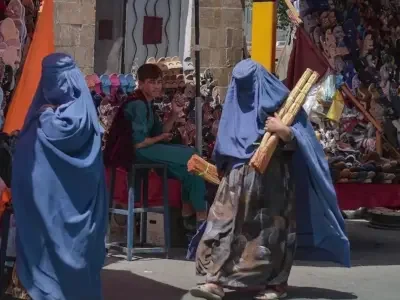
Since August 2021, the systematic dismantling of women’s rights in Afghanistan has unfolded through successive decrees that have banned girls from secondary education and universities, excluded women from the workplace, restricted their freedom of movement, and eventually erased them from the public sphere.
These measures have been repeatedly condemned by the United Nations and international human rights organizations, making Afghanistan the only country in the world where girls are prohibited from continuing their education beyond the sixth grade.
On June 6, 2026, at least 30 women were detained for allegedly failing to comply with the dress code imposed by the Taliban in Afghanistan’s western Herat city. These arrests are not simply another restriction added to the long list of bans. They reveal a deeper transformation in how state repression operates in the country.
The impact of these arrests is not limited to the women who have been detained. It extends to millions of others who are now changing their daily lives because they fear becoming the next target.
A calculation of personal risk
Word that Taliban forces were stopping, detaining, and abusing women in Herat quickly spread throughout the community. For women, it has created an atmosphere of ambiguity, in which they must take calculated risks when leaving home, rather than viewing it as part of their ordinary lives.
A visit to a market, a medical appointment, or a family gathering is no longer judged only by necessity, but also by the possibility of being questioned, humiliated, or detained.
The central issue is no longer whether every woman faces the same level of danger. What matters is that many now believe they could be stopped at any moment. That belief alone is reshaping how women move through their own cities.
Women in Afghanistan who once were everywhere, traveled freely to markets, visited relatives, and attended appointments must now reconsider their choices, remaining restricted to the confines of their homes.
While some postpone journeys until a male relative is available to accompany them, others avoid leaving home unless it’s absolutely necessary. These decisions often remain private, but together they represent a major transformation of public life.
Hence, the significance of the Herat arrests cannot be understood solely by the number of women detained. Their wider impact lies in the invisible changes they create. Every reported arrest sends a message to thousands of other women that ordinary activities may carry unpredictable consequences.
Fear as a tool of control
This is how fear becomes a powerful instrument of control. Repression does not require constant arrests on every street. It succeeds when people begin restricting themselves because they believe punishment is possible.
When fear shapes behavior, control extends and becomes part of everyday life.
The most profoundly affected women are often those who never appear in news reports or human rights documentation. This hidden reality is exceptionally difficult to quantify. Human rights organizations can document cases of arbitrary arrest, enforced disappearance, or physical abuse only when survivors or their families report them.
In an environment of statelessness with a legal vacuum where surveillance is pervasive, and retaliation is feared, many incidents are meant to remain deliberately unreported. To avoid unnecessary attention, collective punishments, and detention, families often choose silence over seeking justice.
As a result, the official record reflects only the visible edge of a much broader system of coercion.
While arrests and detentions provide visible evidence of state repression, they capture only a fraction of its true impact. The larger invisible consequence is the widespread self-restriction that fear produces.
Countless women quietly alter their daily lives long before they encounter the authorities. They stop traveling without necessity, postpone or forgo medical treatment, abandon educational and professional aspirations, withdraw from social and community life, and avoid public spaces altogether.
Its effectiveness lies in cultivating uncertainty and fear so pervasive that many women regulate their own behavior without explicit orders or physical coercion. This form of repression transforms ordinary decisions into calculations of personal risk.
Over time, these daily acts of self-censorship become normalized, shrinking women’s social, economic, and civic participation even in the absence of direct state intervention.
The most significant measure of repression is therefore not only the number of women arrested, but also the number who disappear from public life without ever becoming statistics.
Women’s absence from streets, workplaces, schools, clinics, and community spaces is not evidence of compliance. It is evidence of a climate of fear so deeply entrenched that it renders resistance and often even visibility too dangerous.
In this sense, the Taliban’s repression is most successful not when it fills prisons, but when it convinces women that remaining invisible is the safest means of survival.
**Practical cooperation over human rights? **
Since the Taliban’s return to power in August 2021, the international community has faced a difficult question: How should it engage with a de facto government that exercises effective control over Afghanistan while systematically violating fundamental human rights?
The European Union and other international actors have maintained limited engagement with the Taliban, preserving channels of communication to facilitate humanitarian assistance, address regional security concerns, and increasingly cooperate on refugee returns and migration management.
Critics argue, however, that these channels have been developed while the Taliban has continued to intensify restrictions on women and girls, raising concerns that practical cooperation has increasingly overshadowed human rights.
This has exposed a persistent policy dilemma. Humanitarian engagement remains essential for millions of Afghans, yet it must not contribute to the normalization of a regime that has institutionalized gender-based discrimination.
Despite ongoing international engagement, women’s rights have continued to deteriorate, with expanding restrictions on education, employment, freedom of movement, and public participation.
The challenge for the international community is therefore not whether to engage with the Taliban, but how to ensure that engagement does not come at the expense of fundamental rights. Humanitarian assistance and diplomatic dialogue should be accompanied by sustained pressure for accountability, ensuring that the rights of Afghan women remain central to international policy.