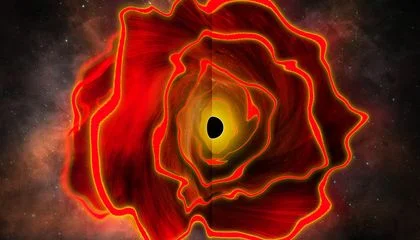
When NASA’s James Webb Space Telescope started to stare at the early universe in 2022, it spotted strange, never-before-seen objects dubbed little red dots. Astronomers have puzzled over what these ruby specks could be ever since.
Now, a team thinks they may have figured it out. They might be a previously unknown type of celestial object: black hole stars.
The researchers came to this conclusion, described in a study published August 12 in the journal Nature, by studying an extraordinarily bright little red dot called MoM-BH*-1. This object, they say, seems to be an enormous black hole powering a surrounding cloud of hot gas that glows like a star.
“It is a very special thing to find an object with no comparison, given the vast stores of data on billions of stars, galaxies and black holes that we have in our archival databases,” study co-author Rohan Naidu, an astronomer at the University of Hawaii, tells Gizmodo’s Gayoung Lee. “MoM-BH*-1 is one in a billion!”
MoM-BH-1 is an object from long ago. Naidu and colleagues observed it 660 million years after the Big Bang, which happened roughly 13.8 billion years ago. That’s because it takes time for light to travel—in this case, MoM-BH-1’s light took billions of years to reach JWST. Because the universe is constantly expanding, light waves stretched and became redder along the way, which is how astronomers estimate how long the light has been on the move.
The researchers spotted this object as part of a survey called Mirage or Miracle (MoM), in which they were trying to find galaxies that formed during the early cosmos. But MoM-BH*-1 stood out as the reddest and brightest little red dot on view, so they conducted follow-up observations.
Astronomically speaking, red typically suggests that an object is enveloped in dust because of the way the particles scatter light. But the light pattern data hinted at little dust around MoM-BH*-1. The object was very bright, except at a certain wavelength where the light vanished. This feature, called a Balmer break, often hints at dense gas absorbing light from a star forming in a dust-free environment.
But MoM-BH*-1’s Balmer break was stronger than ever observed with a star. Its glow was also too bright to have been generated by nuclear fusion, which powers the stellar objects.
The odd little red dot “shines with the energy typically associated with black holes, but at the same time bears signatures classically associated with stars,” Naidu tells the Guardian’s Ian Sample.
So the team ran computer simulations to see what kind of object could create this bizarre combination of characteristics. Analyses suggest that MoM-BH*-1 is a black hole that’s 100,000 times as massive as our sun. It’s wrapped in a thick, star-like cocoon of hydrogen gas that’s about as large as the solar system.
“Notably, the red color of the system can be explained through the effects of gas, with only a negligible contribution from dust,” astronomer Dominik Schleicher, of Sapienza University of Rome in Italy, and astronomer Rodrigo Herrera-Camus, of the University of Concepción in Chile, who were not involved in the study, write in a commentary accompanying the paper. “This discovery provides an important clue about the nature of [little red dots].”
Each of these crimson freckles “is consistent with being a black hole star embedded in a generic early galaxy,” Naidu says in a statement. “But what is special about MoM-BH*-1 is, the black hole star is essentially completely outshining its surrounding host galaxy, such that we’re seeing pure black hole star light.”