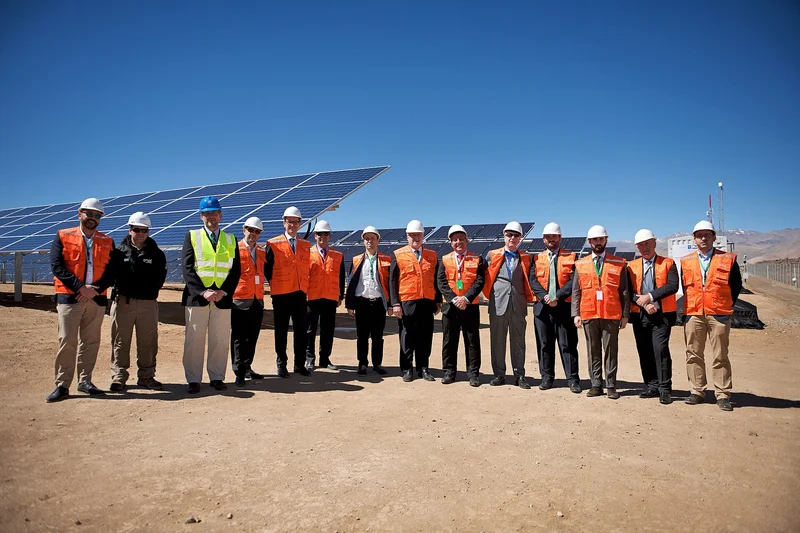
AES Andes Completes US$1.3 Billion Solar-Storage Hub in Chile
Chile · Energy
The complex pairs daytime solar with big batteries, letting the grid lean on sunshine long after the sun goes down.
AES Andes, the Chilean arm of US power group AES, has finished a sprawling solar-and-battery complex in the northern desert. The Andes Solar Hub now bundles 692 MW of solar panels with 510 MW of battery storage.
The company calls it the largest project of its kind in Latin America.
What AES Andes just switched on
The final building block, called Andes Solar III, started commercial operation on April 14, 2026. Notably, it sits in the Antofagasta region, in one of the sunniest deserts on Earth.
As a result, the whole hub reached 692 MW of solar capacity and 510 MW of batteries. Meanwhile, AES Andes puts the total spend at more than US$1.3 billion.
Why the batteries matter more than the panels
Solar panels only work while the sun is up. However, that is a problem in the evening, when homes and factories still need power.
The batteries fix the timing. Specifically, they soak up cheap midday sunshine and release it after dark.
So the grid can rely on solar for far more hours.
A closer look at Andes Solar III
The newest plant is more than panels. It carries a 171 MW battery system that can pump out power for about three hours.
In short, that kind of storage turns a daytime-only source into something the grid can plan around. It is the difference between a nice extra and a real workhorse.
How the hub grew over a decade
The complex was not built overnight. Instead, AES Andes assembled it in stages over nearly ten years, adding capacity piece by piece.
An earlier phase, Andes Solar IV, came online in October 2024 near Calama, about 230 km east of Antofagasta. It brought a large 130 MW battery able to run for five hours.
Where the project sits in Chile
Northern Chile is prime solar territory. The Atacama Desert gets some of the strongest, steadiest sunlight anywhere on the planet.
That geography is why so many solar plants cluster there. The hard part has always been storing the power and moving it to where people live.
AES Andes and the retreat from coal
The company is not only adding clean power. It is also unplugging its old coal units under a strategy it brands Greentegra.
AES Andes disconnected its Norgener coal plant in the north in April 2024, well ahead of an earlier 2025 target. More coal units are lined up to close.
Chile’s wider coal phase-out
Chile set out in 2019 to close every coal-fired plant by 2040 and reach carbon neutrality by 2050. Officials have floated pulling that date forward.
The government also aimed to retire a big share of coal capacity by 2025. Projects like this hub are meant to fill the gap coal leaves behind.
How big is ‘the largest in Latin America’?
AES Andes describes the hub as the region’s largest solar-plus-storage complex. That claim comes from the company itself, not an independent ranking.
Even so, the scale is real. A combined 692 MW of solar and 510 MW of batteries on one site is unusual anywhere, let alone in one desert.
What it means for the grid and for customers
More stored solar means fewer hours when the system has to burn gas or coal to keep the lights on. That tends to steady both emissions and costs.
It also gives big industrial buyers a cleaner supply. Mining, which dominates northern Chile, is under growing pressure to cut its carbon footprint.
Frequently Asked Questions
What is the Andes Solar Hub?
It is a solar-and-battery complex built by AES Andes in Chile’s Antofagasta region. It now holds 692 MW of solar capacity and 510 MW of battery storage.
How much did AES Andes spend on it?
AES Andes says total investment in the hub exceeded US$1.3 billion, spread across nearly a decade of construction in stages.
Why are the batteries important?
Solar panels only produce power in daylight. The batteries store midday energy and release it after sunset, so the grid can depend on solar for more of the day.
How does this connect to coal?
AES Andes is retiring its coal plants, including Norgener in 2024, under Chile’s plan to leave coal by 2040. New solar and storage help replace that lost capacity.
This article was produced by The Rio Times’ automated newsroom system. How we use AI · Report an error
LatAm Markets: Live Signals → — real-time movers, turnover leaders and FX across Latin America.