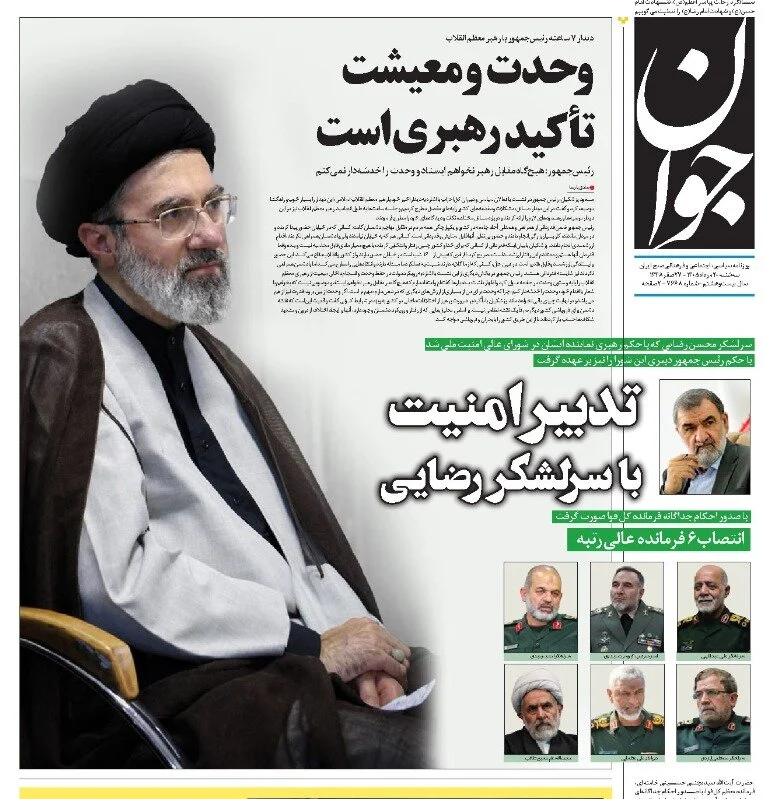
Meaningful message to Washington
Javan analyzed the purpose behind the Mecca Agreement signed by Saudi Arabia, Pakistan, and Turkey. The Mecca Agreement is undoubtedly one of the most significant security developments in the Middle East in recent years.
By signing this pact, Saudi Arabia has taken a major step toward building a regional coalition—one whose objectives go beyond a simple defensive arrangement and include reducing dependence on the United States, pooling the three countries' strategic capabilities, redefining Riyadh’s regional role, and sending a message to Washington. Although Saudi Arabia seeks to diversify its security layers rather than rely solely on the American umbrella, the continued attacks by Yemeni armed forces and the lack of practical response from Turkey and Pakistan reveal serious limitations in this pact. Thus, despite its deterrent messaging toward Yemen, the Mecca Agreement currently lacks the capacity to become an effective military deterrent and is better understood as a diplomatic tool for crisis management.
Kayhan: Hollow superpowers
Kayhan wrote about America’s helplessness toward Iran and the leaked CENTCOM email. According to the paper, the leaked, desperate email from CENTCOM—seeking a way to escape war—exposed the Pentagon’s deep distress in confronting Iran, a strategic dead‑end that has shattered the prestige of America’s billion‑dollar military. “We are looking for new, creative, unconventional ways to pressure and punish Iran.” The disclosure of this controversial email, sent by a CENTCOM intelligence officer to subordinate units, is portrayed as a stark symbol of strategic confusion within the US armed forces. Analysts interpret it as proof of Washington’s desperation and the Pentagon’s empty strategic toolbox in the face of the Islamic Republic’s power. Washington’s initial assumption of quickly containing Iran has now turned into a heavy nightmare. Trump—who once claimed Iran would surrender unconditionally—now devotes all his energy to reopening the Strait of Hormuz.
Iran: A new security architecture
In an interview with the Iran newspaper, Tayebeh Vaezi, a professor at the University of Tehran, examined the trilateral meeting among Riyadh, Ankara, and Islamabad. She argues that amid the tensions and crises imposed on West Asia’s security structure by the United States and Israel in recent years, these three countries are forming a set of trilateral collaborations that may signal regional powers’ efforts to distance themselves from an order long shaped by Washington’s unilateral will. From this perspective, the emergence of these security arrangements can be understood as part of the region’s gradual movement toward multilateralism and the redefinition of major regional powers’ roles in its security dynamics—a path Iran has long emphasized. Iran believes that only through strengthening intra‑regional security mechanisms can the region resist externally imposed frameworks and build a new security architecture based on its own capacities.
Arman‑e-Melli: The US must remedy what it has violated
In a commentary, Arman‑e-Melli discussed the Strait of Hormuz and Iran–Oman negotiations. According to the paper, the issue has become a politically and economically significant case at both regional and international levels, reflecting global attention. The Strait of Hormuz is currently the backbone of the dispute between Tehran and Washington. The US is trying, by any means, to resolve the matter, but Tehran’s view differs substantially. Reopening the Strait depends on conditions imposed on the Islamic Republic. For now, Iran is focused on negotiations with Oman to determine the rules for maritime transit. Iran has no direct negotiations with Washington, and intermediaries continue trying to create conditions for resuming talks. From Iran’s perspective, until the violations of the memorandum of understanding are fully addressed and the US compensates for what it breached, restarting negotiations is impossible.
Etemad: The US seeks a way out of the Hormuz deadlock
In an interview with Etemad, foreign‑policy analyst Rahman Ghahremanpour assessed current Iran–US relations. He argues that both sides currently need some form of agreement or ceasefire, but the US needs it more, as Trump faces growing domestic pressure and increasing criticism. Analysts and political actors repeatedly say Trump is stuck. Some even propose that the US must quickly extricate itself from this predicament. Reports about declining US weapons stockpiles—especially interceptor missiles—have further complicated Trump’s situation. Therefore, it is possible that Trump, as in the Islamabad memorandum episode, may be willing to offer significant concessions to Iran. Iran, apparently based on this assessment, has set forth conditions to increase pressure on Washington and extract greater concessions. So far, the process continues with ups and downs, but diplomacy has not stopped, and efforts persist to persuade the US and Trump to grant more concessions to Iran.