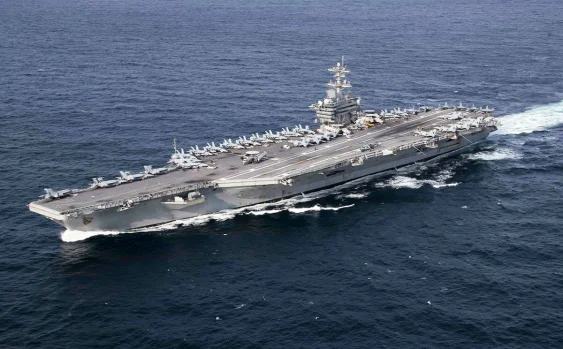
Things seem to be getting dicey on the high seas. Sailors aboard the U.S.S. Abraham Lincoln, a large aircraft carrier deployed to the Middle East to support the United States’ war with Iran since January of this year, are communicating through family members that conditions, morale, and crewmember mental health are deteriorating.
Every day, new reports are filtering in from reporters receiving messages from the families of some of the 5,000 service members on the aircraft carrier, which has been at sea since departing from its home post in San Diego in November of last year. Text messages from an anonymous sailor to a family member and shared with reporter Aaron Parnas at miedasnews.com allege food shortages aboard the carrier. “So the supply ship that comes here can’t bring fruits and stuff cause it can’t stay fresh long enough with the time it gets [sic] them to get here,” read one. “So we haven’t had anything fresh …”
“Haven’t had milk in 3 months,” read another.
“[E]veryone is just burned the fuck out and they gave us 2 days off and a beer day,” reads a message sent to Parnas and reposted on X (formerly Twitter).
Read more: “The Psychological Challenges of Just Getting to Mars”
Stars and Stripes, an outlet that operates inside the Department of Defense but is editorially independent, reported this week that it had interviewed active-duty sailors and their family members and found that “dozens of public social media comments and posts by crew members, describe sailors struggling with exhaustion and declining morale, including reports of suicidal thoughts and at least one instance where a crew member was prevented from jumping overboard.”
The Military Times, another independent news outlet covering the United States military community, spoke to the wife of a sailor who attempted jumping into the sea, off the aircraft carrier’s deck. “He’s scared,” Annabelle Loma, one sailor’s wife, told the outlet. “He thinks he’ll get a dishonorable discharge, and just because he was burnt out, his 13-year career is ruined, just like that. That’s not fair, that’s not right. That’s not what he should be worrying about right now.”
And MS Now yesterday reported that a crewmember jumped overboard and was in the water for almost an hour before being rescued. “i think the boat is finally getting to me and i really dont think i can keep up my peace act anymore,” that sailor reportedly wrote in a text message to his wife on July 21, before he jumped overboard. “i dont think i can do another deployment after this and i dont even know if i can finish this deployment.”
While the alleged conditions on the USS Abraham Lincoln appear to stem from a confluence of unfortunate circumstances and logistical breakdowns, mental health is often compromised by humans inhabiting extreme environments in tight quarters: crews of ships on the open ocean, inhabitants of polar outposts, and astronauts traversing space.
Coincidentally, a NASA-funded study appeared this week that addressed the issue of designing such spaces to optimize the mental health of the people who make temporary homes in them. In the npj microgravity paper, researchers from the Massachusetts Institute of Technology and the University of Colorado Boulder unveil an online tool, the Human-Environment Connection & Interaction Atlas or HECIA, that purports to guide users through designing habitats for extreme environments by mapping out the specific mission stressors and potential behavioral health outcomes.
“Submarines, oil rigs, polar expeditions, and even refugee camps or war zones are incredibly stressful environments,” Mich Lin, an MIT Ph.D. candidate and the study’s lead author, said in a statement. “We try to make this work applicable to a lot of scenarios and identify points of intervention in habitat design to reduce stress in those extreme environments.”
Read more: “Why These Researchers Are Drawn to the World’s Edge”
The behavioral outcomes that Lin and her collaborators considered after reviewing relevant literature and interviewing experts included anxiety, nostalgia, curiosity, fatigue, and others. Mapping these emotions and experience onto habitat design features could help predict their effects on these aspects of mental well-being. Designers of such habitats could use HECIA to craft optimal living and working quarters for people engaged in extreme missions, for example eventual manned missions to Mars. “They may read that research has found ‘access paths, stairs, entrances, contribute to the formation of friendships and social cohesion,’” Lin said. “So that would give them an idea of connecting public spaces in the habitat, via the private spaces, so people have to mingle, essentially.”
It follows that such an approach may also help with the design of aircraft carriers and other military habitats where we ask service people to endure long stays in less-than-comfortable environments.
This, of course, doesn’t do much to help the sailors on board the USS Abraham Lincoln. But The Wall Street Journal reported yesterday that the USS George Washington is heading to the Middle East to replace the USS Abraham Lincoln. This would give the service members aboard the latter a much-deserved rest after a historic deployment of more than 250 days, far longer than typical deployments.
Perhaps in the future we could attack this problem on two fronts: use science to design habitats and supply logistics for members of the military that better support their mental health while not waging interminable wars that stretch deployments to the breaking point.
Lead image: Mass Communication Specialist 3rd Class Clint Davis