Bulls v All Blacks, 5am Sunday
Gregor Paul in Johannesburg
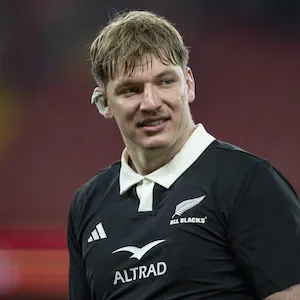
It’s maybe a good job that Fabian Holland has such an impressive frame, for he’s carrying some of the shame of his forefather’s past.
His All Blacks teammates are mostly unaware of South Africa’s political history, or at least seem to be, but Holland has a deep knowledge of it.
He grew up in the Netherlands where Dutch colonial history was taught at primary and secondary school, and before he was 10, he knew the word apartheid – its meaning and context.
“There is no way of hiding it that the Dutch had a wee bit to do with apartheid and that is a bit of a dark history for us Dutchies,” Holland says
“We get taught about it in primary school and high school so that we learn from our mistakes and so that we never let it happen again.”
This is a rarity indeed: a professional rugby player not only willing, but able to go off-piste and discuss the impacts of colonialism and its generational influence.
Holland says that the Dutch have lost all ambiguity over colonialism and have universally agreed that the empire they built in the 16th to early 20th centuries was a shameful episode.
He’s surprised to learn that this differs to the situation in Britain, where historians continue to make the case that colonialism had benefits for the colonised.
The British, unlike the Dutch, can’t quite lose their sense of pride that for the better part of two centuries much of the world map was red, and that the vast expanse of territory conquered and administered should be seen as a sign of exceptionalism rather than brutal, unjustified imperialism.
This latent sense of still justifying and celebrating colonialism – the railways built in India, the bureaucracies and legal systems established across Africa – is anathema to Holland, who has been shaped by an education in the Netherlands that confronted the truth.
“It is an important part of history and apartheid is something that we acknowledge happened but also acknowledge should never happen again,” Holland says.
“Every race is the human race. It was different times back then but the only way we learn from it is to keep touching on it and establish the importance of it and know that we should never treat one another like that again.
“That’s why I find it important. We had the opportunity to go to Robben Island and I found it important to go there with Anton Segner.
“We both went and in some way we paid our respects, and also it gave us knowledge of the situation. You hear about it and read about it in books all through school, but to actually see it right in front of your face is pretty confronting, to be honest.
“It was a good experience and I got a lot from it.”
There is a level of national fluidity about Holland as he speaks on this issue. He bears the burden of colonial atrocity as a Dutchman but he does so as a second-season All Black and key piece in the mission to topple the Springboks.
His accent, too, has the foundational soft ‘s’ use of the Dutch, but with an undeniable Kiwi twang and easy use of the local vernacular.
At 2.04m and 125kg, there is further evidence of him being Dutch, but the way he plays rugby with an old-fashioned appreciation of hard work, accurate core skills and a surprise touch of creativity is quintessentially Kiwi.
There are two distinct streams forming the whole, but now that he’s lived in New Zealand for eight of his 23 years and looks set for a long and distinguished All Blacks career, has there been a point in time where he came to recognise himself or consider himself a Kiwi?
“I don’t think I’ll ever get to that stage,” he says. “I am very proud of my Dutch roots and I am very proud to be Dutch.
“My mum, dad and sister still live there, and a lot of my good mates that I grew up with, so I will always be Dutch. For me, New Zealand has a special place because of the relationships I have made, the way I have been welcomed into the country and been taken care of.
“I think that is why New Zealand has become home and the Netherlands is where I was born.
“I will always be a proud Dutchman but for me NZ is home and I represent my whānau, my whare and whenua.”
Holland is up to speed on the rugby history of South Africa, too, and its interactions with New Zealand.
His own rugby experience with South Africa extends to the two tests he played against the Springboks last year, and what surprised him was the depth of respect between the players.
He thought that there was a chance that some of the Boks players would have said a few disparaging words to him in Afrikaans – knowing he and no one else would have understood what was being said,
“But no,” he says, “they were respectful. I remember walking off Eden Park and one of the craziest experiences is that we had beaten them and I go through the tunnel and I get a tap on my back.
“I turn around and it is Siya Kolisi [Springboks captain] and he was telling me about how much respect he had for my journey and we had a yarn.
“They had just lost a nail-biter but he still had the time to come up to a young buck like myself and it shows the respect we have for one another and that is something that will stick with me.
“For 80 minutes we don’t want to be friends and make life pretty miserable for each other, but after that there is the common respect for one another.”
Kolisi no doubt recognised that, albeit from the stability of a middle-class upbringing, Holland’s odyssey from the Netherlands to the All Blacks was equally unlikely as his own from a township in Port Elizabeth to Springboks captain.
It’s a story Holland has told many times – leaving home at 16 to spend six months at Christchurch Boys’ High School only for that to lead into an NPC contract with Otago, then selection for the New Zealand Under-20s, a place with the Highlanders and now a regular slot with the All Blacks.
It has a fairytale element to it – the little Dutch boy who left home to chase his dream of being an All Black on the other side of the world – but there were dark and difficult periods.
“The media only hear the highs of every story but there were plenty of lows,” he says.
“Plenty of obstacles and plenty of doubts. Plenty of moments where I was asking whether this was ever going to work. It wouldn’t be human for me to say there wasn’t.
“It’s people like mum and dad, and my brother and sister, that got me through those times. Put me back on course. Set your compass right and make sure that you keep heading for that dream. I still haven’t accomplished that dream. I still have a very long way to go and I am sure I will still make plenty of mistakes.”
He says that his parents “set me up pretty well”.
“They knew that from a young age that was my dream. As a mum, all you can do is prepare your kid to live their dream.
“She was very warm, gave me the freedom to do what I felt was necessary to conquer my dream and for that I will always love them and respect them.”
It’s not just his family behind him - he has become a minor celebrity in the Netherlands, certainly within the small, but committed rugby community.
Last year in Cardiff, there was a tour party of around 50 Dutch All Blacks fans in the Welsh capital to see Holland play. He’s a one-man marketing machine for rugby and the All Blacks – able to effectively commercialise the brand in a way New Zealand Rugby’s equity partner Silver Lake will never be able to.
“I am aware,” Holland says of the hype about him in his homeland. “It is a small rugby world in the Netherlands. Not too many people play rugby there. I am aware of the impact that it has for me to play for New Zealand and the support that comes with that is unbelievable.
“I have people following me around and to be able to meet them and hear their stories and hear people say they want to make the same journey that I did is special because when I was a kid, people didn’t even dare to dream of doing that.
“Now we have two people in me and Anton [Segner, the German-born flanker] who have both made the same journey and done it and it kind of opens up the gates of what is possible, and no dream is too big.”
The question of what is possible will remain open-ended for some time, as Holland, at just 23, seemingly has limitless potential. He was World Rugby Breakthrough Player of the Year in 2025 and by every account – coaches, teammates and all those who developed him in the Netherlands – he’s a great listener and learner.
New Zealand has had some great locks and Holland feels like he could end up sitting alongside the likes of Colin Meads, Sam Whitelock and Brodie Retallick in the pantheon.
But the immediate goal is to crack the test team in South Africa after missing Super Rugby due to shoulder surgery.
He produced a solid 59 minutes against the Stormers in which he stole two lineouts and hit 26 rucks – and looked like he could deliver the new game plan implemented by Dave Rennie.
He’s short of game time and wasn’t picked to play the Sharks – the game Rennie suggested was the one in which he picked a shadow test team.
But he is starting against the Bulls – and the expectation is that Holland will feature in the test series at some point because he brings the size, work rate and technical accuracy that Rennie is looking for.
And for Holland, the arrival of Rennie, and the return of mental skills coach Gilbert Enoka, has been revelatory.
“I think as a group of players we had a lot of time to reflect after the Northern tour [last year] and sit down and talk about the things we want to be remembered for and the way we want to play.
“Our leaders did a really good job around setting us up and with Renns’ regime, Gilbert Enoka coming in, that is why the environment is what it is now.
“We are getting results. The boys are getting the most out of each other and we are on a good trending path. We are not where we want to be yet but our horizons are set further ahead and we are growing as a team.”
Having only ever known life in the All Blacks under former coach Scott Robertson, Holland has clearly been impressed by the impact of Enoka in specifically reconnecting the current team with the legacy and history.
“In order to move forward you have to go back and look at the past. We have such a legacy to be proud of that we take strength from that as a group.
“We want to do that jersey justice and the people who have worn it before us justice. We always live by the principle that we want to leave the jersey in a better place than when we first got it.
“The work that Bert does around that, setting us up and making us aware and creating a deeper foundation and understanding of it. He is probably the best in the world at it.”
Gregor Paul is one of New Zealand’s most respected rugby writers and columnists. He has won multiple awards for journalism and written several books about sport.
Listen to Elliott Smith’s live commentary on Newstalk ZB Sport and iHeartRadio, or join the Alternative Commentary Collective on iHeartRadio and Radio Hauraki.