Ihave arranged to meet Liane Moriarty at the Mosman library. This sounds straightforward, but when I arrive – miraculously 20 minutes early – my phone tells me I’m actually at the Barry O’Keefe Library. Barry O’Keefe?! Have I given the world-famous, 25-million-copy-selling author the wrong library name? Is she standing, at this moment, outside some other council building, cursing my name? Alas, even if she is, there’s nothing I can do about it. Her publishing PR is in Italy, and no journalist gets access to the mobile number of a 25-million-copy-selling megastar.
I scuttle up the nearest concrete ramp to the door, which – wave of relief – is labelled Mosman Library, while on the left is a plaque to Barry O’Keefe, who was, it turns out, a long-time mayor of Mosman (and, it seems, an energetic donor of water features to the municipality). Inside, with 15 minutes to spare, it suddenly seems like a good idea to apply for a library card. I’ve just completed the online form when I spot Liane Moriarty beyond the entry doors, sitting on a low wall. She is three minutes early. I listen to the nice librarian’s mercifully brief explanation about using the returns slot, then rush back down the ramp.
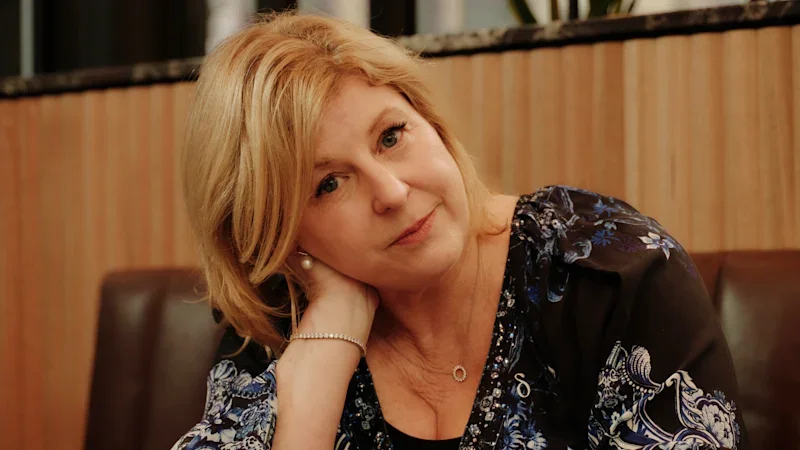
“This ramp!” says Liane Moriarty. She appears exactly as she did 10 years ago, when I first interviewed her, before the publication of Truly Madly Guilty, her seventh adult novel: pale skin, blue eyes, lovely voice. As has always been the case, there’s no hint in her appearance of Moriarty’s capacity to command the forces of novelistic evil. The central tension of all Moriarty stories is their balance between hidden horror – domestic violence, abuse, even murder – and the sunny, funny minutiae of ordinary, middle-class life. But in person, the sunniness prevails – a proof that art does not always imitate life.
Today, she’s wearing a greeny-turquoise dress and a black cardigan, a small sapphire pendant around her neck. Her fair hair is still, as it was a decade ago, reassuringly non-blow-dried, and she’s wearing flat black pumps. “I came here for an event years ago and I had heels on,” she says as we head back up towards Barry’s plaque. “And I couldn’t get up this ramp: the slope was too steep. The publicist had to grab my hands and pull me.” She holds her arms out like a mountaineer, roped to a rescuer on the slopes of Everest.
The mountain analogy is a good one for Liane Moriarty, because her literary career has been a process of scaling peak after peak – a whole mountain range of success – that no other Australian novelist has ever reached. She is the only fiction writer from this country to debut at number one on The New York Times bestseller list – not to mention the only one to have three novels reach number one on this same list, and the only one to have three books on it simultaneously. All 11 of her novels have been optioned for the screen, as has a 2026 short story called The Price of Honey. Four have been made into streaming series.
Financially, she has also been wildly successful. She is acknowledged as Australia’s highest-earning living novelist: her books alone have made her, by conservative estimates, more than $50 million, and her screen earnings have netted an unknown number of millions more. The first time I met her she’d just bought a beautiful home in Pymble in northern Sydney; now she reportedly lives in Mosman, in an extraordinary-sounding house with panoramic views of Balmoral beach, a koi pool and, according to the sales figure in 2023, a $19 million-plus price tag.
A good portion of this house was probably paid for by the most successful of her works, both on screen and on the page: the smash hit Big Little Lies, about a handful of school mums grappling with kids and partners, as well as domestic violence and murder, on Sydney’s northern beaches. The two-series HBO production, set in California, starred Nicole Kidman, Reese Witherspoon, Laura Dern and Meryl Streep – and, for that matter, Alexander Skarsgård, Shailene Woodley, Adam Scott and Zoë Kravitz: a line-up of star power that illustrates Moriarty’s ability to create entire ensemble casts of star-worthy characters. Series one of Big Little Lies won eight Emmys and was among the most successful limited-run prestige dramas of the decade.
Now she’s done it again. Big Little Truths is the sequel to Big Little Lies. Published in Australia on August 25, it will also return as a third series for HBO, with Nicole Kidman and Reese Witherspoon as executive producers. Ten years have passed, and the same school mums are now heading perilously into their 50s; their kids, meanwhile, are teenagers, captivating and terrifying in equal measure. There’s high-school angst, a history project, a severed finger. Most of all, there’s Moriarty’s lovely authorial voice, funny and kind, subversive and dark.
This voice hasn’t changed in the past decade, and neither, it seems, has Moriarty. The first time we met, I was surprised by her modesty, her genuine lack of interest in being a famous person. Since then, she’s entered a whole new league of publishing power and success, but here at the library, none of that is evident. She’s only mildly interested in finding Moriarty in the “M” section of Fiction (copies of Nine Perfect Strangers, Apples Never Fall and The Last Anniversary) and totally unconcerned that none of her children’s book series (written under the name L.M. Moriarty) appear on the shelves at all.
They’ve probably been borrowed, I suggest.
“Or perhaps they don’t stock them,” she says, matter-of-factly.
I tell her I’ve just got myself a library card. “Really?” she says. Now she looks genuinely pleased, even excited. “What a good idea. Let’s find you some books.”
The first recorded sighting of Liane Moriarty writing a book was by her mother, Diane Moriarty. “I remember when Liane was eight, she was sitting on the front steps and Bernie [Liane’s late father] said, ‘What are you doing?’ ” she recalls. “And Liane looked up at him and said, ‘I’m writing a story.’ She had a tiny little notebook in her hand, and a pencil.”
Diane credits Bernie – a surveyor specialising in aerial photography – with providing the crucial early elements for literary success: a wildly enthusiastic readership, plus an excellent royalties deal. “Bernie was so excited,” she remembers. “He was beside himself. He leapt up and flew for his camera. He said, ‘If I buy you an exercise book, would you fill it with a whole story? I will pay you a dollar for it and that means I’m commissioning you. That’s a big word for you.’ ”
Liane remembered the word and fulfilled the commission, as she has fulfilled every one since. “Liane hits every deadline,” says her US editor Amy Einhorn. “And I mean every deadline.” And that exercise book – featuring a sweeping saga about The Joneses, now lost to posterity – was the first step on her road to stardom.
Right from the beginning, she was happy in many literary genres. As well as her novels, when she was in second grade, she wrote a fictional play with 30-odd roles in it: one for each member of her class. Every single child turned up at her house after school to play their part. “I think what the kids these days would say is that she had Big Sister Energy,” says Jaclyn Moriarty (second-oldest among the Moriarty siblings). “She had this kind of vivaciousness; this sense of being thrilled by the possibility of life, that was completely infectious.”
There was, it seems, no limit to her powers. “When she was 10 and I was 8, she invented a boyfriend named Monty Carlo,” Jaclyn recalls. “She would climb out of the window at nighttime to go and meet him. She made him a complete, comprehensive, complex character: he was pretty swashbuckling for a 10-year-old. And I remember thinking, ‘Could this be real? I mean, Monte Carlo is the same name as the biscuit. But that could just be a coincidence.’ ”
Liane is the eldest of six Moriarty children – five girls and a boy – and their collective childhood sounds like a storybook itself: siblings as far as the eye could see; 40-odd foster babies cared for by Diane Moriarty; a dad who returned from overseas work assignments with wild tales of near-aeronautical death. The Moriartys had no TV, and every day was packed with stories – spoken, written, performed – for anyone who would listen.
“I remember our family dinners,” says Katrina Harrington (third-oldest sister). “Everybody sat down, everyone talked – ‘What have we got to share? What’s something funny? Who can get a word in?’ Then cups of tea, everyone still chatting, kids cleaning up while Mum and Dad stayed at the table talking. I remember being in year 12 and hating the fact I had to leave to go and study.”
No wonder 50 per cent of those children became professional novelists. Three sisters, three novelists, one superstar. How does that play out? “I’ve definitely felt added pressure, and professional envy,” says Nicola Moriarty, youngest sibling, who is the bestselling author of seven novels (and the original Nicola Berry in Liane’s kids’ books: 25-year-old Liane created the character as a 10th birthday present). “On the one hand, there are readers who will draw the direct comparison between us – that can be really hard. But conversely, I don’t like it if somebody tells me, ‘Oh, I like your writing better.’ Then I feel quite protective: ‘What do you mean? That’s my sister!’ ”
“When people ask me if I’m jealous I get confused,” says Jaclyn Moriarty (bestselling and award-winning author of 19 novels). “Because I think, ‘Liane wrote those books – I couldn’t write those books.’ Writing only works if you’re true to yourself: I can only write what’s right for me. And also –” she laughs, “I make my living as a writer, and I’m published all over the world, and that is beyond my wildest dreams. It would be absurd for me to go around being bitter.”
Jaclyn was actually the first published author in the family: it was her initial book deal that galvanised Liane. “I was in my [marketing director’s] office, with my shoulder pads, in North Ryde, thinking I was pretty good, and [Jaci] rang,” Liane explained to me when we first met. “I was excited for her … [But there was also] the other feeling – sheer rage! No, no [not really]. But definitely disappointment with myself, that I hadn’t done it and she had.” Three years and a master’s in creative writing later, Liane published her first novel, Three Wishes – about, of all things, three sisters. Since then, her own novels (including Big Little Truths) take the family total to 37. “Every book on the top shelf of my bookshelf is a Moriarty,” says Diane Moriarty. “Every time I walk by it, I go crazy with pride.”
To be honest, I was a bit worried about taking Liane Moriarty to a library. What if she was bored? What if she was mobbed? In fact, the opposite occurs: she seems totally at home among the books and the grey carpet squares and the community events pin-up boards; and no one so much as glances in her direction. You could get a library card, too, I suggest as she combs the shelves. She shakes her head. “I get sent so many books from publishers,” she says apologetically. “I just wouldn’t get the chance to read them.” She looks around almost wistfully. “I was trying to think of some anecdotes to tell you about this library,” she says. “And I remembered that when I was really young I lived near here, and I came in once when I was heartbroken, and borrowed every single book by Elizabeth Berg. I read them one by one, and by the time I’d finished them, my heart was healed.”
‘Liane kind of invented “domestic noir”.’Moriarty’s agent, Fiona Inglis
There are no Elizabeth Berg books on the shelves today, but Moriarty oversees my choice of Frances Whiting and Bonnie Garmus. Both these women are bestselling authors – though not quite in Moriarty’s league, of course. “Well, it’s very hard to think of anyone who is in her league,” points out Fiona Inglis, her agent. “She now has 53 translation territories, which I’m sure is some kind of record.”
Moriarty’s success, says Inglis, has forged a new path for female authors both in Australia and overseas. “Liane kind of invented ‘domestic noir’,” she remarks, “and there are now a lot of people writing in that space. It’s aspirational: ‘If she can do it, we can do it.’” Young female authors, she goes on, are now being seen by editors who might previously have dismissed them. “I shamelessly spruik the fact that I represent her,” Inglis says. “And she’s such a big name, publishers go, ‘Oh, you represent Liane. Maybe it’s worth having a look.’ ”
That being said, “being super famous doesn’t come naturally to Liane. She finds it awkward to have the light shining on her. But she does know what she wants. She’s never strident, she’s just firm.” When she was writing the (unpublished) novella the showrunners used as a basis for the second season of Big Little Lies, Inglis discovered that Moriarty had changed one of the character’s names to Mary Louise, and made her English. “And I said, ‘Oh my god, you’re so clever, you’re going to be able to get Judi Dench or Helen Mirren to do that role!’ And Liane said, ‘No. I’ve called her Mary Louise because that’s Meryl Streep’s real name. That’s who I want.’” And that, of course, is who she got.
These opposing qualities – profound confidence, modest diffidence – seem contradictory, but of course they’re not: it’s possible to be both self-assured and also genuinely humble. “Oh yes,” says Jaclyn. “She’s very low-key. But she’s also brilliant at giving advice. I mean that in the best possible way. She doesn’t just do that thing you’re supposed to do of listening and nodding and waiting for the person to figure out their own answer. She listens very kindly, and then she says, ‘OK. This is what you should do.’ ”
Today, en route to lunch, she asks me carefully all about my life. This is rare enough in an interview subject – usually, of course, the questions go all the other way – but then she tells me decidedly that I should 1) write a book, 2) on the (genius) subject of x, 3) with the (brilliant) title of y. Then we arrive at the cafe, and she hesitates about the extravagance of ordering a green juice to go with her soup.
Speaking of food, she admits that the meals on her upcoming book tour have been worrying her. Or rather, the lack of meals. “The publishing PR is trying to get me hotels with 24-hour room service,” she says apologetically. “It’s so embarrassing, but often you’re doing an event at night, and you come back to the room afterwards, and you just want dinner.” At one breakfast event, all the guests were sitting at tables and the authors had to move every five minutes and repeat a little spiel about their books, “as if we were selling Tupperware. The guests were eating their croissants, having a lovely time, and we got nothing. I became quite hysterical. I thought, ‘I cannot tell another person how I got the idea for this book.’ ”
She got the idea for Big Little Truths, as it happens, when she was thinking about an entirely different novel, set in a high school, and then suddenly thought, “Oh. I could give this story to my women.” By “my women”, of course, she means the sextet of stars in Big Little Lies. But in Big Little Truths, the new stars are their high-school-aged kids.
In real life, Moriarty’s own children are also now in high school. She met her husband, Adam, when she was 37, and they had their son and daughter, George and Anna, via IVF. He runs the house, she writes the books – slowly at first, struggling to face the horror of the blank page. Some days, she admits, “I can’t even bring myself to open the document.” She’s tried programs that turn off her internet; podcasts about meditating (“I nod along, I think a lot of profound thoughts; I totally believe in it”); even – Jaclyn’s suggestion – a sticker chart. “I think, in the end, I’m always trying to write the way I wrote when I was a little girl,” she concludes, “when it was as easy as riding my bike: ‘Now I ride my bike, now I write a story.’ Just entertaining myself. Just having fun.”
The pleasure – and pain – of childhood still feels close to Moriarty: her writing about children of all ages has always been filled with love. “She totally adores kids,” agrees one of her old friends, Marisa Colonna, who met her 35 years ago. “I think she would have loved to have twins or triplets: I just told her my niece is pregnant with twins and she was like, ‘I’m so jealous!’ ”
“I miss little kids desperately,” Moriarty agrees. “And babies. Where are the babies? I am so ready for grandchildren. My children are 15, 16, so they say to me, ‘That’s so inappropriate. You can’t put that pressure on us for, like, at least 10 years.’ ”
All of Moriarty’s novels are, in some form, a reflection of herself. “Liane in person is exactly like she is in her books,” says Colonna. “The tone, the funniness, the subject matter. Reading one is just like sitting down with her for a three-hour lunch.”
“You can see her deep observation of everyday life in every novel,” says Claire Craig, her Australian editor, “her deep interest in people. It’s always such a joy when an author says what we’re thinking or feeling or experiencing in our own lives. And she does it again and again.”
Take the parents’ WhatsApp group in Big Little Truths:
″ ‘Let’s keep it clean folks, this is a pubic forum.’
‘HA HA HA HA HA HA’
‘PUBLIC forum!!’ ”
No one will ever convince me that doesn’t come from real life. “Well, I did tell her about a parents’ WhatsApp group,” laughs Colonna. “And she did say, ‘Oh my god, that’s gold.’ ”
Big Little Truths is, as much as anything else, a multi-stranded tapestry of midlife in all its dubious glory. There are ageing parents and perimenopause; frozen shoulders and fried pelvic floors. There’s even a cancer diagnosis. And that, too, is true to life.
Liane Moriarty had breast cancer for the first time in 2021. She later recalled the experience in an essay for The Sydney Morning Herald and The Age. For days after her biopsy, she wrote, she couldn’t look at her children “without a whooshing sensation of vertigo. By the time my GP calls to say she’s very sorry but it’s not good news, I am wild with panic.”
“I sort of regretted writing that piece afterwards,” she says now. “I think it just felt … too personal? Too something.” She shakes her head. She was diagnosed earlier this year for the second time. And she’s willing to mention the recurrence publicly now, “in case it reminds anyone to get their mammogram. Even if something’s already happened.” She leans forward. “Don’t think, ‘Oh, that’s happened to me, and now it’s done.’ ”
In her own case, the second go-round has involved none of the discombobulation she described so beautifully in her essay. “They’ve caught it very early …” She stops and thinks. “I’m not … it’s more that I’ve realised I’m just going to have to think of this as something like paying your taxes; some kind of an administrative thing. So it’s annoying, but it’s nothing I need to feel frightened of.” She looks at me firmly. “I don’t want it to be a big ‘Liane Battles Cancer’ thing.”
So, without making it into a big Liane Battles Cancer thing, let it be said that she has had surgery and will soon have three weeks of radiation. “Then I’ll recover a bit and then I’ll be off on the Australian tour [for Big Little Truths].” That and her various other publicity commitments will last most of the rest of the year. “And then I’m going away with a group of old friends,” says Moriarty: “for our 60th birthdays.”
Turning 60, she says, holds no fears at all. “I’m always interested in people at different ages.” She leans forward. “Actually, I used to have this thing that I would see this particular type of woman at my events who was really cool; just really had it together – a good sense of humour about the world.” She grins. “I thought I was going to be like that in my 50s, but it was not like that: I’ve been still sweaty and anxious in my 50s. But I think in my 60s, it’s all going to come together. Colourful glasses, interesting scarves, beautiful shoes. They all have handmade shoes that look like they could walk in them, but they’re also fashionable. And they also have sparkly eyes. And they look at me like, ‘Oh darling, it’s all fine. Just calm down.’” She sits back, hands on the table, looking pleased. “I think it’s going to happen.”
So can we expect, in another 10 years, to see Celeste and Madeline – or some other Moriarty characters as yet unknown – at 60, drinking their flat whites and getting their hips replaced while battling whatever zeitgeist terrors the 2030s hold? “I think so,” says Moriarty, smiling again. “I like the idea of my characters getting older along with me.”
Moriarty’s characters – and, one suspects, many of her readers – are not all so serene about growing old. But it’s some comfort, at least, to imagine another Moriarty novel in the library when we do.
Read more from Amanda Hooton in Good Weekend:
- ‘It was quite traumatic’: Hugo Weaving on overcoming a childhood diagnosis – and the secrets to a happy family
- Why has everyone suddenly got ADHD?
- ‘Very few people can do what she does’: How Jane Harper became one of the world’s biggest crime authors
- We thought we’d saved the whales. Were we wrong?
- ‘Gigantic joy’: Melinda French Gates on her new life after divorce