What you need to know
- A wildfire near the Belgian border has forced around 1,800 people to leave their homes
- Authorities say residents will not be able to return to their homes overnight
- Flames burned within 400 meters of one village
- Police have launched an appeal for information on the cause of the blaze
- It is the biggest forest fire in the history of Germany's most-populous state, NRW
Don't let the algorithm hide the news. If you rely on our team for trusted reporting, please take a moment to select us as your Preferred Source on Google so you'll always see our verified news first.
RECAP — Massive wildfire hits Hürtgenwald area, nearby village to stay empty overnight
In case you're just joining us, here's the lowdown on developments in Germany's far west near the Belgian border this Friday.
A large forest fire in the Hürtgenwald forest, not far east of Aachen, forced authorities to clear a nearby village early in the morning.
Various emergency services and the military have rushed to the area to try to contain almost certainly the largest such blaze in the history of the state of North Rhine-Westphalia, thought to cover an area of at least 200 hectares.
Authorities said on Friday that around 400 personnel were in service simultaneously across various agencies.
The village of Gey, home to around 2,000 people, will remain evacuated overnight. Five people, four of them rescue workers, have suffered injuries amid the response to the fire.
The state premier has cut short his vacation and expects to arrive on site on Saturday afternoon.
Emergency services anticipate that efforts to contain the fire will last all weekend, and perhaps longer. Hot summer weather and a dry forest floor are not helping the response.
Weather forecasts do point to falling temperatures over the weekend, and even a roughly 50% chance of light rain in the area on Saturday.
Police are investigating the cause and have appealed to the public for information, particularly photos or videos from the area taken around the time the fire began.
Interior Minister Dobrindt calls fire 'shocking,' praises rescuers
Federal Interior Minister Alexander Dobrindt called the images of Friday's forest fire "shocking" and voiced thanks to local and federal first responders alike for their contributions.
"All emergency services are performing exceptionally in the toughest conditions, to fight the flames, protect people, and limit damages. As well as firefighters, state police and the military, the federal police is in operation with its airborne units and the THW [Germany's federal civil protection agency, made up largely of volunteers, that assists in emergency situations] is helping with logistics and operational coordination," Dobrindt said.
Dobrindt's ministry had similarly listed the efforts by various services in a social media post earlier on Friday.
It also noted that there were "several localized vegetation fires" dotted around the country in various states — North Rhine-Westphalia, Rhineland-Palatinate, Saarland and Saxony — on Friday, but said that, with the exception of Hürtgenwald, they were "for the most part under control and have been almost completely extinguished by regional responders."
5 injured amid fire: 4 rescue workers and 1 elderly resident
Local politician Christian Nolten has told the dpa news agency that five people have suffered injuries amid Friday's evacuation and firefighting efforts.
One elderly man suffered a heart complaint during the operations to clear the village of Gey, Nolten said.
And four rescue workers sustained light injuries, such as cuts and circulatory problems, amid their work.
The public gathering point for those affected has been moved further away from the site of the fire, to a special needs school in Düren, for people's safety.
Two initial gathering points closer to the fire have since been closed because of a buildup of smoke and ash in the area.
The next village of Grosshau, to the south of Gey and the heart of the fire, has not yet been evacuated. Düren's Mayor Stephan Cranen said that authorities currently hoped this step would not be necessary, but noted that the situation was still considered fluid and subject to change.
Rescue official tells reporters village of Gey will remain cleared overnight
One of the leading rescue officials in the area, Wilfried Thielen, has told the Kölner Stadt-Anzeiger (KSTA) newspaper that the village of Gey will remain evacuated overnight.
"The Gey settlement has been evacuated. And for safety reasons, we will not allow residents to return tonight," Thielen told the KSTA.
He said that the situation remained fluid, to such an extent that rescue teams were having to reposition their own facilities.
"We've just had to dismantle our staging area because it, too, is at risk because of the changing weather conditions," he said. "This means we're reorganizing, redeploying our personnel and planning our next steps."
Thielen said that authorities had already planned for personnel deployments on a rough basis through to Monday morning, "and then we may need to reassess the situation and potentially request additional personnel."
What was the Battle of Hürtgen Forest, the reason WWII ordnances are strewn about the area?
Friday's fire is taking place on the site of one of the longest and most costly single battles in the US military's history.
That's why the area is strewn with unexploded munitions from World War II that are at risk of exploding, both aiding the fire's spread and potentially endangering emergency services.
The Battle of Hürtgen Forest, or Schlacht im Hürtgenwald in German, was a three-month push by US forces. They were trying at first to pin down German forces and stop them providing reinforcements in the nearby Battle of Aachen, and then later to push through the forest and advance to the Rur River.
The September-December 1944 battle tried to get through heavy fortifications as part of what the Allies knew as the Siegfried Line, a series of defensive structures that served as one of Nazi Germany's last effective lines of defense as Allied forces tried to move east toward Berlin after the D-Day landings.
Germany's military was already planning its Winter Offensive, which would be known as the Battle of the Bulge, in the same area by this point, and so its troops were given all possible resources for their defensive efforts.
The battle was seen as a comparatively rare Nazi victory in their attempts to stop the Allied advance, with at least 33,000 US casualties, and some estimates ranging considerably higher than that. Germany, with more strains on personnel and supply but also with the defenders' advantage and favorable terrain, suffered an estimated 28,000 casualties.
It's less well remembered than the much larger and more widespread Battle of the Bulge, whose main thrust was located slightly further south but in the same Eifel region. Nevertheless, it was the longest continuous battle on German ground during World War II and the second-longest single battle the US Army has ever fought.
Cologne police launch appeal for information on fire's outbreak
Police in the city of Cologne are investigating the cause of the Hürtgenwald fire and are appealing for help from members of the public who might be able to shed light on how it started.
Police said in a press statement and public appeal that they had set up an online web portal where people could upload information in an "uncomplicated and direct" manner, straight to law enforcement.
"The Cologne Police asks the public for support in the ongoing investigations. Of particular interest are clues and particularly picture or video recordings from the rough time of the start of the fire," police wrote. "Such recordings could deliver important findings and help the investigative work meaningfully."
The appeal provided a link to the site where uploads are possible, and police wrote that "any clue could be meaningful" as they seek to establish the cause of the fire.
Almost all forest fires are ultimately man-made — whether they're caused by accident or oversight or as a more deliberate act of arson.
Even in the driest and hottest summer temperatures, the heat required to trigger a fire among trees is almost never achieved by natural means — with the only plausible all-natural scenario being a lightning strike. The high summer temperatures and dry forest floor, rather than starting the fires, provide conditions suitable to enable and accelerate the spread after it's begun.
State premier Hendrik Wüst breaking off holiday to return
The head of North Rhine-Westphalia's state government is breaking off his vacation to return amid the fire.
Christian Democrat politician Hendrik Wüst wanted to gather first-hand information on the situation, and told German media on Friday that he expected to reach the Düren municipality area by Saturday afternoon.
Earlier on Friday, Wüst had thanked emergency services for their work on site since Thursday afternoon, "many of them without a break," saying "out state stands together!"
Hürtgenwald smoke can be seen, and scented, from Bonn area
The plume of smoke from the Hürtgenwald, some 60 kilometers (around 35 miles) to the west, can be seen from the Rhine River here in Bonn, and particularly the hills on its right bank.
Hikers on the Petersberg summit just to the south of the city had a clear view of the smoke on Friday.
Some residents even confused the smell of smoke for a fire much closer to home.
One woman in the western district of Endenich told local public broadcaster WDR how she had called the fire service, to tell them she had reason to believe a fire had broken out in the nearby woods in Kreuzberg.
"Then the fire department told me, 'no, that really is from the Hürtgenwald. The cloud is passing over Bonn,'" she told the broadcaster. "And a minute later, a warning arrived on the NINA warning app."
NINA (the Notfall-Information und Nachrichten App) is the federal government's emergency information and news app.
State government says fire is likely the biggest in NRW's history
North Rhine-Westphalia's Agriculture Minister Silke Gorissen is visiting the area.
She said the government in Germany's most populous state is now working on the assumption that this was the largest forest fire in the state, at least in decades if not on record.
"We at least are not aware of a forest fire that reached this size," Gorissen said. "It could well be that it really is the biggest since our state was founded, and that shows what we're dealing with here."
She said she was working on the assumption that at least 200 hectares were affected but acknowledged that higher estimates were in play, saying "perhaps we're even knocking on the door of 300."
Gorissen told the dpa news agency that she could already see the smoke as she was approaching the scene.
"It really is a bit apocalyptic," she said. "It's a very imposing sight, a sad sight, seeing the forests in flame," she said.
She praised the emergency responders and the speed with which such a large multi-force response was put together.
Gorissen also appealed to people to avoid the forests in a bid to prevent any more such fires from breaking out, saying "almost all forest fires are man-made."
IN PICTURES — Emergency services respond to Hürtgenwald wildfire
Fire service: 'Under no circumstances' are residents likely to return this evening
A firefighters' spokesman, Peter Berndgen, has told the dpa news agency that he does not expect locals in Gey to be able to return to their homes on Friday. By his estimation, Berndgen said, "under no circumstances" was this likely.
Local politician Ralf Nolten similarly suggested the evacuation could continue, saying "we need to be able to work freely," with clear roads to allow vehicles easy access to the area.
Berndgen said the efforts to extinguish the blaze could take days.
"We have very unfortunate conditions for fighting a forest fire today," he said, calling it a "red flag day" — with high temperatures, high humidity and high winds all fanning the flames.
Berndgen said specialist teams were using machine saws, tanks and other equipment to try to rapidly cut trees and form a 15-meter (49-foot) containment line around the fire, seeking to deny it the fuel it needs to spread.
Where is the Hürtgenwald region of Germany?
Merz thanks emergency services fighting Eifel wildfires
Chancellor Friedrich Merz has voiced thanks to emergency services fighting the wildfires near the Dutch and Belgian borders.
"Wildfires are burning in many parts of the country. I am being continuously updated on developments," Merz wrote in a post on social media. "Where ever it's possible, federal police and the military are providing assistance. I thank all the emergency services for their tireless endeavors, often to the point of exhaustion."
WWII munitions complicate Eifel firefighting
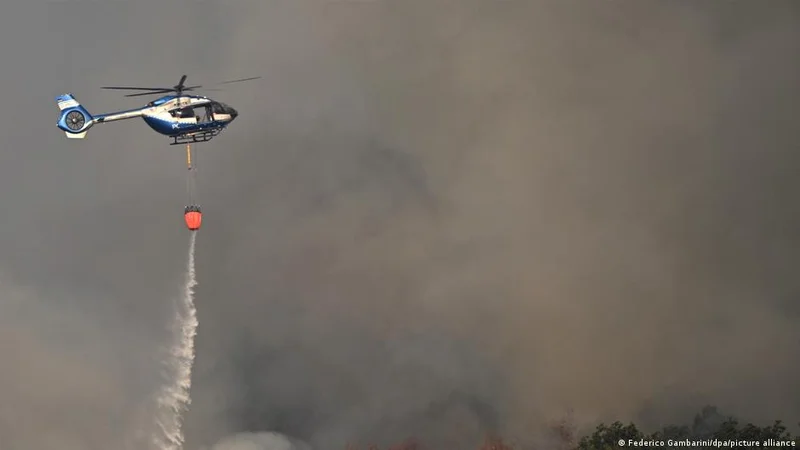
Bundeswehr forces joined in the fight against a forest fire raging in the Eifel on Friday, adding two water transport helicopter to the operation aimed at extinguishing the Hürtgenwald blaze.
Complicating matters are the numerous munitions scattered across the area since the end of the second world war.
In an effort to safely expedite access to the area, the Bundeswehr also deployed two rescue tanks to clear munitions and cut fire roads.
"The terrain is very difficult, and because of the high concentration of ammunition," as local councilman Ralf Nolten (CDU) told Germany's dpa news agency, "we can't send individual firefighters in with firefighting backpacks," said Nolten adding, "We also heard the explosions" that went off overnight.
In the fall and winter of 1944 and 1945, the Hürtgenwald was the scene of heavy fighting between US and Nazi-German troops as US tanks sought to finish their push east into Germany to end the war.
The ferocity and scale of the fighting led US soldiers stuck there waiting for reinforcements and facing entrenched German defenses to dub it "the death factory."
German military joins battle against Eifel wildfire
The German military has deployed firefighting helicopters to help tackle a major forest fire in the northern Eifel region of western Germany.
Two NH90 transport helicopters took off from Fassberg in Lower Saxony on Friday morning, according to the Defense Ministry.
The helicopters are equipped with so-called Bambi Buckets, collapsible containers carried beneath the aircraft to drop water over burning areas.
Each helicopter can release around 2,000 liters (about 530 gallons) of water during a single run.
Several hundred hectares of forest are burning close to the municipality of Hürtgenwald in the state of North Rhine-Westphalia.
The village of Gey has been evacuated after flames moved dangerously close to homes.
Germany's military has also recently used CH-53 helicopters to help fight forest fires in France.