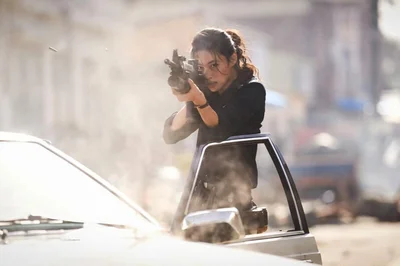
Seong-ae (Jung Hoyeon), a police officer at a local substation, fights an alien in “Hope.” Courtesy of Plus M Entertainment
“Hope” surpassed two million admissions Sunday, just five days after its release, reaching the milestone faster than any other film released this year. But what do cinema’s leading directors make of Na Hong-jin’s first film since “The Wailing” (2016)?
“It stands at the pinnacle of cinematic entertainment, pushing every element — tension, suspense, visceral impact and pace — beyond its limits,” said director Lee Chang-dong, who joined Na for an audience Q\&A at Lotte Cinema World Tower in Seoul on July 14, a day before the film’s release. Lee was Na's teacher during his first year at the Korea National University of Arts.
Directors Lee Chang-dong, left, and Na Hong-jin attend an audience Q\&A for “Hope” at Lotte Cinema World Tower in Songpa District, Seoul, on July 14. Courtesy of Plus M Entertainment.
Bong Joon-ho, whose film “The Host” (2006) similarly centered on a mysterious creature, joined Na for another audience Q\&A at Megabox COEX in Seoul on the film's release day of July 15.
“I watched it in a state of complete exhilaration,” Bong said. “The first 62 minutes offer the thrill and madness of action, but they also gradually build up all the wretchedness, insignificance, cowardice, sordidness and frailty of the human characters.”
Here are four questions that Lee, Bong and audience members raised after watching “Hope.”
Directors Bong Joon-ho, left, and Na Hong-jin attend an audience Q\&A at Megabox COEX in Gangnam District, Seoul, on July 15. Courtesy of Plus M Entertainment
Q: Plans for a sequel?
The film ends with a conversation between two aliens, with many viewers describing the conclusion as ambiguous and unclear. A mid-credits scene that appears to tease another installment has further fueled curiosity about a potential sequel.
The movie is known to be the first part of a planned trilogy, but Na repeatedly stressed before its release that it was “a complete work in its own right” and remained tight-lipped about any follow-up.
“The film ended just as it felt like the aliens’ story was about to begin,” Bong said during the Q\&A. “I suspect you have a much larger story already written for what comes next.”
After a pause, Na said, “I have it ready. If someone will just give me the green light, I’ll work hard on it.”
Predictably, the sequel’s fate will hinge on the commercial success of the first film. If a second installment moves forward, it is expected to delve fully into the aliens’ story.
Lee was equally curious. “From what I’ve heard, the second film is told almost entirely from the aliens’ perspective,” he said, to which Na replied, "That's right."
Q: Why aliens?
The first question Lee asked Na after watching “Hope” was simple: “Why aliens?”
Na had established his own distinctive cinematic style through “The Chaser,” “The Yellow Sea” and “The Wailing,” making his foray into science fiction a curious choice — particularly given that the genre has never produced a major commercial success in Korean cinema.
“A critic once told me that they could see certain patterns repeating across my previous films. While thinking about how to avoid repeating myself, I decided to make something a little more accessible,” Na said. “I wanted to depict human affairs from the perspective of a god. But putting an actual god in the film seemed awkward, so I turned the figure into an alien.”
Na said he wanted the movie to adopt a completely different style from his previous work.
“I hope viewers will approach the movie in the same way — as something completely unrelated to my other films.”
An alien pursues Seong-gi (Zo In-sung) through the trees in “Hope.” Courtesy of Plus M Entertainment
Q: Why so much swearing?
The protagonists — Beom-seok (Hwang Jung-min), Seong-gi (Zo In-sung) and Seong-ae (Jung Hoyeon) — repeatedly let loose with strong language as they fight for their lives. More than a few viewers have complained that the film contains too much profanity.
“I had heard before coming here that there was a lot of swearing,” Bong said with a laugh.
“I think about half of it was improvised and the other half was in the script,” Na said. “I must have removed about 200 instances during postproduction, but there were still more than 100 left.”
“Under circumstances like these — fighting aliens — I thought the dictionary definition of the word needed to change,” Na added. “It becomes an exclamation capable of expressing an entire range of emotions.”
A poster for “Hope” shows the three protagonists fighting aliens in a Romanian forest. Courtesy of Plus M Entertainment
Q: Why was it filmed in Romania?
“Hope” was filmed in three locations. The town devastated by the creature was shot in Haenam County, South Jeolla Province; the forest where Seong-gi fights the aliens was filmed in Romania; and the climactic road chase was shot in Hapcheon County, South Gyeongsang Province.
Asked by Bong why he chose Romania, Na said, “We surveyed mountains across Europe and concluded that Romania offered the ideal combination of terrain and government support. We needed at least 200 meters for the horses to accelerate into a gallop, then slow down and come to a stop.”
The film's reception has been mixed. Its action sequences have drawn praise, but many viewers and critics have found its narrative and dialogue lacking. The film holds a 78 percent critics’ score on US review aggregator Rotten Tomatoes and an 81 percent Golden Egg score among Korean moviegoers on CGV.
This article from the Hankook Ilbo, the sister publication of The Korea Times, is translated by a generative AI system and edited by The Korea Times.