In a white-walled gallery at the Museum of Contemporary Art, Gail Mabo, the daughter of renowned land rights activist Eddie Koiki Mabo, sits in an ordinary office chair, knotting lengths of white macrame cord.
Behind her lie bamboo frames for three navigational maps – one of three new commissions created to mark the MCA’s seven year international partnership with Tate Modern.
“Back in history, we used to have maps that we would give to people travelling through the Torres Strait,” she explains. “They were small, handheld navigational maps you could hold out toward the east to align with boundary lines.
“Shells represented inhabited islands. If you aligned the map to follow the bamboo line to the next shell, you knew there’d be people and water, a place where seafarers could stop.”
The currents of the Torres Strait, known as Zenadth Kes, were notoriously treacherous. Spanish navigator Luis Vaéz de Torres sailed his galleon, the San Pedro, through these waters in 1606. Later, English naval lieutenant James Cook steered HMB Endeavour past Possession Island on his return journey after raising the Union Jack at Botany Bay and collecting turtles for meat at Cooktown. Unlike Torres, Mabo notes, Cook “didn’t stop” on a voyage that would alter the course of First Nations history forever.
Mabo uses red and blue thread to trace the passages of these European explorers in works that will go on public display for the first time this Saturday for the opening of Connections: MCA x Tate. The exhibition highlights the MCA’s commitment to celebrating the histories, diversity, creativity, and resourcefulness of First Peoples on a site of first contact at Circular Quay.
Mabo’s interpretive maps render ocean swells and intricate currents. Shells denote the 17 mapped islands of the Torres Strait, while knotted white threads and mother-of-pearl mark the booming pearling industry established in the late 18th century following the arrival of Japanese divers.
Her grandfather was one of those pearl divers. When government authorities demanded he surrender his vessel in the late 1960s, he gave it a “Viking funeral”.
“Put a light to it,” Mabo says, “and sank it.
“I’ve created smaller maps before, but this is the largest I’ve ever done,” she adds. “My little book scribbles are finally coming to life.”
Connections features 15 of the 35 works jointly acquired by both institutions through a $2.75 million gift from the Qantas Foundation in 2015, which were featured at Tate Modern in 2021 for A Year in Art: Australia 1992 —a landmark exhibition that MCA Director Suzanne Cotter credits with elevating “the visibility of Australian artists on the world stage while building a shared collection of remarkable works that speak to the histories, experiences, and ideas shaping Australia.”
The partnership also supported Richard Bell’s monumental Embassy installation in Tate’s Turbine Hall in 2023.
While Mabo learnt macrame from her mother, Bonita, these three maps – representing the western, central, and eastern straits – honour her father. Next year marks 35 years since the High Court handed down its landmark Mabo decision, overturning the legal fiction of terra nullius – the doctrine that Australia belonged to no one before 1788.
Eddie Mabo passed away just months before the ruling was delivered. “I know in my heart he was with us that day,” she reflects. “I looked up at the sky, saw the clouds rolling away, and thought, ‘Yeah, he’s ready. Ready to dance.’”
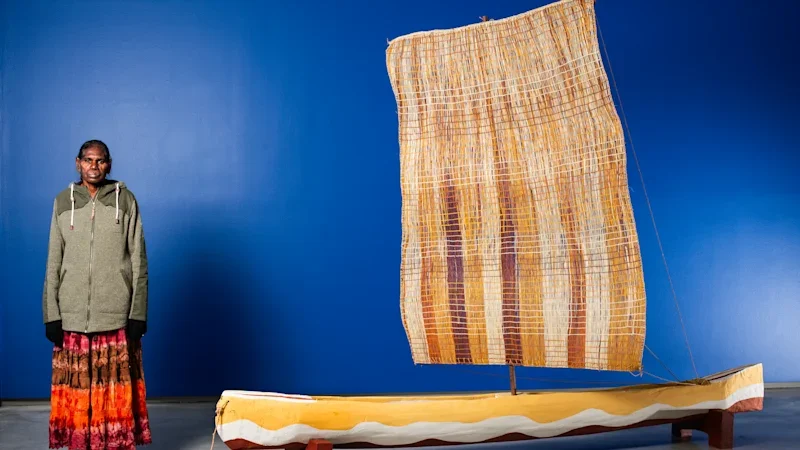
Expanding on the themes of cosmology, navigation, and migration, Yolngu artist Helen Ganalmirriwuy Garrawurra of East Arnhem Land has created a lip-lipa – a wooden dugout canoe fitted with a woven dhomola (sail) and painted with clan designs associated with the ancestral Djan’kawu sisters, creator beings of the Dreaming. The historic development of this nimble sail enabled long-distance sea travel across Arnhem Land waters, facilitating lucrative trade between Yolngu communities and Makassan (Indonesian) merchants.
“My two daughters’ boys – my grandsons – helped me chop the tree to make the canoe,” Garrawurra says. “A big, tall tree in the bush.”
Meanwhile, Yhonnie Scarce’s scaled-up black-and-white archival photographs trace her family’s history of forced displacement and “exile from Country” at the Koonibba Mission in South Australia. Hand-blown glass yams and bush plums bring issues of historical hardship, survival and identity into focus.
Rather than an activist, Mabo views herself primarily as an educator. She sees her artistic cartography as a powerful vehicle for building mutual understanding and connection following the defeat of the Voice referendum.
“I’d like these maps to find a permanent home,” she says. “Where that is, and where they hold their existence, is up to the universe.”
- Ten days ago, this theatre was on death row. Then something marvellous happened
- Sydney Opera House’s famous boardwalk to benefit from $120m renovation fund
- Powerhouse commissioned a documentary about its move. It will cost more than $1.7 million
- Labor wanted to restore Sydney’s nightlife. But young people don’t have ‘time for hangovers’
The Booklist is a weekly newsletter for book lovers. Get it delivered every Friday.