- See more This is Money on Google - save us as a Preferred Source
Does anyone else driving a relatively uncommon car do this?
About 20 years ago, I bought an Alfa Romeo GT. Admittedly, it was one of the more regrettable purchases in my motoring history.
But whenever I spotted one coming the other way, I'd give the owner a nod in acknowledgement. If overtaking, or being overtaken, I would raise a hand in recognition. And I would expect the same in return.
It's the motoring equivalent of a Masonic handshake.
And this week I've found myself doing it all over again. The surprising thing? This time I'm driving a Vauxhall Astra – on paper, the fifth most common model on Britain's roads, so not rare at all.
But crossing paths with the latest model is like stumbling across a long-lost relative. Drivers have simply stopped buying them.
I've been driving the just-facelifted eighth-generation Astra to find out why Britain has fallen out of love with a former family car favourite...
Britons have fallen out of love with the traditional family hatchback. Case in point is the Vauxhall Astra with sales plummeting. But it's still in showrooms - we drive the latest version
From best-seller to beleaguered
Vauxhall's medium-size hatchback has been a mainstay since the early Eighties and is one of the longest-surviving nameplates still in production.
After a 46-year run in showrooms, only the Ford Fiesta and Focus, the Astra's smaller Corsa sibling, and the VW Golf boast higher numbers on Britain's driveways today.
But Astra sales haven't just dwindled recently, they've fallen off a cliff faster than the Lamborghini in the opening scenes of The Italian Job.
Some 20 years ago, Vauxhall could barely make them fast enough at its Ellesmere Port factory.
In 2005, it was the second best-selling new car in the UK (behind the Ford Focus), with almost 108,500 registrations. By 2007, it reached the pinnacle of its popularity, with more than 123,000 delivered to Britons.
But today, it's on the fringes.
Now built in Germany, the mk8 car is an infrequent sight on our streets, which might explain my overzealous handwaving at an owner on the A1 earlier this week [if this was you, I apologise profusely].
How scarce are new ones? Last year, Vauxhall sold just 3,467 Astras. That's a staggering 97 per cent collapse in two decades.
The Astra is now well and truly gazumped by other models in Vauxhall's stable; some 36,000 Corsas were registered in 2025 and both the Mokka (almost 20,000 units) and Grandland (15,000 units) crossovers outsell it.
With Ford dumping its biggest rival, the Focus, late last year, its main competition is the Golf. And Volkswagen handed over ten for every Astra sold in 2025.
Looking at its dreary sales, it's a surprise Vauxhall is keeping it around...
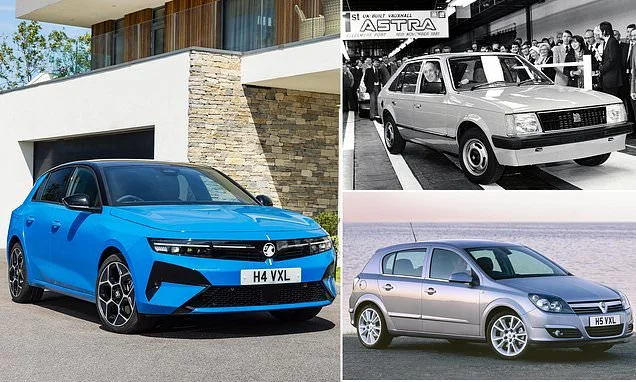
The first Vauxhall Astra - based on the Opel Kadett - being driven off the assembly line in Ellesmere Port in 1981
Astra popularity peaked in the Noughties. In 2005, this Mk5 model was the second best-selling new car in the UK with over 108k registrations. In 2007 Vauxhall delivered 123k to Britons
Now in its eighth generation, the Astra's popularity has plummeted. Last year, Vauxhall delivered fewer than 3,500 to UK drivers
Why the sudden unpopularity?
The biggest thorn in the side of the Astra has been the consumer shift to SUVs, which account for more than a third of new cars sold right now.
Drivers simply like sitting higher. And they're drawn to the protection and roominess of chunkier vehicles.
The result is that the once-mighty 'C-segment' hatchback market has been decimated. In fact, the Golf is now the only mainstream family hatch still capable of troubling the top ten sales charts.
The Astra has also spent much of the last decade being outclassed.
The Focus drove better. The Peugeot 308 had a more interesting interior. The Skoda Octavia more spacious. And the Golf unequivocally more premium.
Then there's the issue of price. A decade ago you could buy an entry-level Astra for £15,295. Today, the cheapest version costs £27,495 – a mark-up of 80 per cent and almost £6,000 above the inflation value.
Anyone returning to a Vauxhall showroom after ten years away is likely to spit out their complimentary showroom cup of tea when quoted these sorts of numbers.
The Mk8 Astra's mid-life facelift has brought subtle updates. A more angular front grille and fresh wheel designs sharpen the look, though the new glowing griffin emblem is a touch tacky
The Astra is a handsome car. It's certainly more appealing on the eye than the vast array of lookalike boxy crossovers families seem to be taken by
More drivetrain options but with price parity
Unlike Ford, Vauxhall is sticking by its family hatch. In fact, it's giving customers even more choice than before.
The Mk8 Astra is available as a conventional hatchback or a Sports Tourer estate. And pricing is exactly the same for both, which is a bonus.
Then there's the drivetrain, of which you have the choice of four.
The cheapest is the aforementioned 1.2-litre petrol for just under £27,500 that delivers 128bhp.
Vauxhall then offers price parity across the remaining three powertrain options – all starting from £29,995.
A mild hybrid adds a supplementary 48V 21bhp electric motor to the 1.2-litre unit, giving a total output of 143bhp.
Next is the plug-in hybrid (PHEV), which is the version I've been driving. This has a 1.6-litre petrol engine and single electric motor that produce a combined 192bhp. And with a 17.2kWh (up from 12.7kWh previously) battery, its electric-only range is 52 miles (up from 35 pre-facelift).
Lastly, the most eco-conscious drivers can have an Astra Electric. With a 58kWh battery, official range is up to 281 miles. With the Government EV grant of £1,500 knocking the start price down to £28,495, this, on paper, is the cheapest of the greener trio.
As well as the new pricing structure, the mid-life spruce-up has added a number of styling tweaks.
There's now a narrower 'Vizor' front grille that includes an illuminated griffin badge, which I think borders closer to tacky than premium. New 17- and 18-inch wheel designs and a contrast black roof across all trims complete the exterior upgrades.
Vauxhall has made changes inside, with an improved infotainment screen and grey centre console after owners complained the previous piano black panel was a fingerprint headache
While the new touchscreen has a higher resolution and is relatively responsive to inputs, Rob said he struggled reaching it while on the move
What's the cabin like?
Inside, there are new comfort chairs, standard-fit heated seats and steering wheel, and a new satin grey centre console after complaints that the old piano-black trim quickly starts to look like a police fingerprint scanner.
The 10-inch infotainment display has updated graphics and is relatively responsive to inputs. It too is sensibly backed up by a panel of shortcut buttons below.
But I found the touchscreen too much of a stretch away to operate with ease, especially when driving and trying to dab with any accuracy at smaller icons.
Thankfully, the voice command system works well. And it allows you to make simple adjustments, like the temperature settings, without having to take your hand off the wheel.
Sadly, the cabin, while functional, is painfully drab.
The black-and-grey colour scheme doesn't help. Nor do the scratchy hard plastics dotted around the place; the lid for the storage compartment in the lower stack of the dashboard, for instance, feels like it could have come off a nineties Cavalier.
The Astra's boot is 422 litres, if you choose the petrol, mild-hybrid of EV. Annoyingly, because the PHEV's battery is under the boot floor, the plug-in variant stores just 353 litres in total
Is it still a practical family choice?
Drivers over 6ft tall who think they need an SUV to sit comfortably on long journeys will find ample space in the Astra. Head and legroom is generous up front, as is elbow room between driver and passenger.
Frustratingly, it's not quite as capacious in the back.
My car has the panoramic sunroof, which eats into the room overhead. Friends also raised issue with a lack of foot space under the front seats. The back of a Skoda Octavia feels gigantic in comparison.
The door openings are also surprisingly narrow, which I found when attempting the near-impossible task of plugging a child car seat into the Isofix points.
Further back, the boot opening is wide, the compartment is usefully square and there's a low sill – all of which makes loading heavier items a doddle.
In total, there's 422 litres of space, which is better than the Golf.
But, much to my annoyance, the PHEV doesn't have a height-adjustable boot floor thanks to the battery stored below. As such, there's only 352 litres available, which then feels stingy against the competition.
Of course, if you want more luggage space, just go for the Sports Tourer. It offers 597 litres (516 if you have the PHEV) and doesn't cost a penny extra.
The Astra is definitely tuned for better handling over ultimate ride comfort. It's nippy off the mark, stable in corners and genuinely good fun to drive if you want it to be
What's it like to drive?
The PHEV feels surprisingly nippy, even against an Astra Electric. And it's certainly tuned towards better handling over ultimate comfort.
It has three adjustable driving modes: Electric, Hybrid and Sport.
In the first of these, there's enough electric range for the average Briton's 20-mile-a-day journey, though its 52-mile claim lacks against the 88 quoted for the Golf eHybrid.
Even in Hybrid mode, the Astra leaps away from the lights with plenty of urgency. Driving around town with enough battery charge means you can easily see a return of 100 miles per gallon. On a mixture of roads, including dual carriageway and motorway runs, the needle sat somewhere between 65 and 70mpg.
In Sport mode, the Vauxhall becomes distinctly more aggressive and much sharper. Power is delivered without lag, though stamp on the throttle pedal too hard and the automatic gearbox holds the revs high for an irritatingly long time.
After back-to-back drives of wallowing family SUVs that tilt in turns and pitch on heavy braking or accelerating, the Astra provides a welcome poise.
The suspension isn't as stiffly set up as a Honda Civic, but you definitely know you've clobbered a deeply cratered pothole more than you would in a Kia Sportage or Nissan Qashqai. That said, the impact doesn't send shudders through your body either.
The steering is nicely weighted and body control is very well managed.
Grip levels are communicated nicely through the steering wheel, too. And they need to be because you can quickly find the limit of grip due to its eco-bias tyres that are tailored more towards fuel economy than outright road holding.
Its ride might not be as plush as an SUV alternative, but you'll be rewarded with far more enjoyment than jacked-up rivals.
Vauxhall has also toned down the safety assistance warning bongs and dings; the intelligent speed assist still lets you know if you've teetered over the limit, but doesn't try to rupture your ear drums when doing so like some other brands.
The Astra PHEV's tyres are low rolling resistance to help make the car more economical. Because of this, you can quickly find the limits of the Astra's grip levels
Is it cheaper than rivals?
While most private buyers will be drawn to the 1.2-litre petrol, it's only around £1,500 cheaper than the entry-level 1.5 Golf on paper.
That said, data* provided by Insider Car Deals shows Vauxhall dealers are far more willing to discount.
The average saving you can haggle on a petrol Astra across finance contributions and twisting a salesman's arm is currently 23.3 per cent.
That's better than the 20.2 per cent you can negotiate off a Peugeot 308 and 18.8 per cent off a Golf. Audi salesmen won't knock more than 13.6 per cent off an A3 Sportback at the moment.
However, average PCP finance APRs on the 1.2-litre Astra petrol are higher – 10.9 per cent v 8.5 per cent for all three rivals.
It's a similar tale for the PHEV's attractiveness to company car drivers, who'll be tempted by the lower benefit-in-kind tax of the Volkswagen (seven v 10 per cent) thanks to its longer electric-only range.
The Astra and traditional hatchbacks still offer families plenty of car and for less than an SUV. It's a shame the dull cabin, limited rear space and small boot in the PHEV let the Vauxhall down
The Cars & Motoring verdict
It's sad to see the Astra's popularity diminish over the last few years and so few examples of the eighth-generation car on the road today. But it is understandable given the shift to SUVs.
Yet there's definitely room for conventional family cars like this to thrive in today's market – and Vauxhall should be applauded for keeping the Astra in showrooms, unlike Ford, which has scrapped the Focus, Fiesta and Mondeo in the last four years.
The Astra drives well and is economical to run. It looks pretty sharp, too.
However, it's let down in other key areas.
The uninspiring cabin won't win over a customer who's already shopped elsewhere. Nor will its relatively cramped second row of seats or small boot in the PHEV.
And even when it comes down to price – Vauxhall's trump card for decades – the Astra's numbers aren't as compelling as they once were.
*discount and APR data accurate to time of publishing