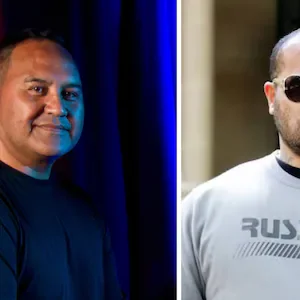
By the time former Lotto presenter Russell Harrison showed up for a clandestine meeting in an Auckland cemetery in July 2019 – collecting $420,000 in illegal drug profits bound for an international gang kingpin – the organised crime group that recruited him had already been under surveillance for years.
His successful imports would have been worth tens of millions of dollars on the black market. He now faces up to life imprisonment.
Only one minor player in the syndicate ultimately decided to go to trial: former Navy petty officer Darren Katipa, who had national security clearance until his association with the group was discovered.
Katipa was found guilty last month.
The New Zealand investigation was given a major boost thanks to an audacious global investigation dubbed Operation Trojan Shield, in which criminals around the world were duped by the FBI and the Australian Federal Police into using ANOM, a supposedly encrypted messaging service that had been promoted specifically to the criminal fraternity. In reality, the service was funnelling communications to law enforcement in real time.
Te Kowhai and most of his co-defendants were arrested in June 2021 as both Operation Trojan Shield and Operation Van ended. Their trial, however, was delayed for five years as New Zealand courts reviewed the unique law enforcement tactic to determine if the messages could be used as evidence.
Most of the guilty pleas came after the Court of Appeal determined that the fruits of the fake messaging app trick could be used even though, defence lawyers argued, it amounted to bugging a suspect without a warrant.
Messaging and other surveillance suggested that Te Kowhai had been taking orders from his cousin, Duax Ngakuru, a New Zealand citizen living in Turkey who was touted as the worldwide “supreme commander” of the Comancheros motorcycle gang.
Police described Ngakuru, who remains overseas following his 2023 arrest, as the “controlling influence and primary benefactor of the enterprise”.
Christmas meeting
It started with a gang summit of sorts two days before Christmas in 2017.
According to an unusually long 21-page summary of facts that Te Kowhai agreed was accurate, Duax Ngakuru had travelled to New Zealand along with another cousin, Shane Ngakuru, who allegedly served as his second-in-command while residing in Thailand.
They relied on the local connections of Te Kowhai and co-defendant Jack Phillips, whose involvement in the drug trade dated back at least a decade, to arrange a meeting with a high-ranking Mongrel Mob member. Phillips also pleaded guilty in June.
It was agreed during the one-hour meeting that the Mongrel Mob member would receive bulk quantities of methamphetamine from the group, which he would then on-sell through his already established distribution channels, court documents allege. He was given a sample batch of meth and an encrypted phone, the summary of facts alleges. The Mongrel Mob member was never charged.
It wasn’t all smooth sailing at first.
Police noted a conversation between Te Kowhai and Phillips a month after the initial meeting in which they discussed the Mongrel Mob member’s disappointment over a batch that was orange and of poor quality.
“Mr Te Kowhai stated that he had talked to Duax Ngakuru, who he said was very apologetic and that he was replacing it,” court documents state. “Mr Phillips expressed that he wanted it worked out as he was the one that made the introductions and he could be held to account if things didn’t go as had been agreed.”
Over the following six months, schemes were researched and discussed to smuggle methamphetamine from China secreted inside boats for resale, cocaine from South America in balsa wood shipments and $2 million worth of methamphetamine from the Pacific Islands.
None of the schemes, it appears, were ultimately successful, but the discussions alone were enough to charge Te Kowhai and others with conspiracy to import drugs. Aiding him in the schemes was “H”, a man in his 60s who would go on to have a greater role with the syndicate.
H, who continues to have name suppression, is serving a nine-year sentence after being the first among the group to plead guilty in 2022.
Although it didn’t result in charges, investigators also noted that Te Kowhai and H began discussing in July 2018 the idea of establishing a legitimate medicinal cannabis business - if they could convince Duax Ngakuru to invest $6m in his drug profits.
“Intercepted communications in August 2018 show that Mr Te Kowhai was worried that people would ask questions about the legitimacy of the funds ...” court documents state. “Mr Te Kowhai noted to [H] that the only way to successfully establish the business was to be ‘incognito’ and to use multiple shell companies.
“There were numerous conversations between members of the syndicate about how to get illegitimately derived funds into the electronic banking system in New Zealand without being discovered by authorities.”
Te Kowhai sent a professional facilitator to Turkey to discuss the potential business with Duax Ngakuru. A week later, Te Kowhai set up Zymbl Capital Limited and around $708,000 was transferred to the company.
A boat and a big plan
The syndicate’s most audacious plan was hatched in October 2018, when they began discussing a 1.5 tonne shipment of cocaine that was to be collected about 300 kilometres off the coast of Tauranga.
“Under instructions from Duax Ngakuru, Mr Te Kowhai and [H] began looking for a boat which was capable of travelling long distances out to sea,” court documents state.
Te Kowhai helped purchase a $180,000 boat, with the expectation he would be reimbursed. He named it the Kryptonite and spent $100,000 on upgrades, including night-vision capabilities for the planned clandestine meeting.
It was initially envisioned that the boat would be used for three importation trips, court documents state. Joining Te Kowhai on the crew would be his close friend Lionel James Ruka McDonald, his daughter’s partner, Carlo Gear, and Navy officer Darren Katipa, whose “specialised maritime knowledge” was described by police as “crucial” to the plan.
Gear brought another gang connection to the group. His father is the president of the Filthy Few’s Rotorua chapter.
The vessel was used at least once, in April 2019, when Te Kowhai and H received a delivery that included a money counting machine, scales and about $800,000 in cash.
There was a hitch in the plan in August 2019, when McDonald was arrested, leading to fears the crew had been compromised by a police investigation. But plans continued for the next several months before fizzling.
In November that year, Duax Ngakuru openly communicated with overseas suppliers about the possibility of attaching a 500kg shipment to a buoy for his crew to retrieve, authorities allege.
“Duax Ngakuru stated that his other mate is in court and if it is a good result, he can probably put something together but if it is a bad result, they will have no chance.”
It ultimately wasn’t a good result for McDonald, who has been sentenced twice for his participation in the criminal enterprise.
Dealing in NZ
In addition to importing methamphetamine, the group was charged with distributing at least 159kg of it in New Zealand. They dealt in wholesale quantities.
H took on a role as banker for the syndicate, starting with the $800,000 in startup money that had been delivered to their boat.
“From this time, a pattern was identified where [H] would uplift cash payments for drugs and then the drugs would be delivered to the customer by Mr McDonald,” court documents state. “The basic premise was that the exchange of methamphetamine for cash did not happen at the same time ...
“Police surveillance, phone tracking and intercepted communications identified numerous cash pick-ups and drug deliveries. The amounts being dealt were in kilogram lots. [H] would also sometimes drop off the cash proceeds to an Asian syndicate for laundering.”
Court documents state McDonald and H took instructions primarily from Duax Ngakuru, with cousin Shane Ngakuru also in charge.
Te Kowhai, meanwhile, “was not necessarily aware of the details of every cash payment or drug supply”. But he helped deal with operational issues and was there to “enforce Duax Ngakuru’s directions as required”, with the expectation that others follow his orders.
He was the person other defendants went to when they had problems, such as a situation in May 2019 in which McDonald accidentally delivered too much methamphetamine to a customer. When McDonald was arrested, Te Kowhai instructed the H on how to distance himself, including destroying all his phones and recruiting a couple to take over his banking duties.
The couple, who went on to launder over $6m, have pleaded guilty and also have interim name suppression while awaiting sentencing. Among those they collected cash from was Pomare Pirini, who was head of the Comancheros’ Bay of Plenty chapter. He has pleaded guilty to laundering over $1m.
McDonald’s arrest came one month after police conducted a covert search of a Ngongotahā storage unit he was renting and found a meth stockpile estimated to be about 150kg. Numerous 1kg bricks had been labelled as tea. The varied packaging suggested the drugs had been obtained through three separate imports.
“Photographs and samples were taken but the methamphetamine was left in situ so that Mr L McDonald would be unsuspecting of the fact that police were aware of its presence,” court documents state.
Police tailed McDonald for the next week as he repeatedly returned to the storage unit to deliver drugs. But they decided to step in and arrest him after he was caught trying to remove 38kg in one trip.
The bust netted $138m worth of drugs.
Police watched as a panic ensued, with other members of the syndicate burying cash and trying to distance themselves from McDonald as much as possible.
A covert recording device in H’s car picked up a conversation in which he told a woman that he had been working for the Comancheros but Duax Ngakuru was “pulling out” in light of the arrest. H went on to tell her “that the Comancheros control all of the cocaine in the country and there’s about to be a ‘s***load here’”.
Gold bars
One day after H’s conversation was recorded, police intercepted a more upbeat conversation in Te Kowhai’s ute between himself, Russell Harrison and the career naval officer.
“Mr Te Kowhai said that Mr L McDonald had been replaced: there was someone else doing it now, same quantities, it is never going to stop,” court documents state. “They then went on to discuss how Duax Ngakuru had made $100 million, so he should hurry up with sending them $3 million for the medicinal cannabis business they were setting up.”
Harrison’s cemetery meet-up had occurred one month earlier. H handed him $420,000 in cash that day, and an hour later Harrison was using it to purchase six gold bars.
As plans were made for the TV personality to take the bars to Duax Ngakuru in Turkey, Te Kowhai was recorded telling H that Harrison “just has to follow orders like a soldier”. The trip and the overseas handoff appeared to go without a hitch.
Duax Ngakuru was so happy with the process that he wanted it repeated with another 50 gold bars, his associates were recorded saying.
It would be another year and a half before everyone else, aside from McDonald, was arrested and started to realise just how poorly their syndicate had been kept secret.
Craig Kapitan is an Auckland-based journalist covering courts and justice. He joined the Herald in 2021 and has reported on courts since 2002 in three newsrooms in the US and New Zealand.