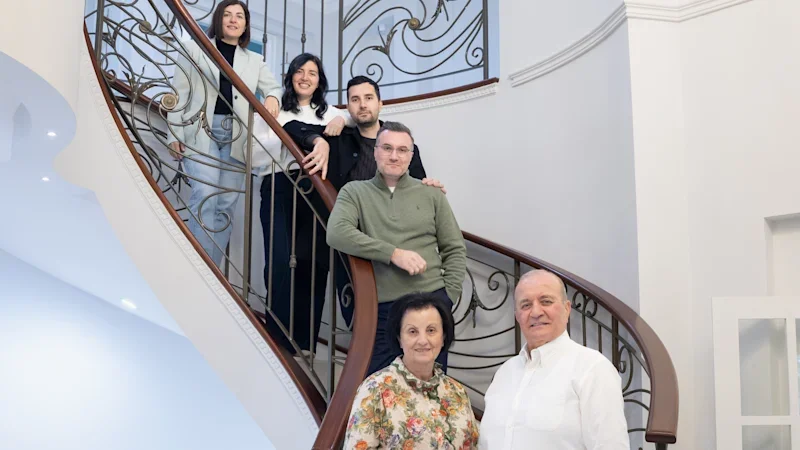
There were many moments in his life where Dr Aniss Chami believed his father had lost his mind.
But the most jaw-dropping moment was when the elder Chami revealed to his family that he had decided to convert his small packing facility in Prestons in Sydney’s south-west into a pharmaceutical manufacturer.
The Lebanese-Australian family were on the verge of ruin after the collapse of a key supplier put their fledgling business, which packed and sold vitamins, at risk. But they turned it around, led by their charismatic and industrious patriarch, only to emerge as a leading manufacturing force in Australia.
And because the family’s success came via leveraging global trust in Australian products, they offer a quiet and powerful rebuke of the anti-immigrant and identity discussion swirling around the surge in support for One Nation.
Theirs is a success born of being both Lebanese and Australian. But the success was not without its challenges.
“We nearly lost everything overnight,” Aniss says. “We were completely screwed. And then Dad announced he had a solution. And we were waiting for something profound to solve our problem, but he goes: ‘Why don’t we make the medicine? Why are we packing it? I’ve decided we’re going to make it.’
“And we said, ‘Have you lost your mind?’” he says, laughing as he recalls the moment.
Elie Chami has a wide grin on his face as he hears his son recount the moment, his eyes sparkling with the kind of excitement that grips a man of faith who has been proven right.
Not only did he succeed in dragging his family through the tortuous process of converting his makeshift factory into a pharmaceutical manufacturer, but he also emerged as a juggernaut in the industry. The family business supplies some of the biggest supplements brands globally, employs 400 people and is looking to have 1200 or more in future.
So, how did a kid from rural Lebanon, who worked in factories and as a taxi driver upon his migration to Australia, build one of our largest manufacturers?
Elie grins again when asked. “I wanted to be the best.”
A western Sydney story
Elie’s journey to Australia was not straightforward. As civil war brewed in Lebanon in the early 1970s, Elie’s parents left for Australia ahead of their children in hope of building a foundation for their family.
They left Elie and his siblings with their grandparents in the mountainous village of Syr in Lebanon’s north for nearly three years, forging in young Elie a drive to prove himself.
“Other people have a father for their birthday,” he recalls. “Have their mother next to them going to school, taking them to church. Why not me?”
At age 14, Elie followed his parents to Sydney in 1974 and was immediately put to work. First at a factory that made bathtubs, then another factory that made glass bottles in Waterloo. He worked alongside his father and studied English at night.
And while he picked up skills that would later become important, these jobs were “never enough”. He moved on quickly to driving instruction and then became a taxi driver, nothing ever feeling right.
The lightbulb moment came during a trip to Lebanon. Intent on baptising his son at the church of his saint, Elie found his family and friends repeating a question: “Did you bring any Panadol?”
It was common, particularly in the ’80s and ’90s, for Lebanese-Australians to visit Lebanon with baggage lined with Australian medicine, inaccessible to the small war-torn slice of the Middle East.
But very few saw a business opportunity in the question. “These people are hungry for medicine,” Elie remembers thinking. “They knew of vitamin C, vitamin D, multivitamin and fish oil, but had nothing. They heard of it, but they didn’t have the money to buy it.”
Despite being an outsider to the industry, he was quickly connected with Jim Selim, the man behind Pan Pharmaceuticals. Himself a migrant from Egypt, the ambitious businessman saw in Elie a willing energy.
He handed him a briefcase of pills, a booklet explaining what they did, and instructed him to find buyers in the Middle East. So Elie bought a suit, “polished up” and was on the road with his trusty, arresting grin.
It didn’t take long to secure his first contract, a buyer in Lebanon who leapt at the opportunity. Elie was off. He soon secured buyers across the region, and by the early ’90s, he had established himself as a capable salesman.
Yet two decisions defined the trajectory of the business, which became known as Vitex – the first, for Vitex to do its own packing; the second, to manufacture its own pills.
Selling Australia
Both transitions were born out of Pan and Selim. But it was Pan’s collapse in 2003 that set Elie on his current trajectory.
The collapse came after the Therapeutic Goods Administration (TGA) recalled 1600 of Pan’s products due to complaints of defective pills, leaving Elie and his fledgling company broken.
At that point, Elie sat the family down in the dining room of their Hoxton Park home and declared that he wanted to make his own pills.
They had, just a couple of years earlier, scraped together the money and equipment to begin packing, and had received their licence from the TGA after a thorough audit which included remodelling their facility.
“Apparently you can’t have a bathroom open out to your packing room,” Elie says with a laugh. “How was I supposed to know?”
The jump to making their own pills was an enormous move, both expensive and risky. The family put everything on the line to make the transition, but it was when Elie successfully turned a lolly machine into a tablet coater that Aniss thought they could make it work.
“That was the moment, for me, when I started to believe in him,” Aniss says. “You believe in God, you believe in yourself, but I believed in him from that moment. I said, ‘He must be Midas’.”
Between 2005 and 2016, Vitex expanded from one factory unit to eight, before moving from one mammoth facility to the next.
“This is a family that keeps reinvesting and growing the industry for the Australian economy,” Aniss says. “It’s no longer about us getting rich; it’s us building a legacy for Australia.”
Two prime minsters (Anthony Albanese and Malcolm Turnbull) and one premier (Chris Minns) have visited their factories, and the family says each one was stunned by their achievements.
Theirs is a story littered with themes often associated with migrant success, such as their perseverance, their willingness to suffer and their foresight.
But, in recognising the commercial potential in Australian-made medicine globally, Elie and his family came to this fascinating intersection of opportunity and identity. As migrants, they understood the power of Australia, arguably more so than those already living here.
“He knew how to sell Australia,” Aniss says. “He used to say to me, we aren’t selling medicine. We’re selling Australian provenance.”
Elie adds, in Arabic: “We’re selling the name.”
Asked how he feels about Australia, Elie stares at the vast expanse of suburban and industrial spaces outside his office window.
“What country can understand my ambition?” he says. “Lebanon definitely couldn’t. I always used to dream and believe nothing is impossible.
“I want to prove that I came to this Earth not just to walk and go. I want to leave something here,” he says, stubbing his finger into the desk for emphasis.
“I want people to think of me after a hundred years.”