Business
Key Facts
—The measure. Brazil issued a provisional measure, MP 1,368/2026, opening an R$8 billion (about US$1.6 billion) credit line for airlines operating in the country.
—The trigger. It responds to a jet-fuel price spike of around 70%, driven by conflict in the Middle East, which sharply raised airlines’ costs.
—The mechanism. The money funds loans to reinforce carriers’ working capital, not cash grants; airlines borrow to keep flying.
—The politics. The aid lands in an election year, drawing criticism that the government is cushioning a well-connected sector.
—The status. Like all provisional measures, it is already in force but must be approved by Congress within 120 days to become permanent.
Brazil airlines have just been handed a lifeline. A new government measure opens an R$8 billion (about US$1.6 billion) credit line to help carriers absorb a punishing jump in fuel costs.
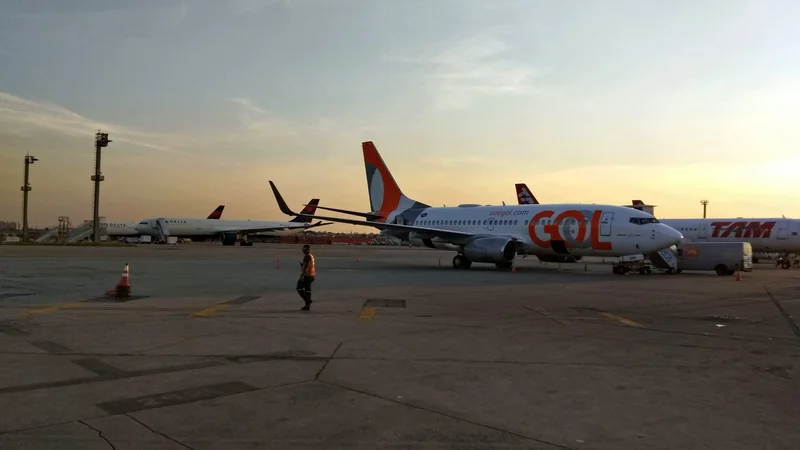
GOL and other carriers on the tarmac in Brazil. A new measure opens an R$8 billion (about US$1.6 billion) credit line for airlines. (Photo: Ecliptics / Wikimedia Commons, CC BY-SA 4.0)
One-stop reference
Company Intelligence
Every listed company in Latin America — financials, ownership and structure for 1,450+ companies across 26 exchanges, in one place.
RTAsk Rio TimesMarkets, currencies and the economy›
RT
Ask Rio Times
Latin American markets, currencies and companies.
×
Markets todayThe currencyRates \& inflationEconomy outlook
Brazil’s government has stepped in to steady its airlines. A new decree opens billions in cheap credit for carriers battered by a surge in the price of jet fuel.
The move is designed to keep planes flying in a country where, for many journeys, there is no realistic alternative to air travel.
What the Brazil Airlines Rescue Does
The vehicle is a “medida provisória,” or provisional measure — a decree the president can issue that takes effect at once but expires unless Congress approves it within 120 days.
This one, MP 1,368/2026, opens R$8 billion (about US$1.6 billion) of extraordinary credit in the federal budget to fund loans for airlines flying in Brazil.
Crucially, it is not a giveaway. The money backs financing lines the carriers must repay, aimed at shoring up their working capital so operations continue.
The R$8 billion (about US$1.6 billion) is drawn as extraordinary credit, a budget mechanism reserved for urgent, unforeseen spending — a measure of how suddenly the fuel shock struck.
Provisional measures are a common, and controversial, tool in Brazil, letting the executive act fast but leaving a deadline hanging over Congress.
Why Airlines Needed Help
The immediate cause is fuel. Jet kerosene, an airline’s single biggest cost, jumped by roughly 70% in a short span as conflict in the Middle East disrupted oil markets.
For carriers with thin margins, a shock that size can be fatal. Brazil’s aviation sector has long been fragile, with past bankruptcies still fresh in the memory.
Fuel can account for a third or more of an airline’s costs, so a 70% jump in kerosene lands almost immediately on the bottom line.
Brazil’s market is dominated by a handful of carriers — Gol, Latam and Azul — so trouble at any one of them ripples across the whole system.
The country has seen carriers collapse before, leaving routes cut and passengers stranded — a history that shapes today’s caution.
The government’s bet is that cheap credit now prevents a collapse — and the grounded flights and lost jobs that would follow — later.
The Election-Year Question
The timing is politically charged. The aid arrives in an election year, and critics accuse the government of “topping up” a decree to please a well-connected industry.
Supporters counter that keeping airlines aloft protects passengers, tourism and the remote regions that depend on flights.
Public money for private companies is always contentious, and doubly so when budgets are tight and an election looms.
For the opposition, it is an easy target: state help for big companies while households feel the pinch of high interest rates.
A Separate, Looming Tax Fight
Confusingly, airlines face a second, opposite pressure. Brazil’s sweeping tax reform, which folds several levies into a value-added tax, could raise the tax burden on aviation.
Industry groups warn that a higher tax on tickets would make Brazil less attractive to airlines and foreign tourists, undercutting the very sector the credit line is meant to save.
So the government is, in effect, propping up airlines with one hand while a coming tax could squeeze them with the other. The two measures should not be confused.
The tax reform is meant to simplify one of the world’s most complex tax systems, but every sector is now fighting over where the new burden falls.
What It Means for Travellers
For passengers, the immediate hope is stability: fewer cancellations and less risk of a carrier failing mid-year.
But relief for airlines does not automatically mean cheaper tickets, and fuel costs plus any future tax could still push fares up.
Air travel in Brazil is already expensive by regional standards, a frequent complaint from residents and visitors alike.
For a country of continental size, the health of its airlines is a public concern as much as a corporate one.
Domestic flights knit together a nation larger than the continental United States, linking cities that road and rail cannot practically connect, so keeping that network running and affordable is a recurring headache for every government.
Frequently Asked Questions
What is MP 1,368/2026?
It is a Brazilian provisional measure that opens an R$8 billion (about US$1.6 billion) credit line to fund loans for airlines operating in the country, helping them cope with a sharp rise in fuel costs.
Why do Brazil’s airlines need help?
The price of jet fuel, their biggest cost, rose by roughly 70% in a short period as Middle East conflict disrupted oil markets, squeezing carriers that already run on thin margins.
Is this a bailout?
Not exactly. The measure backs loans the airlines must repay to reinforce their working capital, rather than handing them cash. It still needs approval by Congress within 120 days to become permanent.
Read More from The Rio Times