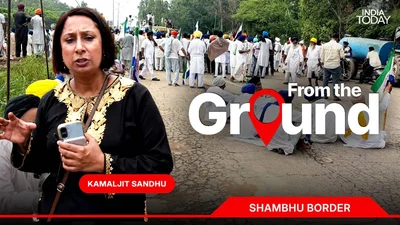
Thousands of farmers from Punjab on Tuesday suspended their planned march towards Delhi after the Haryana government accepted two of their key demands, including the release of detained farmer leaders and an assurance that a meeting with Union Agriculture Minister Shivraj Singh Chouhan would be held within the next 8–10 days.
The farmers, protesting against the proposed India-US Free Trade Agreement (FTA), had assembled at the Shambhu border for a one-day march to Delhi's Kisan Ghat to hold a Kisan Mahapanchayat.
However, following talks between farmer representatives and Haryana Agriculture Minister Shyam Singh Rana, the protest was called off and the farmers agreed to return home.
Addressing the media after the meeting, Kisan Mazdoor Morcha leader Sarwan Singh Pandher said the discussions had yielded a positive outcome.
"Two key demands were met: release of detained leaders including Gurnam Singh Chaduni and BM Singh and assurance of a meeting with Union Agriculture Minister Shivraj Singh Chouhan within 8-10 days," Pandher said.
He added that the farmers had decided to suspend their march after receiving these assurances from the Haryana government.
Confirming the agreement, Haryana Agriculture Minister Shyam Singh Rana said the state government had received the memorandum submitted by the farmer organisations and would forward it to the appropriate authorities for further action.
"I have received the demands submitted by the farmers' union, and we will forward it to the appropriate authorities so that all issues can be resolved," Rana said.
"Regarding the matter concerning Gurnam Singh Chaduni, I will speak to the Chief Minister and ensure a resolution by this evening. We will arrange a discussion with Union Minister Shivraj Chouhan, or whoever the central government designates, within a week or 10 days," he added.
More than 2,000 farmers, primarily from Punjab, had reached the Shambhu border early Tuesday morning under the banner of organisations including the Desh Bachao Morcha, Kisan Mazdoor Sangharsh Committee and unions such as the Bharatiya Kisan Union (Chaduni).
They travelled in buses with plans to march to Delhi but were stopped by heavy police barricading at the Haryana border.
The Haryana Police had fortified the Shambhu border with concrete blocks, multi-layer barricades and a heavy security deployment.
Authorities also imposed prohibitory orders under Section 163 of the Bharatiya Nagarik Suraksha Sanhita (BNS), preventing large gatherings and restricting the movement of the protesters towards the national capital.
Despite the restrictions, Pandher maintained a conciliatory stance and urged protesters to avoid confrontation with the police.
"We will not create any conflict from our side. We have neither decided to block the road nor will we stop it. Nor do we want any clash with the government," he said.
Responding to questions on whether ongoing student protests in Delhi had influenced the administration's decision to stop the march, Pandher said, "There has been no notification of section 163 being imposed. Though they empathised with protesting students, the issue being raised by farmers is a different one."
Senior government officials, speaking on condition of anonymity, indicated that the Centre was keen to avoid another prolonged standoff with farmers, particularly in view of previous confrontations between protesting farmers and the Haryana Police at the state's borders.
With student protests and political demonstrations already underway in Delhi, officials said the government did not want another flashpoint.
The protest also triggered sharp political exchanges in Punjab, with leaders across party lines taking contrasting positions on both the proposed trade agreement and the handling of the farmers' agitation.
Punjab Chief Minister Bhagwant Mann accused the Centre of preventing farmers from exercising their democratic right to protest.
"Farmers are protesting against the India-US treaty. I want to tell Modi ji that they should not be stopped by Haryana Administration. Modi makes claims that he stopped wars such as Ukraine-Russia, so he must talk to own people too," Mann said.
Punjab BJP president Kewal Dhillon sought to allay fears surrounding the proposed agreement, asserting that no final deal had yet been signed.
"The situation is absolutely clear. No deal has been signed yet, and our Prime Minister has made this very clear. Nothing in this deal will harm any farmer, whether in India or Punjab. The Chief Minister should also join hands with us, appeal to the farmers for calm, and explain that the deal has not been signed yet and contains nothing detrimental to them. He should be the one to clarify this..." he said.
Punjab Congress president Raja Amarinder Singh Warring accused the AAP government of preventing farmers from reaching Delhi and alleged that police had been detaining farmer leaders across the state ahead of the protest.
Shiromani Akali Dal president Sukhbir Singh Badal also called on the Centre to engage with farmers before finalising any trade agreement.
"It is the Govt's prerogative to make agriculture a profitable sector. Govt should consult with farmers and release all details of the pact otherwise rumours mar the deal and that harms the country overall," he said.
Farmer organisations have been strongly opposing the proposed India-US Free Trade Agreement, arguing that it could open Indian markets to subsidised American agricultural products, including soybeans, dairy products, grains and dry fruits, adversely affecting domestic farmers, dairy producers, small traders and rural livelihoods.
The detention of several farmer leaders, including BKU (Chaduni) chief Gurnam Singh Chaduni ahead of the protest, had further intensified tensions before Tuesday's breakthrough talks at the Shambhu border.
- Ends
Published On:
Jul 21, 2026 20:48 IST