Medical Mysteries
Girl born with skin missing from her scalp, body, arms and legs, treated with her own lab-grown skin
Medical Mysteries is a series that spotlights rare diseases or unusual conditions.
AI generated
SINGAPORE – When housewife Siti Abdullah heard her baby cry after giving birth by caesarean section in 2020, she thought everything was fine.
“Then the room went very quiet before the doctors and nurses started whispering. They rushed Sumayyah out of the operating theatre and summoned my husband in,” the 46-year-old mother of five said.
Her husband, Abdul Rahman, 45, said that when he first set eyes on his daughter, he thought she was still “dirty with afterbirth”.
“But when I looked closely, I was shocked by what I saw,” the patient relations associate at a hospital said.
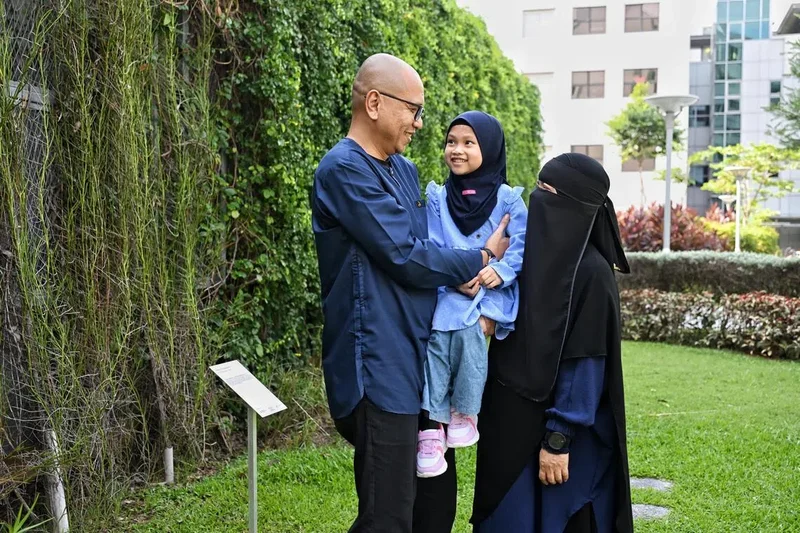
Sumayyah was born without skin on nearly 40 per cent of her body.
All she had was a membranous covering over her scalp, torso and four limbs through which doctors could see her organs and blood vessels.
Sumayyah, now five, has aplasia cutis congenita (ACC), a rare birth defect in which a baby is born missing layers of skin on a localised area of the body. It affects about one in 10,000 births.
ACC most frequently appears as an open, ulcer-like wound or thin membrane on the top of the scalp, though it can affect the limbs or torso. In its extensive form, babies born with such large areas of missing skin have not survived.
Singapore General Hospital (SGH) neonatologist Alvin Ngeow said: “To our knowledge, (Sumayyah) is a living survivor with the largest extent of missing layers of skin in Singapore. You can imagine that in place of her skin, there is the transparent membrane that looks like cling wrap.”
He said Sumayyah’s issue was that the skin on her head was replaced by a thin membrane that was so transparent that her brain was visible, “and that was worrying”.
A baby’s skull is made of several bones joined by flexible sutures and soft spots called fontanelles, which allow the skull to flex during birth and expand as the brain grows.
Ngeow said: “It was through the fontanelles that we could see her brain underneath. Unfortunately, there were minute breakages in the ‘cling wrap’, and that meant there was a possibility of complications such as an infection that could be life-threatening.
“Right in the middle of the brain is a huge blood vessel called the sagittal sinus and once it bleeds, it is very difficult to stop... A (third) feared risk is called brain herniation, which is when the brain is pushed outwards through a weak spot.”
The doctor said it was good that Sumayyah was delivered through a caesarean section instead of natural birth, otherwise her brain might have herniated.
“We had to prevent all three scenarios from happening in a quick and decisive manner, or we would very likely lose her,” he added.
Otherwise healthy, Sumayyah was whisked off immediately to the neonatal intensive care unit (NICU) where she was cared for like a major-burns patient.
When she was first brought from the operating theatre to NICU, the doctors were not prepared, as Sumayyah was not diagnosed before her birth “as it is not easy through ultrasound”, Ngeow said.
“Both burns patients and Sumayyah have lost the function of their normal skin, so the management is similar – giving antibiotics to prevent infection, and judicious and careful fluid management because they can lose fluid a lot more quickly than if they have normal protective skin over the body,” Ngeow said, adding that Sumayyah was put in an incubator for extra protection.
A multidisciplinary team, including a neonatologist, a dermatologist and a plastic surgeon, was convened for Sumayyah’s care.
Ngeow even ploughed through 800 medical journals about the condition, but the majority, he said, were case reports that “did not give the full picture”, so the team had to piece together what the journals were saying about the rare condition.
The priority was creating skin to cover Sumayyah’s head to prevent infection and even a brain hernia. One option was a split-skin graft, which is normally applied to treat burn patients.
It is where doctors take the top layer of skin from an unaffected part of the body to cover the burnt areas.
“In Sumayyah’s case, it was not an option as she barely had enough skin to cover herself,” Ngeow said.
SGH can culture and grow skin
Plastic surgeon Cheryl Hui, also from SGH, said that, being the only specialised facility managing major burn injuries in South-east Asia, the hospital has the capability to culture and grow skin.
“We took a small part of the skin from Sumayyah’s groin (on day 10 of her birth) and put it in the laboratory for three weeks to grow, and we managed to expand it into a few sheets. However, because it takes three weeks to grow the cells, we had to make sure that she did not have any chance to develop an infection,” she said.
On day three, the team used an artificial dermal matrix, a specialised “scaffold” used in surgery to replace or repair the deep layer of skin, and laid it over the baby’s scalp to protect her brain.
On day 10, the artificial skin, which was a success on the scalp, was attached to her torso and limbs. And that was also when doctors took a skin sample from her groin to grow new skin.
Ngeow said: “We changed her dressing every two to three days throughout the whole process (for 29 days). When the actual skin came a month later, we used that to do the graft over the child and continued to change her dressing every two to three days for six months. We even bathed the baby in a sterile saline bath.”
He added that it was improvised from what he learnt in the field during his national service.
“We set up a drip stand and the (saline) bag was set up to provide a clean source of water for the baby. We also placed her under a warmer to ensure she did not lose heat. We did this every two to three days until the skin grew, and she had beautiful coverage,” Ngeow said.
Sumayyah was discharged after six months, and the team continued to change her dressing – sometimes at the clinic and other times at her home.
Like burns patients, Sumayyah still has to deal with scars and often goes for what the doctors call scar revision operations at KK Women’s and Children’s Hospital. Her healed skin is considered scar tissue, which does not grow and stretch like normal skin.
Her doctors say Sumayyah will need regular follow-up and scar management through her growing years and with consistent care, they expect her to lead a full, normal life.
While the skin graft provided a protective covering for her brain, it does not have the structures needed to grow hair. So Sumayyah is bald.
To spare her from feeling different, her father shaves his head as well.
“But she tells me not to, as she will be fine,” he said.
An intelligent child who is chatty when she is at home, Sumayyah has since become rather quiet and withdrawn as she is beginning to be rather self conscious of her condition, her mother added.
Ngeow said: “As she grows up, she may have to navigate the reactions of other children and strangers who notice that her appearance is different. Hence, supporting her confidence and social adjustment will be just as much a part of her care as looking after her skin.”
Sumayyah will be starting primary school in 2027, and Ngeow had written a letter to both the Education Ministry as well as her school asking that she be allowed to wear a beanie to school.
Siti said: “We felt lost and shocked (when Sumayyah was born), but the doctors, nurses, and even the cleaners in the NICU assured and comforted us. They told us to think positive, trust that they will do their best. Our trips up and down, from (home to) hospital, were always teary, but the staff kept us calm and talked us through our worries.
“We are still touched because they took care of Sumayyah like their own. We were deeply grateful and thankful to each and every one of them.”