The title of Joe Sacco’s latest graphic narrative, The Once and Future Riot, is unlike Palestine, Footnotes in Gaza, or The Fixer. Not immediately referencing a place or a people, The Once and Future Riot indicates a sense of tension instead. And not just between past, present and future, but also palpably in the ability of the journalist or the graphic artist to draw their reader towards some semblance of “truth”.
Throughout his career, Sacco has been well aware of the complexity of bearing or collecting witness, including the ethical complications and subject unreliability. He knows objective facts carry less weight in shaping public opinion than appeals to emotion, personal belief and pre-existing worldviews. However, Sacco finds himself on even shakier ground here, represented in the densely populated, chaotic page architecture of this narrative. His usual immersive research process of relying on the use of multiple eyewitness testimonies combined with including himself as a character in the narrative proves to be not enough.
What precipitates a riot
Sacco is compelled to start the narrative on the back foot: he realises that the riot he wishes to reconstruct cannot be done till he gives some context to communalism in the Indian subcontinent. So even before he can get to the actual “incident” that provokes the narrative (which he does not until page 45), he needs to go back and forth in the last century of India’s history to explain sectarian violence in India.
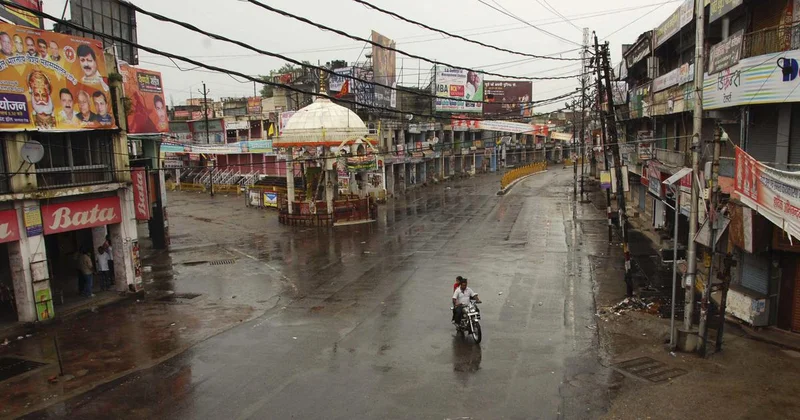
He starts – as many are wont to do – by drawing a continuum from the Partition riots to riots after the Babri Masjid demolition to the 2002 Gujarat riots to Muzaffarnagar in 2013. The trigger in this case was the sexual assault of a Muslim woman by Jat men, leading to retaliation by men from the victim’s community, followed by “kaha suni” between the communities, blowing up into communal “muthbhed”. Sacco comes to realise that in the “historical” conflict between Hindus and Muslims, it is not the inciting incident that matters but the consequence, the outcome, the political intrigues in the aftermath that precipitate a riot.
When he begins “retracing” the riots in the Muzaffarnagar district in 2013 in Uttar Pradesh, he visits the villages at the centre of the conflict, notebook and camera in hand and translator in tow. He collects state and bureaucratic evidence, and first-person accounts of local journalists, local leaders, eyewitnesses, perpetrators and survivors. What results is contradictory, differing and conflicting views on the same incident(s), which is where Sacco’s craft excels. He places contradictory testimonies side-by-side across the same page layout, grappling with the confusion on the page itself.
For instance, on one page, Sacco and his companion meet a lawyer who is verbally convincing them that no one died, brings out a sheet of paper dramatically to prove his point, and when Sacco and his companion actually read the document, it clearly states the person in question was pronounced dead. In another instance, local journalists tell Sacco that village Lisarh had the highest casualties in the district. The District Magistrate confirms that many Muslims died in the village and many more fled and are in camps. He added that measures were underway to rehabilitate the victims, especially since the Jats of the village were repenting and ready to welcome their neighbours back.
When Sacco reaches Lisarh, the Jat village chief denies point blank – “no one was harmed”. Everyone he speaks to in the village (mostly Jats) regurgitates the same story: outsiders went on a rampage in the village, no one was harmed, most Muslims had fled even before the violence began, others managed to escape later, no contact with them since. Sacco doggedly manages to track down Lisarh’s survivors in a camp, and pieces together an alternative version, full of violence, treachery and state apathy. In this entire sequence, Sacco juxtaposes contradictory testimony, tension between “officials”, official records and those who bear witness.
Slow journalism
While he leaves it to the reader to make what they may of the plural versions, the shifty gaze and facial expressions of the Jat villagers betray Sacco’s bias. When he revisits the site of the panchayat, he juxtaposes the quiet present against his visual imagination of the 30,000 to 40,000-strong throng that gathered on the day. The verbal caption notes that the “police stood back and let it happen”, which Sacco visualises by drawing the state authorities as indiscernible, swallowed up by the immense crowd.
He does this in most of his work, hinting at his own position within his journalistic enterprise. Sacco’s method of “slow journalism” counters the rapidity with which digital journalism works, with its culture of sensationalism and splintering facts into bytes that have the potential to go viral. The immense physical labour required to produce a graphic narrative itself acts as an intentional deceleration. By forcing the eye to dwell, scan and flip back and forth across a physical page, comics disrupt the instant gratification of post-truth media, restoring depth and context to events that have been flattened by headlines.
By overlapping past memories and present-day interviews within the same visual field, Sacco’s comics style maps out how memory is weaponised. The medium does not paper over the gaps or contradictions; it forces the reader to look at the fracture itself, treating truth not as a static historical fact, but as an ongoing, highly volatile battleground.
The pages of this narrative are crowded and stuffy, mirroring the dense population and spatial confinement of the marginalised communities and ghettos he witnesses. The panels are not self-contained boxes with borders, margins and gutters, but bleed almost entirely into the edges of the page. Individual characters rarely emerge as distinctive or memorable protagonists. The faces all seem to merge into each other, operating as caricature, to serve the purpose of providing oral testimony.
The angry mob on the cover page is in his typical black and white, with the red lettering gesturing towards bloodshed that often accompanies such mobs (almost as a ubiquitous decontextualised image from the subcontinent). This is replicated in all mob scenes in the narrative – the panchayats and the incidents of violence. What is, however, atypical in this narrative is Sacco’s departure from the more common crosshatch style that he uses to indicate shading and darkness. All faces in this narrative are coloured dark through the use of thin parallel lines. Just as crosshatching has served as a means of ethical engagement with the vulnerabilities of the subjects of his stories, the use of parallel lines here may serve as a visual shorthand not just to depict dark skin colour but also to represent the symbolic purpose of the lines drawn across communities.
Also read:
A visual evidence of human vulnerability
Nevertheless, Sacco is limited by the project of documenting sectarianism in the midst of Hindutva ascendancy, particularly to explain India’s fraught secularism in the present context. As it has been pointed out elsewhere, a great omission in his representation of Muzaffarnagar 2013 is the alleged mass rape of Muslim women. Journalist Neha Dixit documented the testimonies of survivors in at least two articles, freely available on the internet, highlighting the “missing” narrative of sexual violence during the riots.
Sacco does interview Simrana, whose rape and subsequent case against her Jat perpetrators purportedly precipitated the violence between the communities. He implores us to remember her later in the narrative, but depicts no other survivors or witnesses who tell him about sexual violence during the time of unrest. One wonders why Sacco chose to remain silent on this, when he did devote a few pages to explaining “Love Jihad” in the narrative. Did he not hear whispers when he visited the camps or read the work of journalists who were still working in the area when he visited?
At the end of the book, it seems like Sacco wanted to do a book on communal violence in India, and found the Muzaffarnagar riots to be a valuable starting point, especially because they preceded the rise of the current political party in power. The book’s central contention is that sectarian violence in modern India is not an isolated, anomalous incident, but a recurring structural mechanism where past grievances are continually excavated and weaponised to engineer future conflict.
In an age of incremental manipulation of truth, perception and shared reality, Sacco forces us to dwell within the visual evidence of human vulnerability. Rather than manufacturing a sanitised, monolithic narrative to satisfy a desire for easy ideological closure, Sacco leans into the inconclusiveness, scepticism, hearsay and contradictory claims of his testimony-gathering. He refuses to flatten the chaos of memory into propaganda, presenting truth not as a neat artefact, but as an ongoing political battleground. And his book becomes one too; its original Indian publisher and distributor, Penguin Random House, pulled out citing inaccurate representation of facts. Delhi-based Leftword Books will correct the “minor factual errors” and publish the Indian edition at an affordable price. Therefore, despite its limitations, Sacco’s book highlights that the fight to control the narrative of violence is as fierce and unyielding as the violence itself.
Amrita Singh is an Assistant Professor of English at Delhi University.
We welcome your comments at letters@scroll.in.