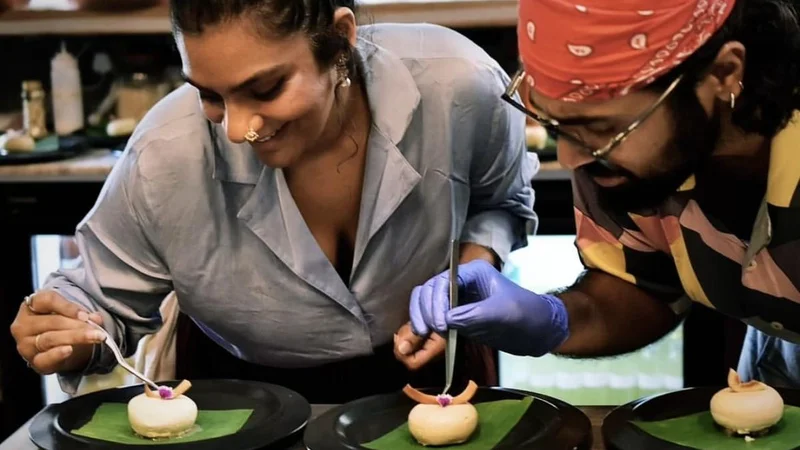
A red rice congee spiked with sambar spices and topped with avial vegetables. An olan, traditionally a ash gourd curry, reimagined as a consommé with grilled pineapple. A pradhaman recast as a toasted coconut cake drizzled with salted jaggery caramel. This was chef Arthi Rathore’s sadya at Indica, a pop up venue in Ghitorni near Gurugram, last year.
While on paper it barely resembles the meal it claims to have descended from, taste it, though, and the flavours are unmistakably unfamiliar, just rearranged into a shape the feast has never taken before.
For generations, the Onasadya has followed the same rules, 25 dishes, give or take, arranged in a fixed order on a banana leaf, cooked more or less the same way for years. It’s one of the few Indian feasts where the sequence matters as much as the food itself. That fixity is starting to crack with a handful of chefs now treating the sadya less as a ritual to preserve and more as a format to work with.
“We wanted to innovate while staying true to the ethics of the sadya. There’s been a lot of innovation globally around food from the north of India, and almost none from the south. I wanted to show that southern food can be reimagined too, because of the sheer power of flavour we have here,” says Arthi a MasterChef India Tamil participant.
The most radical version comes from co-founder and executive chef Sara Jacob Nair of Nair On Fire a chain of delivery kitchens in Mumbai, specialising in home-style Kerala cuisine.
Her onsadya keeps the traditional vegetarian spread intact and adds one non-vegetarian curry alongside a celebratory roast of either prawn, fish, chicken, mutton or buff, a nod to how Syrian Christian households in Kerala have always folded meat and seafood into their celebrations. It’s proved more popular than the original with over 60 percent of the her customers now choosing the non-vegetarian version.
Her superfood sadya is built around black rice, palm jaggery, jackfruit and moringa, ingredients Jacob sees not as trendy additions but as things Kerala cooking always relied on.
Her sadya on a thali turns the usual 20-30 dishes on a leaf into a course wise experience. “A Malayali doesn’t need instruction, you just mix everything on the leaf and eat. But for someone unfamiliar with the cuisine 25-30 dishes can be over whelming. This gives them an entry point,” says Sara . She’s firm this isn’t dilution. “I see it as creating more doors into tradition,” she adds.
Payasam made with Kashmiri plums
At OMO in Gurugram, the approach is far more conservative. Culinary director Chetna Chopra keeps the classic dishes intact, changing only a handful of ingredients such as a toran made with fiddlehead fern instead of beans, a pineapple pulissery and a payasam built around Kashmiri plums from a partner farm. Chetna says, “The idea is to create an unmistakably traditional sadya seen through our sourcing philosophy, rather than a contemporary reinterpretation.”
Sarada Krishnan, founder of South Side Mumbai a catering company in Mumbai and now also a supper club in Dubai, has cooked a traditional Onasadya every year for the past six years. This year she’s giving a modern spin to the dishes and presenting each dish as a tasting portion. The menu includes parippu vada with puli inji and chammandi, mooru curry balls and a pothichoru of Kerala red rice with sambar, avial, kalan, olan, thoran and manga curry, wrapped in banana leaf. For Sarada , the format is changing, not the food.
Jackfruit panna cotta
“The intention is to honour the essence of the sadya while presenting it in a way that allows every guest to appreciate each individual preparation,” she says. At Punjab Grill in Dubai, brand executive chef Sandeep Ail has found a middle ground. He keeps all the savoury dishes in their traditional forms and uses dessert for experimentation. His pal payasam becomes ice cream, served with ada pradhaman in a coconut shell, while jackfruit and tender coconut come together in a panna cotta. “The heart of a sadya lies in its iconic dishes like avial, olan, kalan and erissery, so we stayed true to those recipes,” says Sandeep . His approach is simple: preserve the familiar flavours and allow the unexpected to arrive at the end.
Not everyone is convinced any of this is necessary. Marina Balakrishnan, known for her traditional sadya, doesn’t see innovation here so much as interference. She says, “A sadya is already elevated. How do you elevate an avial by turning its sauce into a foam? The beauty of an avial is its rusticity, its earthiness, the way the vegetables are cut, the coarseness of coconut. There’s a reason it’s done that way.”
She recalls a nine-course sadya she once encountered where the rasam was served through a percolator. “If something is already perfect in colour, flavour and texture, why meddle with it? Ayurveda says if you want to understand the six rasas, go to a sadya on a banana leaf. If you serve it French style, is that still a sadya? The invention here was already made decades ago. You’re only tampering with what was there before,” she says.
Namboodaris from Kerala
Regi Mathew, who runs Kappa Chakka Kandhari in Chennai and Bengaluru and Chatti in New York, has been serving sadya in restaurants since 2007. This year Chatti is running its own Onasadya as well with 27 dishes and the same uncompromising format. Mathew brings namboodaris from Kerala to prepare the feast, keeping the customs around the meal as important as the food itself.
“A sadya has cultural nuances and rules. The namboodaris start with prayers before the flame is even lit. I could cook it myself, but when they make it, it becomes more than a meal. It’s our culture on a plate.” He points out that the number of dishes is always odd, twenty-five or twenty-seven, each with a fixed place on the leaf that dictates the order in which it’s eaten, building toward four payasams and ending in buttermilk for digestion. “It’s all very logical, very scientific. When you put hot rice on a banana leaf, the polyphenols in it rupture and add flavour to the food. You can’t get that with a plate. And you can’t really enjoy a sadya with a spoon and fork, it has to be eaten with your hand,” he insists.
The question is no longer whether the sadya can change. It is how much it can change before it becomes something else. Thankfully, the traditional sadya isn’t going anywhere. Neither are the chefs trying to reinterpret it.
This Onam, both are sharing the table.
Published - August 15, 2026 09:00 am IST