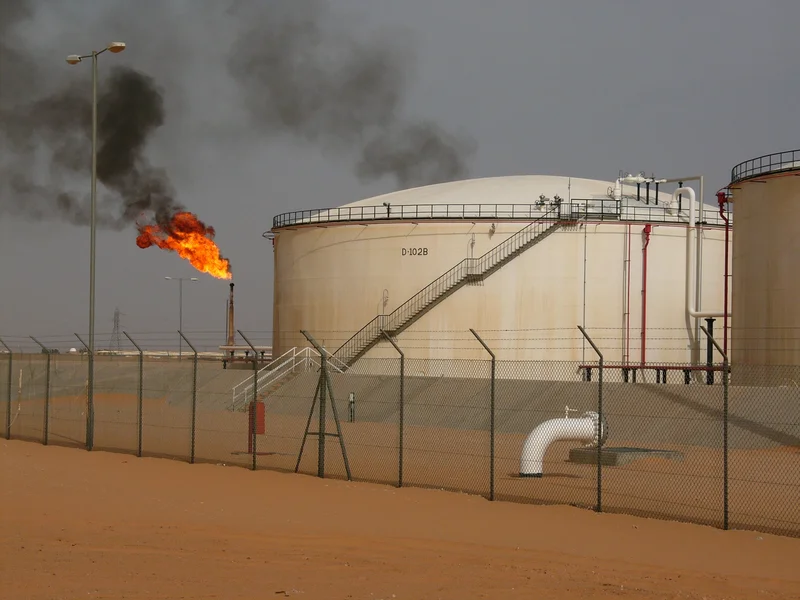
Drones Hit Libya’s Biggest Working Refinery as Oil Output Nears a 13-Year High
LIBYA · ENERGY
What happened at the Zawiya refinery
The strikes ran across three days. The National Oil Corporation counted three attacks over Sunday and Monday, and by Tuesday its tally had reached five.
The worst came on Monday, when a drone hit tank T402 at the depot operated by Brega Petroleum Marketing Company. It held about 4.5 million litres of petrol destined for the domestic market, caught fire and completely collapsed.
The blaze burned through the night and into Tuesday afternoon before it was brought under control. There were no casualties, and two engineers told Reuters the refinery itself was undamaged.
On Wednesday a further drone burned down an electrical substation in Zawiya, cutting power to areas south of the city.
Why the warning matters more than the fire
The physical damage was contained. The institutional signal was not.
The National Oil Corporation said that if the attacks continued it would be forced to declare force majeure and completely halt operations at the Zawiya refinery, to protect lives and the safety of the facilities. Force majeure is the legal instrument that releases a producer from its delivery obligations.
Zawiya is the sole source of fuel for greater Tripoli. A shutdown there is not an export statistic; it is petrol queues in the capital.
The National Oil Corporation declared a maximum emergency in the region. Prime Minister Abdulhamid Dbeibah called the use of drones against vital facilities an organised and dangerous act that would not go unanswered.
The recovery this threatens
Libya has spent two years rebuilding an industry that repeatedly collapsed after 2011. Output reached 1.44 million barrels a day in June, the highest since 2013, and the NOC chairman put it at about 1.4 million in early August.
Pre-war production was roughly 1.6 million barrels a day, and the stated target is 2 million by the early 2030s. The country holds Africa’s largest proven oil reserves.
International majors had begun to return, including in the country’s first licensing round since 2007. That is precisely the constituency an unclaimed drone campaign is most likely to deter.
Reserves are not the constraint in Libya, and they never have been. Security and institutional continuity are.
The part nobody can price
No group has claimed responsibility for any of the strikes. That is the most consequential detail in the story.
An attack with a known author can be negotiated with, deterred or sanctioned. An anonymous one cannot be modelled, which is why insurers and investment committees treat it so harshly.
The strikes coincide with rising tension between Dbeibah’s Tripoli government and armed groups in Zawiya itself. They also land while Libya’s central bank leadership is unsettled, a dispute that in 2024 sharply cut national oil output.
Libya’s energy revival is one strand of the wider competition for African resources that The Rio Times tracks in Africa: The New Scramble. It is also the clearest illustration of why that competition keeps stalling.
What to watch
The immediate question is whether the strikes resume and whether the NOC follows through on force majeure. That declaration, not the fires, is what would move oil markets.
The second is whether the licensing-round entrants keep committing capital. Signatures are cheap; final investment decisions are not.
The third is the central bank. Libya’s oil revenue disputes have historically been settled through control of the currency, not the fields.
For now the refinery is running, the fires are out and nobody has said who did it.
Frequently Asked Questions
What happened at Libya’s Zawiya refinery?
At least five drone strikes hit the Zawiya oil complex between 9 and 11 August 2026, and a petrol tank holding about 4.5 million litres caught fire and collapsed. A further strike knocked out an electrical substation in the city on 12 August.
Did the refinery stop working?
Not at the time. Engineers told Reuters the fires caused no damage to the refinery itself, but the National Oil Corporation warned it would declare force majeure and halt operations entirely if attacks continued.
Why does the Zawiya refinery matter?
It processes 120,000 barrels a day, making it Libya’s largest refinery still in operation, and it supplies fuel to greater Tripoli. It is connected to the Sharara field, which has a capacity of 300,000 barrels a day.
How much oil does Libya produce?
Libya produced 1.44 million barrels a day in June 2026, its highest level since 2013, according to the National Oil Corporation. The NOC chairman put output at about 1.4 million barrels a day in early August.
This article was produced by The Rio Times’ automated newsroom system. How we use AI · Report an error
LatAm Markets: Live Signals → — real-time movers, turnover leaders and FX across Latin America.