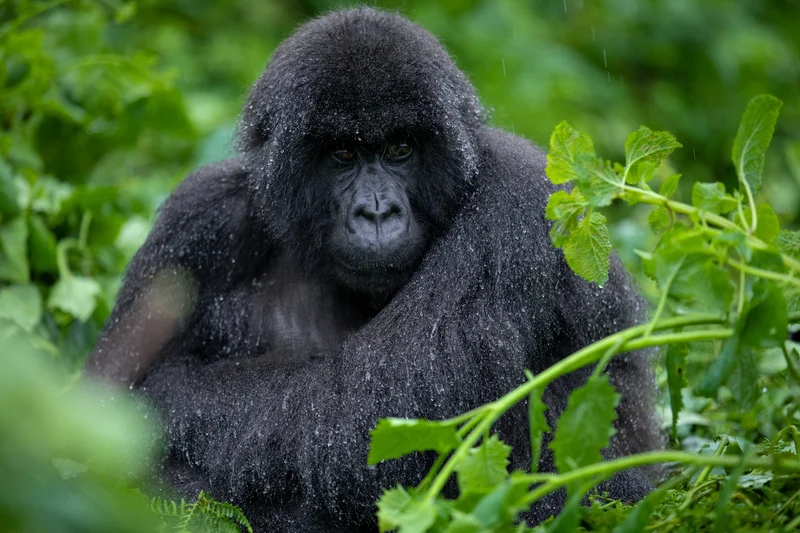
Rwanda Will Name 22 Baby Gorillas. Here Is What That Is Worth
RWANDA · CONSERVATION
What Kwita Izina 2026 involves
Twenty-two infants born over the past twelve months will be named at Kinigi, in Musanze District, on Friday 4 September. Namers are announced separately in the weeks beforehand.
This is the 21st edition, running under the theme “Conservation is Life: Sustaining the Future”. The number of editions and the number of infants happen to be close, which is a common source of confusion.
The week around it has become a programme in its own right. An exhibition runs at Kinigi from 28 August, with screenings, a namers’ trek, a community concert in Musanze and a closing concert in Kigali.
Since the ceremony became annual in 2005, 438 gorillas have been named. This year takes the running total to 460.
The economics behind the ceremony
A gorilla trekking permit in Rwanda costs US$1,500 per person per day. Ninety-six permits are issued daily, eight for each of twelve habituated groups, with a minimum visitor age of 15.
That is deliberately high-value, low-volume tourism. Rwanda has priced access so that a small number of visitors generate substantial revenue with limited disturbance to the animals.
Ten percent of permit revenue is channelled to communities around the park, funding schools, health centres and roads. There is also a compensation fund for farmers whose crops gorillas damage.
That last mechanism matters more than it sounds. Conservation fails where the animals are a cost to the people living beside them, and succeeds where they are an income.
Why the population is rising
Close to 1,100 mountain gorillas live in the wild, across the Virunga Massif shared by Rwanda, Uganda and the Democratic Republic of Congo, and the Bwindi ecosystem in Uganda.
They are, on the Rwanda Development Board’s account, the only great ape whose population continues to grow. Every other great ape is in decline.
The reversal took decades of ranger patrols, veterinary intervention, habituation and revenue sharing. It also took a tourism product expensive enough to pay for all of that.
The animals do not respect the borders, which makes the achievement a genuinely transboundary one, sustained across two countries with a difficult recent history and a third with an active conflict.
What Rwanda gets from it
Rwanda’s tourism sector earned a record US$685 million in 2025, up from US$647 million the previous year, on 1.49 million arrivals. Gorilla trekking is the anchor product.
Kwita Izina is also the country’s most effective piece of soft power. It draws conservationists, executives and celebrities to Musanze each year and puts Rwanda in front of an audience that no advertising budget would reach.
For expats and investors in the region, that visibility is part of the proposition. A country known internationally for gorillas is doing something few African economies have managed, which is to own a globally legible brand.
The model is studied elsewhere for exactly that reason, including by economies wrestling with how to make conservation pay without extraction.
What a baby gorilla is worth
The question sounds flippant and is not. At US$1,500 a permit and 96 permits a day, the arithmetic of habituated gorilla groups is the reason the species survived.
It is also the reason the naming ceremony is not merely sentimental. Each named infant is an asset in a portfolio that funds rangers, veterinary care and the community payments that keep the park politically viable.
The vulnerability is concentration. A single security incident, disease outbreak or border closure in the Virunga Massif reaches straight into Rwanda’s foreign-currency earnings.
Rwanda’s conservation economy sits inside a wider competition over how African natural assets are valued and by whom, a theme The Rio Times follows in Africa: The New Scramble.
Frequently Asked Questions
When is Kwita Izina 2026?
The naming ceremony takes place on Friday 4 September 2026 at Kinigi in Musanze District, Rwanda. It is the 21st edition, themed “Conservation is Life: Sustaining the Future”.
How many gorillas will be named?
Twenty-two mountain gorilla infants born over the past twelve months will be named. That brings the cumulative total since 2005 to 460.
How much does a Rwanda gorilla permit cost?
A gorilla trekking permit costs US$1,500 per person per day, with 96 permits issued daily and a minimum age of 15. Ten percent of permit revenue is channelled to surrounding communities.
How many mountain gorillas are left?
Close to 1,100 live in the wild across the Virunga Massif and the Bwindi ecosystem, according to the Rwanda Development Board. They are the only great ape whose population is still growing.
This article was produced by The Rio Times’ automated newsroom system. How we use AI · Report an error
LatAm Markets: Live Signals → — real-time movers, turnover leaders and FX across Latin America.