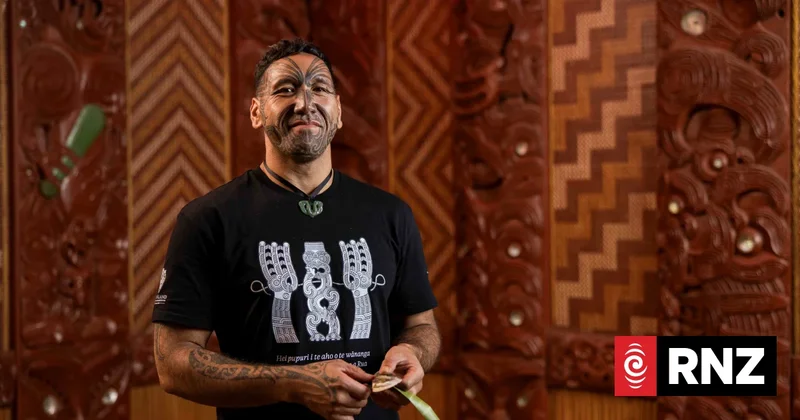
The New Zealand Māori Arts and Crafts Institute (NZMACI) is bringing the arts of the whare pora, or school of weaving, to the runway at New Zealand Fashion Week this year.
As part of Kāhui Collective's 2026 programme, six woven pieces created through a collaboration between designer Shona Tāwhiao and NZMACI's Te Rito o Rotowhio, National Weaving School, will feature in Tāwhiao's collection, The House of Harakeke, at Fashion Week on Thursday, 20 August.
NZMACI is also celebrating a milestone this year, being one hundred years since the Māori Arts and Crafts Act 1926 established schools dedicated to the study and practice of Māori arts and crafts.
Tumu (Head) of Te Rito o Rotowhio, Cori Marsters (Te Arawa, Te Whakatōhea), told RNZ he built a relationship with Tāwhiao and Kāhui Collective founder and designer Kiri Nathan, and through that were able to collaborate and bring more weavers into the fashion world.
"They're heavy hitters, Kiri Nathan and Shona Tāwhiao are internationally renowned, but I was probably surprised on how well we got on so quickly. I'd like to mihi to them for sort of letting me in to share space. If you were to ask me, Kiri, for Damehood."
Marsters said he hopes this is a beginning rather than a one-off.
"Although this might sound like a new thing, stepping into the fashion space, whare pora was always the house of fashion and textiles to our ancestors. So we're just an echo, I guess, of the past and just making sure that echo carries on."
Tāwhiao (Ngāi Te Rangi, Whakatōhea, Te Whānau-ā-Apanui) and Nathan (Ngāpuhi, Ngāti Hine, Ngāti Hauā, Ngāti Maru and Ngāti Paoa) spent a week-long wānanga with Marsters at the National Weaving School at Te Puia in Rotorua at the end of May.
The collaboration began with the harvesting of harakeke.
"We prepare our materials, and we let it dry, and it dries to a creamy white, and that's our canvas. You can dye green, but we prefer to dry it white. Once it's dried bone colour, we'll heat the pot up, get it boiling, rolling, and add a dye in it," Marsters said.
For this project, they used a commercial dye, and once the harakeke is added to the boiling water, it only takes five minutes until it's complete, he said.
"In the New Zealand Māori Arts and Crafts Institute, we are steeped in the traditional dyeing practice. We do contemporary dyes, but it's not our first port of call. So it's good to sort of bring our whare pora into that space again, because it's quite instant.
"With paru (mud), when you dye black with the paru, it takes a day. Two different worlds coming together in a good way."
"I'm hoping the collaboration will inspire the tauira to take their weaving skills further in their careers. The collection is called The House of Harakeke, which has a connection to Te Rito o Rotowhio and the harakeke that it's made from," Tāwhiao said.
For Tāwhiao, the relationship between fashion and Māori weaving also challenges conventional ideas about where high-end fashion is made.
"In Europe, designers have ateliers and staff who make their collections, and this is what it was like being at the New Zealand Māori Arts and Crafts Institute for me at Whare Pora Te Rito o Rotowhio."