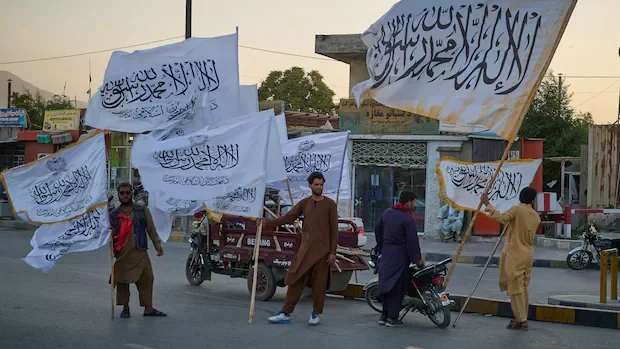
Five years after Kabul fell, the reckoning over Afghanistan is far from over
Women, the focus of much western social policy during the war, have suffered enormously
Five years ago Abdul Razaq Khan, a former translator and fixer for Canadian media during the Afghan war, received a late night text from one of journalists he had shepherded through the wild streets of Kandahar.
He had been trying to sleep in his Kabul apartment, having moved on following the Canadian withdrawal from Afghanistan to a job at the American aid agency USAID.
In the summer of 2021 the Taliban were advancing on Kabul.
"Are you OK?" the message read.
"It is like doomsday for us," Khan responded.
Half a decade later and now re-settled safely in Canada, Khan is still trying to wrap his head around not only the loss of his job, his home and his country, but all of the events that led to the swift collapse of the western-backed government.
"I had to leave my country. No one leaves their country happily."
LISTEN | Meet the underground learners:Khan is one of the lucky ones. He got out on foot, dashing across the Pakistani border just ahead of a spray of Taliban bullets, around the same time the Afghan capital fell to the hardline insurgents.
His work with the Canadian media — principally The Canadian Press (including myself), but also other organizations such as CTV News and Postmedia — had long painted a target on his back.
It was the same for many Afghans who worked not only for journalists, but also western military, diplomatic missions and aid organizations.
The Taliban victory not only displaced hundreds of thousands of Afghans, the reimposition of their strict, authoritarian fundamentalist regime has featured the systematic erasure of women from public life, the suppression of free media and dissent and the enforcement of rigid moral codes through a dedicated ministry.
What Afghan women have faced
Women — the focus of much western social policy during the war — have suffered enormously.
The Zan Times, an Afghan women's advocacy and human rights group, has extensively documented rising violence against women in the country, and the absence of justice.
It released a report this week with data that shows only one arrest is made by Taliban authorities out of every four women who are the victims of a sudden death, and the male suspects are usually released within hours of their capture.
"That shows that the Taliban have created a complete impunity for the crime of women being killed by their fathers, brothers and husbands," Zahra Nader, founder and editor in chief of Zan Times, told CBC News.
She said many cases are simply labelled as suicides.
"If you label the death of a woman, suicide, that means nobody will be [held] accountable for the crime of killing that woman."
Her organization utilized an extensive network of local journalists inside Afghanistan to gather the data and the evidence. Many of their findings contradict the official account of suicide and point to "women who have been beaten down by their husband or relatives."
Since the 2021 collapse, western countries have not been able to directly protect or enforce women's rights inside Afghanistan. Instead, their response has relied on diplomatic condemnation and targeted travel and financial sanctions.
WATCH | Remembering Afghanistan:## Pathways to resettlement
Many countries, however, did implement special humanitarian visa pathways and resettlement programs to evacuate and shelter high-risk Afghan female judges, activists, journalists and politicians.
But even those efforts have been found wanting.
Two organizations that spearheaded resettlement efforts across western countries released a report this week that assessed, in stark terms, how allied nations fared.
The analysis, entitled Allied Ledger, was written by Local Staff International and the U.S.-based AfghanEvac. It found that each country scrambled with both the evacuation and the eventual resettlement efforts.
There is no exact count of how many Afghans were hired by NATO forces, governments or aid agencies.
- Girls are banned from Afghan schools. Secret networks are teaching them anyway
- Canada won't let this Afghan refugee in from the U.S. His family worries the Taliban might kill him back home
According to Global Affairs Canada, over 60,000 vulnerable Afghans — interpreters and their families — were allowed into the country following the Taliban takeover in August 2021. The federal government initially pledged to bring in 40,000 people, a target it met and surpassed.
There are still more vulnerable people out there under the grip of the Taliban's harsh rule, said former Canadian combat commander, retired major-general Denis Thompson.
"As the Allied Ledger shows, Canada resettled 63,000 Afghans, and we should be proud of that," Thompson is quoted saying in a news release issued with the Allied Ledger report.
"But it left thousands of eligible people still vulnerable inside Afghanistan. To finish the job, we have to reopen the program that started this."
U.S. Democratic Senator Chris Coons, of Delaware, said the Allied Ledger report is significant because of the debt owed to those who risked their lives for American and NATO troops.
"The Allied Ledger is an accounting of which countries have kept their promise and which have not," Coons is quoted saying in the news release.
"There is more work for us to do to make sure we keep our promises in this most important and challenging chapter of our recent history."
With files from Nahlah Ayed