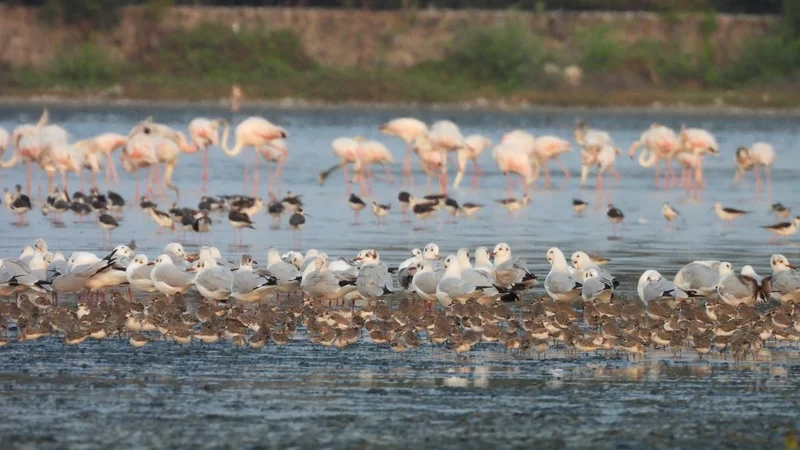
Water moves in two directions across the Nemmeli coastal wetland — freshwater flowing east from inland lakes and tanks, and seawater moving inland through two estuaries. Spread across more than 8,500 acres between Kelambakkam and Mamallapuram, the wetland is a meeting point of these two water systems, shaped by tides, rainfall and the seasons.
That landscape is now being reshaped into a freshwater reservoir. The first phase of Mamallan reservoir project covers 4,375 acres. A second phase is proposed for the remaining wetland.
The proposed reservoir will occupy a landscape marked by marshes, mudflats, shallow waters, salt pans and seasonal grasslands, spanning freshwater and brackish-water habitats. The wetland is also a seasonal stopover along the Central Asian Flyway, drawing migratory birds, while its waters support fish, prawns, crabs and other species that sustain fishing activity in the surrounding villages.
The wetland is also being documented from the ground up. Environmental groups and naturalists are recording its biodiversity through field surveys, documentaries, signature campaigns, rallies and a coffee-table book.
Nemmeli’s Last Tide, a documentary conceptualised by Deepak Venkatachalam of Suzhal Arivom, a grassroot level, volunteer-driven environmental education, research, and conservation group and produced by the Wetland Conservation Network, brings together voices from naturalists, scientists, maritime researchers, educators and fisherfolks to document what the wetland holds and what could be lost.
According to Deepak, making people see the landscape is central to conservation. “We try to break that barrier by bringing in people and increasing the footfall to these places,” he says, describing the need to reconnect people with nature through direct experience and visual storytelling. “The landscape has so much life. It is a very complex, intricate ecosystem. It cannot be recreated at any cost once it is depleted.”
That life is reflected in the numbers. Suzhal Arivom’s documentation records 232 species in the Nemmeli Wetland complex, with nearly 45,000 birds counted during the 2025–26 peak season. A count of 16,000 migratory ducks, spread across half-a-dozen species, was recorded.
The wetland is also an important node in the Central Asian Flyway, with 88 migratory species recorded.
The documentation extends beyond birds. In January 2026, Suzhal Arivom recorded a established colony of Burmann’s Sundew (Drosera burmannii) at five GPS-verified locations. The tiny carnivorous plant survives in acidic, nutrient-poor, seasonally waterlogged soils making its presence an indicator of relatively undisturbed wetland conditions.
A parallel effort has come from the Palluyir Trust, a group for Nature Education and Research, founded in 2021 by naturalists, through its coffee-table book Kovalam–Nemmeli Coastal Wetland: A Biodiversity Montage. Combining photographs with species information, the book records the wetland’s birds, insects, benthic life, mangroves and other flora. Crucially, it was printed and sent to bureaucrats, MLAs and government authorities, accompanied by letters highlighting the wetland’s ecological importance and concerns over the proposed reservoir. A digital version is also available on their official website.
The documentation also places these species within the wider wetland ecosystem, its mudflats, marshes, shallow waters and vegetation which provide feeding and breeding grounds for aquatic life and habitat for migratory birds. It also records the wetland’s links to fishing livelihoods and flood protection.
“The idea is we are trying as many strategies as possible to make people feel for that place and be moved by the life there,” Yuvan says. For him, the question is also whether a freshwater reservoir can ever be considered an “alternative” to this landscape. “A freshwater body does not belong by the beach,” he argues, pointing to the difference between inland reservoirs and tidal wetlands.
Fewer fish, less income
Fisherfolk from more than 16 villages depend on the Kovalam–Nemmeli wetlands, with nearly 7,000 families relying on its shallow waters to collect prawns, crabs, oysters and other species. Unlike mechanised fishers, they work largely by hand and foot, following Iral Thazhuvuthal, the traditional practice of catching prawns and fish by hand. The Paraval, as they locally call the coastal wetland, has 18 distinct habitats, with the Purattasi season (mid-September to mid-October) bringing the highest catch. During this period, a family can earn ₹1 lakh–₹3 lakh, an income that can sustain them through much of the year.
The proposed reservoir threatens this livelihood system. About 5,000 acres of the wetland is proposed to be converted into an impounded freshwater reservoir, with Phase I covering 65% Kazhuveli marshland and 35% Uppangazhi salt pans. Forfisherfolk who have depended on these waters for generations, the loss could mean shrinking incomes and a shift to unfamiliar and precarious work.
For Kovalam R. Narayanan, the impact of the Mamallan Reservoir Project can be measured in the distance between what fishing once earned his family and what it brings in today. A fisherman from Kovalam, Narayanan began fishing at 11 and has continued in the occupation for decades. The earnings have now dwindled considerably. Narayanan links the decline partly to what has happened to fishermen who once worked in the coastal wetlands. As access to the wetland has reduced with the progress of the reservoir project, he said, many of those fishermen have moved to the sea.
That has changed the arithmetic of fishing. “Earlier, there were around 500 fishermen fishing in the sea and another 500 depending on the wetlands. Now all 1,000 are going to the sea,” he said. More boats and more fishers are consequently chasing the same marine catch, he said, leaving each fisher with a smaller share.
“The wetlands earmarked for the project are not an empty expanse waiting to be developed. They are a living ecosystem supporting an intricate network of species and livelihoods” said Narayanan.
Link to the documentary https://tinyurl.com/NemmeliDoc
Palluyir Trust - @palluyirtrust.org
Published - August 15, 2026 01:37 pm IST