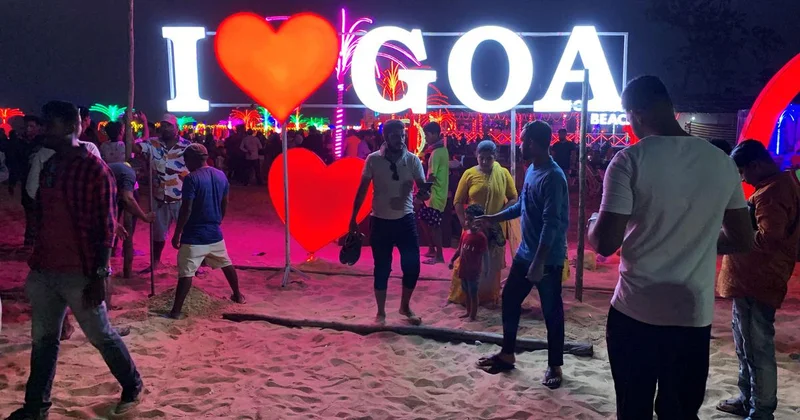
It is difficult to not romanticise Goa. Not the hyper-curated, exaggeratedly aestheticised party destination that lives in perpetual revelry on Instagram, or the casino capital that flashy billboards at the Dabolim airport promise, but the real deal. Small villages that awaken at daybreak. Old Portuguese houses with their red benches, often under the strict surveillance of a resident dog or two. The sound of the poder and the satisfaction of biting into the still-warm crust of a fresh poi. The energy of Mapusa market. The seven hundred and sixty-five distinct shades of green that form the landscape of monsoon months. The roiling July sea that humbles the most intrepid of tourists and adventurers. The inviting plates of ambotik and xacuti, and the sticky sweetness of dodol.
All this, if you are an outsider looking in. More, if you claim kinship with the land, the history, the culture. It is this liminality between longing and belonging that Shivranjana Rathore and Tino De Sa’s anthology of new writing from Goa captures.
Appetite: New Writing from Goa, appropriately titled, brings together short stories, poems, essays, memoir pieces, and one graphic narrative that collectively explore the complex terrain of desire, nostalgia, embodiment, historicity, anguish, horror, and uncensored, ungovernable joy. Posited as “a celebration of hunger – “literal, metaphorical, ancestral and imagined” by the editors, this selection is your non-romanticised, steeped-in-the-Goan-way-of-life, sharply incisive, wryly humorous, and sometimes eerily chilling introduction to a place that has always existed in our collective consciousness as a slice of paradise.
Appetite and desire
Gail Pinto’s “Eucharist”, set in a bleak albeit recognisable future, performs an etymological exercise, useful for the reader: “Appetite comes from ‘ad’ and ‘petere’. ‘To seek’, ‘to reach for’, ‘to beseech’. Not ‘to consume’. Not ‘to hunger’. Not ‘to yearn’. But ‘to seek’. It implies humility”. Pinto’s protagonist disagrees. Father Leonard Fernandes, struggling with loss of faith in a world that seems to have stepped away from religion, discovers an otherworldly chalice in his church and is forced to confront appetite as an atavistic desire, punishing and all-consuming.
Rachana Patni, in her delightful essay, “A Vegetarian Goan Wannabe Writes to Digest”, observes: “Appetite can be divine, and it can be inhuman. It can sometimes be an insatiable urge to consume.” That is the spectrum that the pieces in this anthology traverse.
In Sheela Jayawant’s “The Divide”, a young wife, unused to physical affection, discovers the joy in her own body even as she navigates the complexities of living in a shared space that allows for no privacy, no private space.
Shivranjana Rathore’s “Netheria” goes dark as it dives into the afterlife and the eternal human desire for visibility and dominance. Pragya Bhagat’s poem, “eulogy”, referencing EE Cummings at a slant, anchors itself in the desire for the self – for personhood – and the tussle between becoming and unbecoming.
Victor Rangel-Ribeiro and Veena Gomes-Patwardhan write of the desire to read, to consume books and the worlds contained within them. Salil Chaturvedi’s slyly subversive “To Paula (name changed) and Her Mum” locates desire physically, in the consumption of food and of bodily pleasure. And then there is the appetite for land- to own, to flip, to turn a profit from- a leitmotif that runs through these stories and essays.
“Outsiders” setting up home in the state, leaving their big city lives in search of something more meaningful, is a cultural phenomenon that continues to rile Goans. Tino de Sa’s “The Happy Hearts Beach Resort” takes an unflinching look at the North Indian obsession with owning “property” in Goa. The Hindi-speaking manager who refuses to learn the names of his employees, the businessmen who want to defraud a vulnerable old couple, and the dysfunctional married couple who blame everyone but themselves for their misery are eerily accurate portraits of the avaricious outsider who has no desire to assimilate.
“The Real Housewives of Assagao” employs delicious irony when its four successful women with their first-mover advantage of having bought villas in the trending, “upscale” village of Assagao, are put out by water-woes (a consequence of over-consumption by settlers like them), new laws that disallow private pools, and the sprouting of “villa chawls”, occupied by a sub-stratum of the middle-class, with its middle class aesthetics, blamed for destroying the “real Goan village life”.
Visiting holiday homes does not translate into easy access to the “susegad Goan life”, Michelle Mendonça Bambawale seems to say. Seema Mustafa, coming at it from the perspective of the visitor, the one who upends their life to move to Goa and falls irrevocably in love with it, puts it succinctly: “Susegad is not for the frenetic city-walas who have come here to holiday, where holiday means an endless party.” The tearing down of old houses in the name of modernisation, the indiscriminate felling of trees to create more real estate, the insistence on “global” cuisines, does not make for ease of acceptance. And yet, the desire to belong remains, as much in the essays of Rachana Patni, Seema Mustafa, and Mehru Jaffer, as in the sea-struck, world-weary (sometimes even North Indian) visitor who cannot get over the magic of the aforementioned 765 distinct shades of monsoon green.
The question of belonging
With belonging comes the concomitant factor of class identity. Who belongs is not just a question of domicile but, often, also of privilege. While the well-heeled from Delhi, Mumbai and Bangalore aspire to real estate, Lalita, in Ashlesha Athavale’s “Full”, aspires to a bathtub in the two-room set her family occupies in a Mumbai chawl. Working as a domestic labourer in a high-rise, Lalita desires upward mobility, a life of leisure, of lying in a warm tub, of wearing pink lipstick and irkal sarees, like her employers do. The materiality of her desire is adjacent to that of the “Real Housewives” but unlike them, Lalita never gets to buy her dreams. The waiters who work at the Happy Hearts Beach Resort all aspire to bigger things – one wants to speak English fluently, another wishes to take his mixing skills to a swanky bar, and a third wants to become a professional athlete. What happens instead is as predictable as it should be unnerving.
The unnamed wife in “The Divide” must somehow find intimacy and sexual fulfilment in the abject absence of privacy. In “Sorpotel”, an adoptive brother becomes the proverbial thorn in the side because of his unchartable origins. Access to ease needs to be purchased; the world remains bereft of parity, and class continues to raise its divisive head in paradise and elsewhere.
And what of the most primal appetite, food? Because food is not just desire but also material and cultural history; as political a choice as casting your vote is. Heta Pandit describes her essay, “An Appetite for Memories”, as a “story of the memory of food as milestones in a life’s journey.” Who can forget the taste of their favourite childhood treat, after all? Or the smell of spices roasting in a family kitchen. Pandit writes of the effect of food, its rootedness in love and nurture.
Rachana Patni makes a study of cultural practices, identifying the uniqueness of offering coconut oil to Our Lady of Milagres on her feast day. She also writes of her experimentation with food, calling into question the spectre of “authenticity” so viciously debated on internet fora and elsewhere. Hune Margulies asks similar questions of authenticity in “A Meditation on the Appetite for Goa”: “What institution gets to decide what an original and authentic cultural norm and content is? Who are the people behind these institutions who get to shape those norms and content?” The answer is deceptively simple. The marginalised are rarely represented in dominant local culture. The ruling class, the top rung of the caste hierarchy, those in control of the master narrative, decide what carries cultural value and what does not.
Ashok Hegde’s “Loss of Appetite”, centred in influencer culture, deconstructs the mythos of novelty in a constantly shifting food economy, harking back to the primitive ability of food to heal, to nourish, and to nurture, minus the bells and whistles of Instagram aesthetics.
The range of the 34 pieces that form this anthology is a treat for the reader’s appetite, for sure. “Sorpotel” is sensational in an almost Wilkie Collins way, with amplified family drama. Along with “Eucharist”, “Netheria”, and “Paying Guest”, it also leans into the meta genre of horror. Brian De Souza traces the fascinating history of philately in Goa and alongside, Edith Noronha Melo Furtado writes of the rich cultural traditions, a melange of Portuguese, French and Konkani influences.
Alisha Souza’s “I’ll Do It My Way!” is a provocatively funny and entirely too-relatable account of the marriage market where neighbours and acquaintances become more involved in marriage prospects than the individual themselves. The post-pandemic reliance on social media as the fount of information and the primary platform for human connection is amply evident in “Eucharist”, where the priest has a YouTube channel where he regularly uploads content because who has the time to go to church in person anymore. His is also a world, much like ours (and a bit like Orwell’s 1984), where all digital records are under surveillance and where “people are so chronically online, they forget social mores.”
“Loss of Appetite” details the same society, where fame and relevance are fickle and a newer trend, a younger influencer, is always waiting in the wings to become the new flavour of the season. The perspectives on Goa in this anthology are multifarious. Consumption is served to the reader on a platter. And yet, the one takeaway, more important than others, is what Rachana Patni offers: “Eat what you will. But let’s contain our appetite for Goa so that others may make stone soups of its red earth till eternity.”
Appetite: New Writing from Goa, edited by Shivranjana Rathore and Tino De Sa, Penguin India.
We welcome your comments at letters@scroll.in.