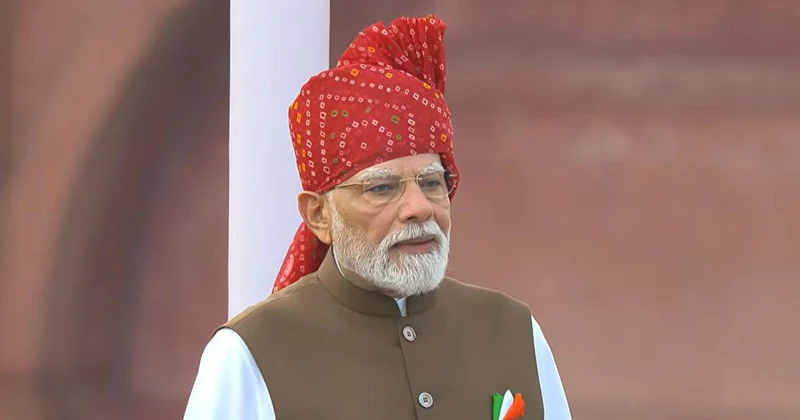
Prime Minister Narendra Modi on Saturday said that “dimagi Naxals”, or persons with “Naxal mentality”, are a threat to Indian society and called for them to be “found and isolated”.
Addressing the nation from the Red Fort on the 80th Independence Day, Modi alleged that persons with Maoist ideology had for years “established themselves in the corridors of power and influenced policy making, including as advisers on government committees”.
“In our jungles, we have been successful in weeding out Naxals with weapons,” he said. “But those with Naxal mentality are still around. They are threatening our society. We have to find and isolate these dimagi Naxals.”
He added: “The dimagi Naxals are waiting for an opportunity…they are trying to revive the paths of violence and anarchy and are making various attempts to drag society in the wrong direction.”
Modi said that the left-wing extremist violence had destroyed the future of lakhs of young persons and killed more than 3,500 police and security personnel. He added that his government had resolved to rid the country of Maoist violence when it came to power in 2014 and claimed that the movement was now “breathing its last”.
In 2025, the government’s anti-Maoist offensive saw several key Maoist leaders killed and others surrender. However, civil liberties groups and Opposition parties have questioned some of the killings, alleging that civilians were among those killed and that they amounted to “fake encounters”.
Free coaching, AI training for youth
Modi also used his Independence Day address to announce measures aimed at India’s youth, including free online coaching for competitive examinations and artificial intelligence training for 1 crore young persons over the next year.
The announcement came weeks after nationwide youth protests over alleged irregularities in competitive examinations led to Bharatiya Janata Party leader Dharmendra Pradhan stepping down as Union education minister.
Modi said that the government would create a network for free online coaching by bringing together digital public infrastructure, teachers and educators.
He said that the move was intended to ease the financial burden on poor and middle-class families, who spend thousands of crores of rupees on coaching.
“Every parent feels that if they do not send their child to a coaching centre, they are somehow falling behind or do not belong to a respectable family,” Modi said.
Modi said that India had added nearly 650 new universities in the past 10 to 12 years and that the number of medical seats had increased substantially since 2014.
Protests over alleged mismanagement of competitive examinations began on June 6 with a demonstration at Delhi’s Jantar Mantar demanding Pradhan’s resignation. The agitation intensified on July 20 when thousands joined the protests and police action against demonstrators marching towards Parliament left dozens injured.
The protests subsequently spread to other parts of the country, with Pradhan resigning as education minister on July 25.
Women reservation
Modi also appealed to political parties to support 33% reservation for women in Parliament and state assemblies.
“For one reason or another, in the political arena over the last 40 years, this dream had persistently fallen victim to political games and political battlegrounds,” he said.
He urged political opponents to support the move and “take credit for it”.
The 75-minute address was Modi’s shortest Independence Day speech in four years.
Written by Sara Varghese. Edited by Tanya Shrivastava.
We welcome your comments at letters@scroll.in.