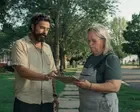
Going door to door in western Wisconsin, Bill Hogseth tells strangers about the seizures he has multiple times a week.
Hogseth, the co-executive director and lead organizer of the nonpartisan group GrassRoots Organizing Western Wisconsin (Groww), tells them about waking up in an ambulance, and the impact of the seizures on his ability to drive and work. Usually standing on their doorsteps, he asks to hear their stories too – about ambulance rides, hospital bills, broken bones.
Hogseth’s vulnerability encourages others to share. It’s a concept called “deep canvassing”, a long discussion, usually about 15-20 minutes, with a neighbor at their door about a political issue not tied to a specific candidate. It’s designed to assess a person’s support for a policy at the start of the conversation, then see if it changes by the end of it.
Open minds are key to Hogseth’s work in western Wisconsin’s third congressional district, where a heated season is ramping up as Democrats are trying to unseat Republican representative Derrick Van Orden. A host of national Republican figures have visited the area in recent months, including Trump himself, who came to Chippewa Falls in June to talk about farming, a sign of the area’s prominence on the electoral map.
Healthcare has become a critical issue in the state, and system failures have become a political liability. Democrats are reminding voters that Van Orden voted for Trump’s so-called big beautiful bill, which will deliver $1tn in healthcare cuts over the next decade, starting in January. Two hospitals in western Wisconsin closed permanently in 2024, and researchers have identified others at risk of closure or service reductions.
Rebecca Cooke, who won the Democratic primary to face Van Orden in November, lists “healing our healthcare system” first on her website’s priorities list. Cooke told the Guardian earlier this summer that she not only frequently heard about healthcare concerns from voters, but shared them herself.
“I’ve actually canceled my own insurance through the ACA because it’s increased so much and I can’t afford it,” Cooke said in June. “There’s a lot of people that I know that are doing the same.”
The people who open their doors to Hogseth and his colleagues often share stories of how the US healthcare system has failed them.
There’s the man who drove himself to the hospital while passing a kidney stone to avoid a costly ambulance ride and the mom who wants to stay home with her kids but needs her job to cover health insurance. There’s the cancer care, the surgeries, the peculiarities of medical billing, the lapses in insurance coverage, the people who see the state’s Medicaid program as a lifeline for their family members.
Groww is conducting these deep canvasses throughout western Wisconsin on healthcare, specifically on potentially expanding access to BadgerCare. That’s the state’s Medicaid program, which provides insurance for low-income families. The group wants to have 4,000 conversations in the northern part of the third congressional district from May to November, Hogseth said. About 40 trained deep canvassers are out in the field three times a week throughout the region.
In addition to the congressional race, Wisconsin voters in November will also decide on key state legislative races and an open governor’s race that could make expanding BadgerCare a reality. Estimates show more than 276,000 Wisconsinites could lose healthcare coverage as the cuts roll out. Wisconsin is also one of 10 states that did not expand Medicaid under the Affordable Care Act (ACA).
“Regardless of who people vote for, [the issue of healthcare] is cutting into people’s anger,” Hogseth said.
At the doors in western Wisconsin’s small towns, people show a willingness to slow down and talk, even to a stranger. Most say they don’t think anyone in Washington understands their struggles with healthcare. By the end of the conversations, many people move up in support of expanding access to BadgerCare. In some instances, they say they don’t support the issue at all, then fully support it and want to get involved by the end.
Studies have shown these deep canvasses can lead to reduced prejudice and decreased exclusionary attitudes. One study, commissioned by a group called People’s Action in 2020, showed that the method can change voting behavior.
At a July protest in Taylor county, one of the reddest areas of the state, a decommissioned ambulance and gurney sat outside a picnic shelter right next to a Republican picnic where Tom Tiffany, a Republican congressman who is the state’s gubernatorial nominee, was set to speak.
The Medford, Wisconsin, protest, led by Taylor county’s Indivisible chapter and attended by allies from other parts of western Wisconsin, was so close to the Republican picnic that attendees of both could look each other in the eyes. When protesters chanted against Tiffany’s support for Trump’s budget bill and its healthcare cuts, they were a few dozen feet away from Tiffany himself. When someone at the protest mentioned Tiffany’s support for healthcare cuts, some at the Republican picnic cheered.
The county is outside the competitive third district, but similar protests have plagued Van Orden’s events and Wisconsin visits from prominent Republicans, including JD Vance.
Van Orden has countered the protests by claiming the upcoming cuts, which leave people uninsured partly through work requirements and other barriers, are not cuts at all. “There has been no cuts to Medicare and Medicaid. There’s not going to be cuts to Medicare and Medicaid,” Van Orden said. “What’s going to end, though, is the rampant waste, fraud and abuse present.”
Sally Rasmussen, part of the Taylor county group, said participants came together during this year’s winter mostly in response to the immigration enforcement surge in Minneapolis, a few hours away. The group holds a weekly protest. They sometimes get middle fingers and obscenities, she said, but the balance has felt tipped since the start of the war with Iran.
“Now we get more positives than negatives,” she said. “And I think that a lot of people that want to be Republican just say, I can’t. It was a step too far for them.”
At these ambulance protests, people share their experiences of getting cut off from Medicaid or seeing their premiums rise, and healthcare providers talk about the crises they’re seeing at work.
“People also are not realizing that the cuts to Medicare and Medicaid are going to eventually affect them, even if they’re not on Medicare and Medicaid,” said Teresa Kriese, a voter who lives in the third congressional district and who has spoken about her experience with a cancer clinical trial. “Because hospitals and clinics do a lot of treatments that are funded by those coverages, and if they lose that money, they’re not going to be able to survive and they’re going to close.”
Kriese, 61, has lung cancer that’s spread to her brain, and there’s no approved treatment option. But she has stayed alive beyond her doctor’s initial predictions due to a clinical trial in Chicago, which was defunded in January 2024. The drug she takes is still available, so she’s still able to take it – for now.
“It’s the only thing that’s kept me alive for the past three years,” she said of the trial.
If she loses access to the drug, she will have to seek out another trial in a scarcer environment as Trump administration cuts to scientific research have disrupted clinical trials. Kriese felt a responsibility to share the plight of people in clinical trials, so she spoke at the Eau Claire rally against the healthcare cuts.
“Clinical trials are there for everybody,” she said. “It’s not just cancer that clinical trials work for. Every single drug that you take, over-the-counter or prescription, at some point was in a clinical trial. You don’t get drugs for any other condition without clinical trials. So if we’re not funding them, that to me says this entire administration doesn’t care if we live or die.”
Mark Steigerwald, a 54-year-old colon cancer survivor from Eau Claire, saw his monthly health insurance premiums nearly triple this year after Congress allowed Covid-era subsidies to run out. For the small-business owner and his wife, the monthly cost is now more than $2,700.
Steigerwald recently spoke publicly about his experience at a similar Eau Claire rally against the healthcare cuts. He felt it was time to speak up because he felt “we’re crossing some lines here that we shouldn’t be”.
He’s started working more hours to cover the price hike. He called private insurers to see if he could get a better price, but none would cover him due to his pre-existing condition, leaving him with the ACA marketplace. His current plan has a $13,000 deductible for him and his wife.
“If you’ve ever had an illness like cancer, you’ll never be without health insurance,” he said. “That illness cost over $1m to deal with, and that was a good outcome.”
A political independent, Steigerwald ranks healthcare among his top three issues when casting his vote this year. Van Orden voted to extend the subsidies, he acknowledged, but the US Senate has not taken up a vote on the extension.
While the Democrats fit more with his values now, he thinks they’re struggling to come up with a platform. He’d love to see a groundswell of independents challenge the two-party system.
“They’ve both been around for all this time,” he said of the Democrats and Republicans. “And all these problems are still around, and they won’t face them. Almost everybody’s responsible who’s ever been in power before.
“I just want to see better responsibility for humanity.”
Elsewhere in the third congressional district, deep canvassers hit the doors in Menomonie, a politically mixed town of about 17,000, where most people readily agreed to talk. One older woman said people in Washington don’t know what life is like for everyday people like her. “They don’t shop for their own groceries,” she said. A man at a different house pointed out that he sees health insurance company logos on Nascar racecars.
Groww filtered out strong Democrats and strong Republicans, seeking to talk to people in the political middle, Hogseth said.
The script helps show why decisions made by Congress are personally relevant to the people at the doors. Canvassers also invite locals to a summit on the topic, hoping to find people interested in organizing together long term.
People don’t always move up in support for expanding BadgerCare; canvassers said they sometimes talk to people who start with zero support for expanding BadgerCare and stay there at the end. Some mention concerns over fraud in the system or believe people are taking advantage of it.
Even in those tough conversations, canvassers feel they’ve planted a seed or found some places for common ground. One canvasser said the conversations renewed her hope in humanity. Another said the conversations show that people have contradictions in their views, a sign they can change their minds.
“There’s a lot of people who are with us on the issue, who are either hopeless or cynical,” Hogseth said. “And they’re like, the only way things will change is if there’s a major crisis or if I move to another country. Part of what I think we need to break through with people on is their cynicism and hopelessness.”