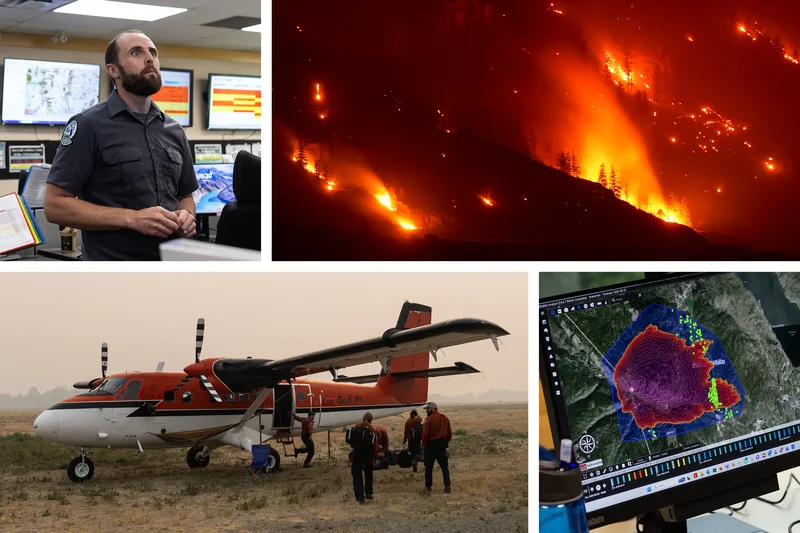
As fire exploded across the mountainsides toward Summerland, B.C., Dale Bojahra and Brad Litke could see the tide of the battle was turning. Even the air tankers and helicopters dumping water on the flames couldn’t slow it down.
Homes were ablaze. Roads were cut off. People were trapped. Helicopter pilots had already abandoned their buckets to start flying rescue missions, but it wasn’t enough. They needed more aircraft.
Mr. Litke made the only decision he could. He called the incident commander on another major fire in the province, searching for any aircraft they could spare. “I need all the medium helicopters you have,” he said. “Send everything.”
Bald Range wildfire
Satellite view at 12:39 p.m. on Aug. 7
Fire perimeter,
as of Aug. 13
5 km
Fire reported
at 4:29 p.m.
Summerland
B.C.
THE GLOBE AND MAIL, SOURCE: BC WILDFIRE SERVICE;
PLANET LABS
Bald Range wildfire
Satellite view at 12:39 p.m. on Aug. 7
5 km
Fire perimeter,
as of Aug. 13
Fire reported
at 4:29 p.m.
Summerland
B.C.
THE GLOBE AND MAIL, SOURCE: BC WILDFIRE SERVICE; PLANET LABS
Bald Range wildfire
Satellite view at 12:39 p.m. on Aug. 7
5 km
Fire perimeter,
as of Aug. 13
Fire reported
at 4:29 p.m.
Summerland
B.C.
THE GLOBE AND MAIL, SOURCE: BC WILDFIRE SERVICE; PLANET LABS
As the Bald Range wildfire erupted on Friday, Aug. 7, The Globe and Mail had exclusive access to the provincial wildfire service’s Regional Wildfire Coordination Centre in Kamloops, B.C., seeing firsthand how the system responded to one of the most aggressive and damaging wildfires in recent years.
After voracious early growth that night, it would get to more than 19,000 hectares in size. A week later, officials are still unable to tally the total devastation.
This is the nerve centre for detecting and fighting new fires across the province’s fire-prone southern interior, which stretches from Blue River in the north to the U.S. border in the south, and from Bridge River in the west to the Monashee Mountains in the east. More than seven million hectares.
Mr. Bojahra and Mr. Litke are the hub’s co-ordinating officers. Alongside their colleagues, they are responsible for ingesting a mountain of data – weather forecasts, lightning strikes, fire behaviour modelling, reports and photos from police and the public – and deploying firefighting resources where they’re needed most, often under incredible time pressure.
They have to be masterful communicators, co-ordinating on the fly with local politicians, regional governments, First Nations, provincial ministries, the RCMP and others. With their counterparts at five other centres and the provincial headquarters in Kamloops, they steer B.C.’s wildland firefighting machine: its 1,000 front-line firefighters, hundreds of contractors, dozens of air tankers, reconnaissance planes, helicopters, heavy equipment and structure protection teams.
They are the experts who tell communities when it’s time to flee, making recommendations that empower local governments to issue evacuation orders.
And over the course of 12 agonizing hours last week, they faced a critical test.
At first, it was just a blip on Mike Scharf’s computer screen.
At 4:29 p.m., a new purple icon popped up, indicating a public report about a potential fire for Mr. Scharf to investigate and triage, the latest in a long summer’s worth of similar notifications coming into the Kamloops fire centre.
In the space of mere hours, what would become known as the Bald Range wildfire exploded with such ferocity that it left hardened veterans speechless and more than 12,000 people fleeing for their lives, some of them through walls of flame.
The fire may not have started until late afternoon, but the conditions for its explosive growth had been obvious for days.
Earlier that Friday, at 9 a.m., staff delivering a daily weather report described wildfire fuel conditions across the region as the driest ever documented. “Expect widespread cross-over conditions,” the forecaster said, describing weather that can make for uncontrollable fire growth.
There was one paradoxical saving grace that morning: A thick pall of smoke and haze hung over much of the southern interior as fires to the west continued to burn. It was so dense it was blocking the sun’s radiation, moderating surface temperatures and essentially smothering potential new fires, at least for the moment.
As the weather report came in, Mr. Bojahra, whose imposing presence belies a gentle voice, sat at his desk in a small room overlooking a parking lot beside the Kamloops airport.
Balloons floated over his shoulder, and a banner was stretched across a window behind him. He’d recently celebrated his 50th birthday, but had no time to take down the decorations. A few brave souls were still sneaking bites of leftover cake in the fire centre fridge.
Beside him was Mr. Litke, a veteran firefighter with swept-back hair, a greying beard and a cellphone with a ringtone that sounds like the rumble of a motorcycle engine. Together, they have more than 60 years of experience in wildfire management.
Outside the co-ordinators’ office is a room full of cubicles where operations experts like Mr. Scharf sit, along with about a dozen dispatchers and other staff, each with their own suite of monitors. They maintain near-constant radio contact with firefighting crews on the ground.
The walls around them are festooned with yet more screens, showing maps of fires, planes and crews across the Kamloops zone and the entire province.
Air tankers and water skimmers sit parked on the tarmac outside, waiting to be called into action.
The morning was relatively quiet, and Mr. Bojahra and Mr. Litke spent it focused on the Riley Creek wildfire. That fire had made a significant run downhill the previous night, threatening the town of Lillooet, a little more than 100 kilometres to the west. But by midafternoon, things across the board were heating up elsewhere.
While smoke in the Kamloops zone was still choking the area, skies across the southern part of the Okanagan Valley were clearing. Long-standing fires began to wake up as temperatures climbed. An e-bike caught fire on a road just east of Penticton, but local firefighters were able to get it contained quickly.
The atmosphere in the room began to tighten.
Then the blip on Mr. Scharf’s screen. Someone was reporting a fire next to a road in Okanagan wine country that connected Summerland to Princeton. The report did not include any photos, so for the moment, Mr. Scharf and the others had no way of knowing exactly what the fire was doing.
But they leapt into action. They knew the Summerland-Princeton road might have to be closed, which meant co-ordinating with the Ministry of Transportation. There were also two recreation sites in the area, and lots of campers who might need help getting out.
They ordered two heavy-lift bucket helicopters to the fire immediately. Air tankers were not far behind them.
“We may need to alert Faulder,” Mr. Bojahra said, referring to the small farming community along Meadow Valley, just west of Summerland. Purple notifications were popping up on staff screens. More reports were coming in.
At around 5 p.m., Summerland resident Brandon Bishop had just arrived home from work when his wife, Alora Bishop, sent him a Facebook post about a nearby fire.
The framer hopped back in his truck to investigate, quickly locating the flames about seven kilometres away, along with BC Wildfire Service personnel who told him the wind was pushing the fire toward town.
Mr. Bishop phoned his wife and told her to start packing.
“‘I think we’re going to be leaving here pretty quick,’” he would later recall telling her.
As they gathered their things, a wildfire officer was sending back the first pictures from a helicopter above the fire. A large column of white, grey and dark copper smoke was already spiralling upward.
Here, the sky was clear and blue: The protective layer of smoke over Summerland had lifted. Feeding on the fresh air and winds, the fire had taken off with ferocious speed. Within a half hour of the first report, trees were already torching.
At the co-ordination centre, the photo gave Mr. Litke an idea. Maybe nearby parattack firefighters, who use parachutes to deploy quickly, could get to the fire while it was still small enough that they might be able to catch it. He asked them to try.
The team immediately began gearing up, and they huddled next to their plane near the runway outside, scanning fire reports on their phones and checking the BC Wildfire Service’s mobile mapping app, preparing their tactics once they hit the ground.
But the sky in the Thompson River valley at Kamloops was still choked with smoke. It hung too low for the jump ship aircraft’s pilot to take off. The parattack firefighters were grounded. A whole squadron of water-skimmer planes and several large tankers were also sitting on the tarmac, unable to see far enough to safely take off.
“You can’t fight mother nature,” quipped a chopper pilot standing nearby, glaring at the sky.
Near Summerland, word was spreading.
Just after 5 p.m., baker Kyla Gaudiuso was driving home to Faulder from Penticton when her son phoned about the fire, having been told about it by a firefighter friend.
Contractor Joe Wagner, another Faulder resident, was also heading home when his wife phoned around 5:15 p.m. to tell him that someone had knocked on their door, warning of a fast-approaching fire.
As the minutes ticked by, other locals began posting in online community forums, first reports of smoke, then fire, then flurries of requests and offers to help move animals.
Fear was setting in.** **
At 6:07 p.m., pilots above the wildfire radioed in to the co-ordination centre estimating the size of the nascent blaze at 400 hectares.
“Surely that’s not this fire,” one person in the co-ordination centre said under their breath. It couldn’t be. That kind of rapid fire growth is – or at least used to be – almost unheard of.
By now, at least 200 structures were already at risk, strung along two valleys running north-south between the fire and Okanagan Lake: Meadow Valley and Garnet Valley.
Growth projection modelling displayed on computer screens in the co-ordination centre suggested the fire would reach Garnet Valley and the outskirts of Summerland by 10:30 a.m. the next morning.
The models draw on huge fire science datasets tracking everything from forest and fuel moisture, to drought codes, weather and past fire behaviour. Using advanced machine learning, they are designed to predict how far and how fast a fire would go if it were left to burn on its own, with no attempt to suppress it. This gives firefighters a picture of what the fire naturally wants to do, and shows them a potential worst-case scenario. It also helps co-ordination officers like Mr. Bojahra and Mr. Litke know when to recommend evacuation alerts and orders.
But even the fire service’s most sophisticated modelling would disastrously underestimate how fast and far the Bald Range fire would spread, underscoring yet again the challenges in predicting what modern climate-change-fuelled wildfires are now capable of.
The evacuation alert Mr. Bojahra had been preparing for local officials in Faulder quickly became a recommended order.
Firefighters on the ground called for air-tanker support. But with fire behaviour already so extreme, dropping water would be like spitting on a campfire.
Instead the tankers would fly to paint houses, coating them with bright red fire retardant and – hopefully – give the structures a better chance of survival when the fire inevitably rolled through.
Ms. Gaudiuso, the baker, had arrived home not long before to find a scene of “pandemonium.” The strength of the wildfire was causing strong winds that caused the towering pine trees on her property to sway back and forth, illuminated by a creepy, orange glow from encroaching flames.
Her husband rushed to video record the inside of their home for insurance purposes as emergency workers shouted at them to leave. They still don’t know if the house survived.
Mr. Wagner, the contractor, had arrived home to find flames licking at the back of the property. As he got out of his work van, an air tanker roared directly overhead, dropping fire retardant, splattering him in red.
Mr. Wagner and his wife scrambled to collect their dog, three cats and a folder of important documents.
Within 10 minutes, police pulled up and said they had to leave now. A half kilometre away down the hill, their eldest son and his wife, who had just put a pot pie in the oven for dinner, scrambled to gather their belongings at the home they had just purchased months earlier.
Both Wagner families would learn later from videos shared online that their homes were gone.
As Mr. Bojahra and Mr. Litke focused on addressing the Summerland fire, Jeff Dunne scanned a larger digital map of the region on a wall in the dispatch area.
As fire centre manager, it’s Mr. Dunne’s job to oversee the response to initial wildfire responses, but also to watch the rest of the board for other growing threats.
And there were some. Two car fires had been reported on the Coquihalla Highway’s high mountain passes. Structural firefighters from Merritt were responding, but if those fires reached into heavy timber next to the highway, they could risk severing the vital artery to B.C.’s Lower Mainland.
At 6:30 p.m., more photos of the Bald Range fire were rolling in from the public on the BC Wildfire Service’s mapping app as Summerland residents saw the ominous column looming over their town.
The clear air and blue skies were a double-edged sword, allowing aircraft to fly, but also giving the fire more oxygen to burn. Winds that had pushed the smoke out of the valley earlier that morning now turned the juvenile fire into a blow torch.
The Bald Range fire was already throwing spot fires more than half a kilometre ahead of its flaming front.
It was barely two hours old.
Staff at the fire centre had seen this kind of behaviour before, and knew its terrifying consequences. In 2023, a wildfire exploded out of the McDougall Creek drainage area west of West Kelowna and within hours, it threw burning debris clear across Okanagan Lake, starting spot fires more than 2.5 kilometres away. Almost 200 homes were lost in that blaze.
“We’re going to lose structures tonight,” Mr. Dunne said. “I don’t see how we get out of this without it.”
At least nine helicopters were now fighting the fire, as well as tankers and other aircraft, and ground crews were doing what they could on foot. Initial attack crews and structure protection teams had been prepositioned to the southern Okanagan valley days earlier, allowing them to respond rapidly, but even that hadn’t been enough.
They were throwing everything they had at the fire, and it was having no discernible effect. Crews began to focus on helping with tactical evacuations, trying to get as many people out of harm’s way as fast as they could.
Despite the crushing pressure they were under, no one in the co-ordination centre lost their cool. No one shouted. They just kept working their phones and computer screens. Mr. Dunne fuelled himself on frequent cups of coffee, and handfuls of licorice from a large basket set out on a table.
Mr. Bojahra hardly left his chair or took off his headset, going from video call to video call co-ordinating with the municipal government, the regional district, the ministry of transportation, the RCMP, search-and-rescue teams and more.
The municipality had started issuing evacuation alerts in outlying areas of Summerland, and some residents decided to start preparing to leave voluntarily.
Mr. Bishop, the framer, and his wife quickly loaded their most precious cargo into two pickup trucks: their eight-week-old daughter, the baby’s grandparents, two dogs, a cat, five reptiles, some clothes and small valuables.
At 6:36 p.m., the situation was getting dire, and the rolling evacuation alerts and orders delivered to residents via e-mail, social media and knocking on doors just couldn’t keep up. Officials decided to broadcast an intrusive alert, the kind of that forces its way to people’s phone screens with a jarring alarm.
Lineups began forming at gas stations.
As residents began to flee with more urgency, dispatchers learned the fire was burning on both sides of Fish Lake Road, north of Summerland, nearly eight kilometres from where it had started.
At 6:42 p.m., a report came in from a panicked resident who described driving through a wall of flames, and spoke of a possible medical emergency.
Details were sketchy: Did the person have the medical emergency themselves? Was it someone they’d encountered but had to leave behind? Operators tried to get the caller back on the phone, while Mr. Litke ordered a helicopter to investigate.
“Launch the R.O. out of Merritt for an SAR mission,” he said, assigning a wildfire response officer to a search-and-rescue operation.
Twelve minutes later, another report: A group of RCMP officers had been conducting evacuations, going house-to-house along Fish Lake Road. But they were being pushed back by the growing fire.
According to the report, a forestry worker who had been with the police officers and claimed to know the area had decided to press on alone, trying to rescue more people. He planned to push north and find a large clearing to shelter in if needed. But police weren’t convinced he would succeed. And staff at the fire centre worried he, too, would wind up needing rescue.
The fire was also growing south of the Summerland-Princeton road where the flames had first been spotted. The nearby McNulty forest-service road was overcome by flames, leaving more people cut off.
At 7:02 p.m., yet another report. A woman who lived on Bathville Road, near where the fire had started, was afraid that she and her neighbours were trapped. Mr. Litke called her back, explaining where the fire was and directing her to gather as many people as she could to a rally point for helicopters to pick them up.
They weren’t alone. Another group of people in Meadow Valley were also trapped. Fire behaviour was now so extreme that helicopter bucketing was virtually useless against the flames and people’s lives were at risk. The call went out for more aircraft.
By 7:23 p.m., the fire was burning at an intensity that hit the top of the scales that measure fire behaviour – a five or six on a six-point ranking. It had already reached at least 5,000 hectares, and was growing more than 10 times faster than the McDougall Creek fire that had devastated West Kelowna three years earlier.
Understanding the size of a fire in the chaos of battle is a challenge under ideal conditions. To be accurate, pilots have to fly its entire perimeter, or firefighters have to walk it. In Summerland, there was no time, so pilots eyeballed it as best they could and relayed back estimates.
The fire’s enormous growth was so unusual it was only confirmed days later. In the moment, obscured by its towering smoke column, no one knew how truly monstrous the fire had become.
At the three-hour mark, 7:30 p.m., a fresh enemy entered the field as Mr. Dunne stared at the map. Lightning strikes were rolling across the Alberta border and into the northernmost part of the region. As the fire centre raced to respond to the Bald Range fire, Mr. Dunne now had to worry about new fires that could further strain his resources.
At around the same time, an evacuation alert was issued for homes on the western hillsides overlooking Summerland, more than four kilometres farther than modelling had predicted the fire could reach.
Winds were becoming dangerously unstable. The airspace over the fire was crowded with aircraft, and tanker pilots struggled to keep their planes level in the turbulence. They would soon be forced to stop flying all together.
As evening approached, the situation was growing desperate. Homes were already burning. Dozens of people were still trapped. Darkness was closing in, and 18 helicopter pilots were racing an unforgiving clock to get them out.
Transport Canada strictly regulates how many hours pilots can fly in a day, and aside from a handful of night-vision-equipped helicopters, no one could fly at night. Yet one by one, pilots began calling their dispatchers, requesting extensions to their duty days, hoping to keep flying, keep trying to rescue people.
Protocol demanded that each request get individual sign-off. But they came in so fast that Mr. Bojahra gave blanket approval to keep everyone in the air as long as possible.
“Got it,” a dispatcher in the operations centre said. Any pilot who asks, tell them they’re approved to keep going, “as long as we’re not breaking laws.”
At 8 p.m., Mr. Litke was back on the phone with another anxious caller, this time someone worried about a kids’ camp in the mountains outside of Summerland.
He assured her that while the road out was compromised, the camp itself wasn’t at immediate risk and, like before, gave her co-ordinates to gather people for helicopter rescues, effectively recruiting her to the rescue effort.
“Follow direction from the helicopter pilot and we’ll get you outta there,” he assured her.
Just after 8 p.m., the fire centre night shift staff began arriving. One woman asked Mr. Litke what she needed to know.
It was bad, he said, his voice falling. Mr. Litke did not know yet just how big the fire had grown. What he knew now was awful enough. “We’re suffering.”
There was no longer any hope that Summerland would escape the fire unscathed. Mr. Bojarha began the process of recommending that those in the northern part of the town be ordered to flee.
Word of the fire’s incredible speed continued to spread across town. Even in daylight, trying to get firefighters in place while roads are clogged with fleeing civilians is incredibly difficult. Doing that after dark is the stuff of nightmares.
But they had no choice. The sun set at 8:32 p.m. Dusk would last a little more than half an hour.** **
Throughout the evening, as more of the night shift arrived to help cover the fire centre phones and radios and the blaze continued to travel, traffic crowded onto roads heading south toward Penticton. Headlights groped through the thick smoke while the fire glowed bright on the mountainsides behind them.
Helicopters had finally been forced to stand down at around 9 p.m. and they had been unable to get everyone out, though many dozens were rescued. Some people in Faulder had refused to evacuate. Others couldn’t be found.
Police would confirm one fatality occurred on Friday night, as an 80-year-old woman attempted to flee the wildfire from Meadow Valley. Days later, B.C. Premier David Eby would call for a review of how emergency services responded to the fire, adding to at least four other reviews undertaken after devastating fires stretching back to 2001.
At 11:33 p.m., seven hours into the barrage, the District of Summerland issued a boil-water notice as its water system began to falter under the strain. Homeowners had already been ordered to stop irrigating their lawns and conserve water. The firefighters would need every drop.
At four minutes past midnight, the northern half of Summerland was officially ordered to evacuate, though many residents had already left, including the Bishops, who would later find out that their house burned down.
The next morning, standing outside the fire centre in the parking lot, Mr. Dunne was still coming to grips with what the fire had done. He said BC Wildfire crews had worked through the night alongside their structural fire colleagues to help evacuate people, and fought to save what structures they could, battling until dawn.
A photo released by the fire service shows red-shirted wildland firefighters dragging hoses up a hill toward an advancing fire, surrounded by darkness and flames.
“Pretty heroic efforts by all of them,” Mr. Dunne said. The fire’s behaviour had left him rattled. He called it “mind-boggling.”
“There were tankers. There were bucketing helicopters, trying to slow it down, and basically it still blew right through the models,” he said. “We just got bowled over.”
Inside the co-ordination centre, Mr. Bojahra and the others were arriving for another shift, having slept for barely two hours.
The battle against the Bald Range fire had only just begun.
Where there’s smoke: More from The Globe and Mail
Commentary
The bigger picture
The Decibel podcast
When The Globe spoke with evacuees from Summerland, B.C., they could only guess what had happened to their homes or when they could return. The Decibel shared their stories. Subscribe for more episodes.