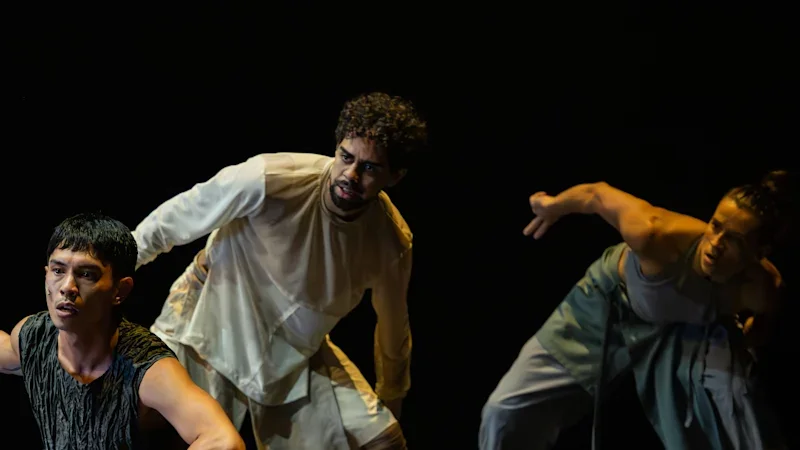
Carriageworks, August 13. Until August 15.Daniel Riley, the artistic director of Australian Dance Theatre, deserves five stars and a standing ovation for the calm, genuinely concerned audience address he gave on the opening night of
Two Blood, when a medical emergency in the audience halted the performance.
It occurred just as the piece was galloping to its dramatic climax, the dancers in lines on all fours, hurtling across the stage with admirable speed and focus despite the sudden change in house lights and scurrying audience movement.
Riley sprang noiselessly from his seat, softly instructed the dancers to pause, then turned to the audience with warm composure, explaining that the welfare of ADT’s audience friends was paramount. With Riley’s leadership setting the tone, a potentially distressing event was handled with exemplary compassion and professionalism.
A pity, then, that Two Blood itself is something of a patchy affair. It is a co-creation between Riley, a Wiradjuri choreographer; Jasmin Sheppard, a Tagalaka choreographer with Anglo-Australian, Chinese and Hungarian ancestry; and the Sri Lankan-Australian theatre writer, director and producer S.Shakthidharan.
Marketed primarily as the story of a forbidden love affair between a Tagalaka woman and a Cantonese man in gold rush Australia, Two Blood is more a mosaic of disparate scenes and characters, exploring “otherness” in Australian multicultural identity.
Certain facets of Two Blood are outstanding. Dynamic ensemble choreography, which bookends the work, hooks the eye with the dancers’ supple, effortless muscularity and formidable group discipline. The opening ensemble sequence is danced on confetti, which — caught up in the dancers’ tailwinds and spiralling around their movements — acts like a fascinating flow visualisation or contrast dye.
The music by James Howard and Andy Qilong Chia is similarly outstanding: an addictive fusion of synth rock and traditional Asian instruments, complete with an attractive music video screened in crystal-clear resolution across two moving LED panels (Elias Nohra’s audio-visual design). Nohra’s soundscape also vividly evokes a sense of place: the clear birdcalls of Australian Country, the hum of a teeming industrial Indonesian city, and the trickle of creek water.
Protracted sections without music or ensemble dancing are distinctly weaker. Fragmented poetry reciting, guttural wordless vocalising, and shouting all seemed intended to create emotion, but instead splintered any sense of narrative coherence. It gave Two Blood a disjointed, inexpert feel — like watching a series of disconnected drama class experiments strung together.
Considerable effort and energy are required to watch this display without feeling alienated or disengaged, which from a viewer’s perspective is highly regrettable given Riley’s evident care for ADT audiences.