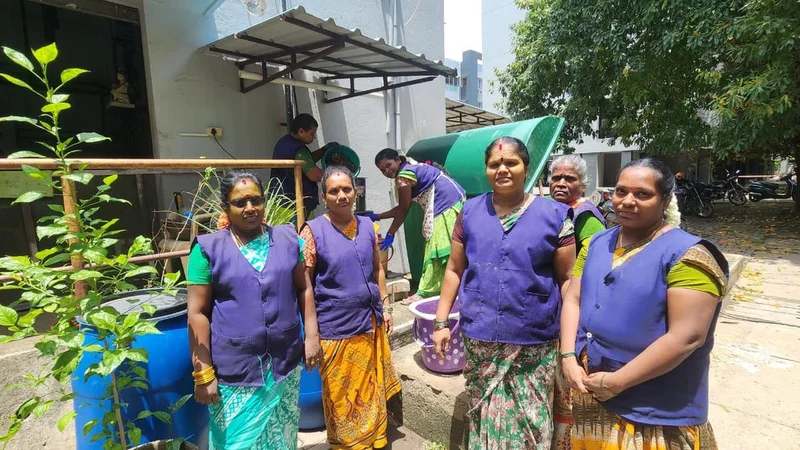
What began eight years ago with purchase of basic composting bins has grown into a sustained waste management effort at Ragamalika, a gated community in Mandaveli. As a bulk waste generator, the community is required to manage its own wet waste, but residents soon discovered that successful composting needed more than equipment — it required segregation, training and steady participation.
Initially, Ragamalika bought bulk composting bins from My Green Bin, but what followed was marked by a see-saw between a burst of activity and a lull of inactivity. Now, for the last one-and-a-half years, residents and housekeeping staff have got adjusted to the new system and are composting in earnest. By 2025, most blocks in the complex were segregating waste into three streams: recyclables, wet waste and landfill-bound waste.
Recyclables are handed over to Bintix, while about 20 kg of wet waste is processed within the community every day. Earlier, an outside service provider checked the wet waste to ensure that plastic and other inorganic material had not entered the bins before adding microbes to the green composting units. When sorting mistakes occur, residents are informed and educated on what goes where, helping improve segregation over time.
After three service providers discontinued the work, the community asked its housekeeping staff if they would be ready to take on the responsibility for additional pay — a decision residents now count among their best.
The staff initially collected wet waste from every doorstep, spread it on a tarp to remove plastic and other inorganic pieces, and chopped larger food scraps so they would break down faster. To reduce the time and effort involved, they suggested buying a chopping machine. Commercial machines, however, cost more than ₹ one lakh and were beyond the community’s budget.
Maithreyi, a resident, then researched alternatives online and found a fodder chopper made in Pune that cost only one-tenth the price of commercial machines. The machine, purchased through crowdfunding, arrived a few weeks ago and has made the composting process quicker.
Smaller pieces of organic waste now decompose faster, producing nutrient-rich compost in less time while saving the housekeeping staff valuable labour. Ragamalika uses the compost and leachate to fertilise plants within the complex. Some residents also buy the compost for their balcony gardens and house plants, and the community now sells the surplus. A 5-kg bag of compost costs ₹125, while a one-litre bottle of leachate costs ₹40. Buyers are encouraged to bring their own bags and bottles, and payments are accepted only through UPI.
The project has been spearheaded by the community’s Green Champions, Hetal Somasundaram and Sumanapriya, whose efforts helped turn a difficult responsibility into a model of community-led waste management.
For details, contact Hetal at 9488466778/Sumanapriya at 9444851212
Radhika Karthikeyan is a resident of the apartment
Published - August 15, 2026 05:24 pm IST