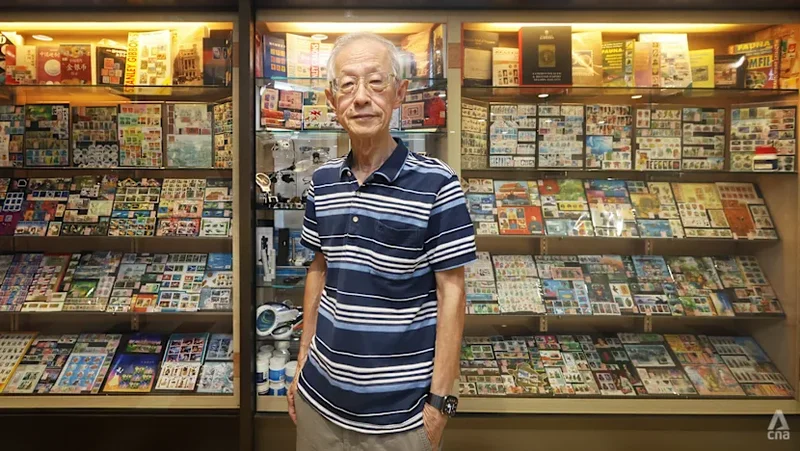
'Stamps are in my blood': How this 81-year-old stamp dealer keeps the trade alive
Mr Tan Chun Lim, 81, owns and runs the last "pure stamp shop" in Singapore. With 70 years of stamp collecting and dealing under his belt, he shares with CNA TODAY his fondest memories of what used to be a wildly popular hobby – and what's next for his dwindling trade.
Walking into CS Philatelic Agency feels less like stepping into a store and more like slipping back in time.
On the wall nearest the door, stamps hang in clear plastic sleeves sorted by country, some of which no longer exist: East Germany, Yugoslavia, the USSR (Union of Soviet Socialist Republics), for example.
Postcards from the 1970s and 80s fill the corners. A chest of drawers overflows with first-day covers – envelopes bearing stamps that were postmarked on their first day of release. Some date back to the 1950s.
Over at the counter, store owner Tan Chun Lim was deep in conversation with a collector hailing from Brunei. A chuckle here, a couple of taps on the calculator there and soon S$600 (US$469) and several omnibuses of stamps changed hands. "Omnibus" is the term collectors use to refer to folders containing a full set of stamps.
As the happy customer left with his prizes, Mr Tan, 81, crossed the shop in casual dress, including socks and Birkenstocks, and welcomed me properly into his little domain at Peninsula Shopping Complex.
Leading me to a corner of the 46sqm unit, he showed me what he had just bought himself earlier that afternoon: several volumes of yellowed stamp albums, cleared out of someone's grandparents' flat.
I've never been much interested in stamps, but I still found myself marvelling at how old some of the stamps are, some dating back as far as the 1940s. They must fetch a pretty penny, I remarked.
In truth, said Mr Tan, collections such as these are usually incomplete sets, odds and ends that rarely add up to a full set. In other words, old is not the same as valuable.
"I'm just helping people to clear it," laughed the octogenarian, the creases by his eyes crinkling a little deeper.
As far as Mr Tan is aware, his is the only "pure stamp shop" in Singapore. Most retailers, he explained, cannot make a business of stamps alone and must expand to other items to stay afloat, such as commemorative coins or antiques.
Each day, after closing his store, Mr Tan spends hours painstakingly sorting through his new acquisitions, identifying and sorting them, removing adhesive residue on first-day covers.
Some of these he sets aside for potential buyers. The rest find their way into his extensive repository.
I love stamps, but I also love money.
Pointing to a shelf of meticulously organised clear folders behind the counter, Mr Tan said that any collector could come in looking for something oddly specific and he would have it.
Hunting down stamps from China's Cultural Revolution from February of 1971, or stamps featuring a specific reptile or dinosaur? He's got those – and he knows exactly where to retrieve them out of the hundreds or possibly thousands of folders and albums in his shop.
"Whatever customers need, they can get it," he said, his wiry chest puffing up with pride.
It might be easy to mistake him for a simple hobbyist, but our conversation soon revealed a shrewd businessman who loves to close a deal.
"I love stamps, but I also love money," he said with a glint in his bespectacled eyes.
THE VIRTUOUS CIRCLE OF STAMPS
Mr Tan's fascination with stamps began at the tender age of 11. At the time, he said, stamp collecting was quite the hobby de rigueur, not the niche interest it is now.
Stamp collecting was all the rage in 1950s Singapore. Children swopped stamps, built albums and chased new issues, while clubs and competitions gave the hobby a real sense of excitement. Kids today have Labubus; Mr Tan and his generation had stamps.
"Almost everybody collected stamps, whether you were serious or not," he said.
Without the global connectivity of the internet, for Mr Tan, those small perforated rectangles were portals to new worlds. Through each sheet and edition, he learnt about countries he had never seen before, and their storied and complicated histories.
"For example, at that time, we didn't learn so much about Malaysia. Like the state of Perlis in Malaysia, it's not something everyone will know about – but I learnt (about) it through stamps."
By the age of 14, Mr Tan worked out a scheme to keep expanding his collection and still make a quick buck.
He began buying packets of 500 stamps that could be broken into five packets of 100 each and sold off, advertising his offers in the school magazine. He used the money he got from selling stamp packets to buy new stamps.
This practice is called 以邮养邮, which directly translates to "using postage to support postage". Philatelists make money by transferring, selling or exchanging surplus or duplicate stamps. They then use these funds to purchase stamps they desire or lack, thus achieving a virtuous circle of reducing collecting costs and enriching their personal collections.
He soon began printing his own first-day covers. Avid stamp collectors often purchased their envelopes in advance before queueing at the post office on the morning a stamp was released to have it postmarked.
Collectors who missed out printed their own, also known as private first-day covers. These "unofficial" versions weren't very popular and thus were cheaper, recalled Mr Tan, but still managed to sell as their official counterparts often sold out.
He continued printing and selling these private first-day covers throughout secondary school. On one occasion, he printed 1,000 of his private covers and passed them to men selling postcards to tourists outside the old General Post Office at the Fullerton Building.
Mr Tan made three cents a cover. Then, with a profit of S$30 – translating to somewhere between S$120 and S$150 in value today – he went in to buy more covers for himself.
Mr Tan pulled open a drawer with a rubber-banded stack of private first-day covers, noting that these unofficial replicas have now become more valuable by virtue of being limited in supply. With the right buyer, some of these first-day covers can reach as much as S$50 or even S$100 apiece.
Upon graduating from higher secondary (equivalent to A-levels) in 1963, Mr Tan made a beeline for the post office – then known as the Postal Services Department.
He spent the next 18 years there moving through different departments, including security and management, while taking night classes in accountancy.
THE SERIAL ENTREPRENEUR
While Mr Tan "loved" the job, his entrepreneurial itch was hard to ignore.
In 1973, while he was still employed at the post office, he opened a batik shop with his wife at Colombo Court, having noticed that Japanese tourists appeared to have a penchant for local sarongs.
His wife helmed the batik store at first, and nine years later, he resigned from the post office to join her.
The batik shop ran for about 10 years at Colombo Court before it was reclaimed by the government. In 2005, the High Court was built on the site.
While running the batik shop, Mr Tan noticed that some operators were subdividing office units and renting out individual desks together with shared secretarial services – a cheaper way for small businesses to gain an address and administrative support without maintaining a full office of their own.
At a time when much of business and enterprise still ran on physical mail, it meant one thing: a steady demand for postage stamps.
Ever one to jump on an opportunity, he got himself an office unit in Colombo Court and proceeded to buy stamps by the thousands, sorted them into hundreds and then packed them into stamp packets – cheap sealed packs of stamps, sorted by country or theme.
Most of his business was to other businesses selling stamps for use on letters.
He then supplied these to smaller dealers, bookshops, department stores, and, for a period, biscuit manufacturers trying to boost sales by enclosing stamps in biscuit tins, as some cereal companies did with children's toys.
After accumulating a respectable nest egg, he bought a retail unit at Lucky Plaza in the 1980s.
The rent from the Lucky Plaza unit proved more lucrative than anything he could have made trading from the space. After relinquishing his Colombo Court shop, he used the income to buy another unit at Peninsula Shopping Complex in 1984, where he continued supplying stamp packets.
For the next several years, he cycled through various roles and businesses while his wife helped to tend the shop. He was a share remisier, then an insurance agent who rose to manager, and later became director of a floor tile business.
He operated almost like a "freelancer" for these roles, working from his Peninsula Shopping Complex shop instead of an office.
"Anything my staff needed, like my signature, they would come here."
From the late 1980s to the early 1990s, the stamp market was booming.
Mr Tan recalled attending the 1993 World Philatelic Exhibition in Bangkok, Thailand, where demand was so feverish that almost anything dealers put on their counters would sell out instantly.
Some counters were so overwhelmed with customers that they barely had time to count their takings, he said, tossing the money aside until the crowds subsided.
In Singapore, the frenzy peaked around the 1995 World Philatelic Exhibition, which Mr Tan remembers being "as packed as sardines". As the stamp market heated up, he began spending more time at the shop.
"Business was that good."
THE COLLECTORS OF TODAY
Around 1997, the market turned. The masses became less interested in stamp collecting, and the once-booming market began dwindling down to a few serious and focused collectors.
By 2010, Mr Tan had slowly wound down his various ventures outside of his stamp businesses. The stamps that had followed him through much of his working life finally became his full-time occupation.
He also ran a popular stamp shop at what was formerly the Singapore Philatelic Museum from 1997 till 2019. The store was largely self-service, and like everything else he took on, arranged it so that he did not have to be physically present.
The museum was eventually reborn in 2022 as the Children's Museum Singapore.
Stamp collecting no longer appeals to kids and youths as it did in the past. "If you go to a stamp exhibition, the people (are) all white-haired or bald," laughed Mr Tan.
"There are some younger collectors, but they are largely in their forties."
New philatelic stock usually arrives in his store in one of two ways: People attempting to reduce clutter in their parents' or grandparents' house, or clearing memorabilia after a parent or grandparent has died.
"I'm not like other buyers who just pick what they want – I'll take everything. It will help the customers solve their problem."
Mr Tan goes through the collection and prices only what he can realistically move. For the rest, he usually pays a token amount and takes it anyway.
"Whether it's junk or precious items, I will try to close the deal. That's why people are happy to come here."
AN ENDURING PASSION
These days, he rarely gets customers coming to browse around aimlessly. He largely receives his long-time regulars and specialists who arrive with precise wish lists, such as stamps with a particular printing error, an exact date for cancellation, or an obscure missing piece of a specialised collection.
The term "cancellation" refers to the postmark put on a stamp when it is used in order to prevent its reuse. It usually carries the date and location where the stamp was used.
One of his long-time regulars has been coming to Mr Tan for over 30 years and is an ex-bank director with deep pockets who has been collecting stamps since his school days. According to Mr Tan, this collector has every stamp that Singapore has ever printed and, more impressively, collects them in full sheets spanning decades of the country's postal history.
"If I have anything special, such as stamps with printing errors … he will buy them," said Mr Tan.
Another time, one collector came to him in search of a single Japanese Occupation-era cancellation. His son found one of them on Carousell for S$3,000 and brought it to Mr Tan to ask whether it was worth the price.
In Mr Tan's opinion, the listing was poor, the date was unclear, the cut was dirty – and he could do much better.
"I found him such a beautiful stamp, with a much nicer and clearer cancellation," he said.
He priced it at S$1,000, and his buyer took it immediately.
It's been 70 years since Mr Tan first fell in love with stamps and even now, he sees no end to this romance. Despite his advanced age, he moves about his shop with the spryness of a man several decades younger.
He credits his energy to the exhilaration of endless new hunts and the sweet satisfaction of closing deal after deal.
"When a collector wants something, I will find a way to get it for them," he declared with confidence – a philatelic bounty hunter.
Nevertheless, now that he's in his 80s, the shop's future has begun to look cloudy.
So far, no potential successors have emerged to take the reins. Mr Tan's two children have no interest in stamps, which he attributes to his own insistence that they prioritise schoolwork in their growing-up years.
"During those days I didn't get them to help out around the store," he said wryly.
"Maybe if I did, they would be a little more interested. That was my mistake."
Over the years, several parties have offered to take over the store, from civil servants to stockbrokers. Nothing ever panned out.
Even so, Mr Tan is unfazed by the lack of a succession plan. What matters most to him is staying close to his beloved stamps.
"Stamps are in my blood. I'll (keep going) until I cannot anymore."