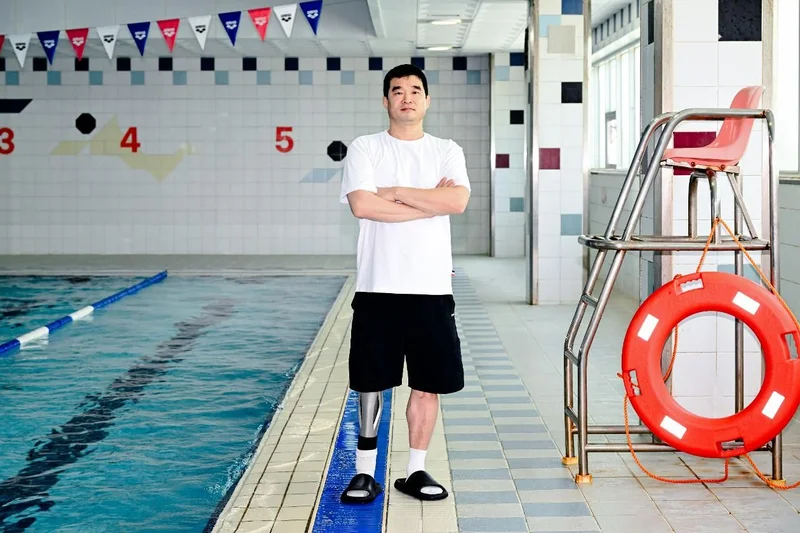
At the wheelchair curling final of the Invictus Games, an international sporting event for wounded, injured and sick service personnel and veterans, held in Vancouver, Canada, in February 2025, gasps erupted around the arena when Britain's final draw shot fell short.
As the Korean team secured its first gold medal of the games, Lee Hwan-kyung, 53, a key player on the team, turned his head toward the British players. His eyes fell on an athlete who had lost an arm after being injured during military service.
Lee watched as the athlete pushed a delivery stick with all his remaining strength while struggling to maintain his balance. Lee lowered his head and sobbed for a long time.
Speaking to Hankook Ilbo in Goyang, Gyeonggi Province, Aug. 6, Lee recalled the moment.
"I think I felt a sense of kinship and solidarity, knowing that the opposing player must have gone through difficult times, just as I had," he said. "The British players patted us on the shoulders and congratulated us. I couldn't understand everything they said, but it felt as if they were saying, 'You've overcome it, too. I have as well.'"
For Lee, the greatest reward was not the medal but the "Invictus spirit" — the determination not to surrender to difficult circumstances.
Life-changing injury
Lee was once an elite wrestler who majored in wrestling at the Korea National Sport University. During middle and high school, he trained with the goal of competing in the Asian Games and Olympics. After entering university, however, he dreamed of becoming a physical education teacher and coaching students.
In his senior year, he obtained a teaching certificate for secondary schools. After graduation, he began his military service, with plans to take the public school teacher recruitment exam after completing his service. But an accident during his military service turned his life upside down.
While he was conducting vehicle inspections on a road, a midsize car suddenly crashed into the guard post where he was stationed, causing severe injuries to his right leg. Doctors fought for more than a month in the intensive care unit to save the leg, but as his condition became life-threatening, amputation became unavoidable.
"I woke up after the surgery with a bandage the size of a soccer ball wrapped around my knee," Lee recalled. "I was only 26 at the time, and it felt as if my life was over."
Returning to sport, raising the Korean flag
It was the sport he loved that helped Lee get back on his feet.
Just three months after being discharged from the hospital, he joined a skiing camp for people with disabilities at the recommendation of a professor he had met at university. He began learning three-track skiing, using one leg to support himself on the ground and a pair of outriggers for assistance.
Even simply supporting himself on one leg made his legs tremble, and his underwear would become soaked with sweat.
"I kept telling myself not to quit the camp halfway through, so I repeatedly fell down and got back up," Lee said.
Thanks to his determination, his skills improved rapidly. He competed in an international competition in 2001 and then took part in the 2002 Paralympic Winter Games in Salt Lake City, Utah.
He had earned the chance to raise the Korean national flag — something he had never managed to do even when he was fully able-bodied.
The competition that gave him the greatest sense of fulfillment was last year's Invictus Games in Vancouver and Whistler, Canada. Lee won gold in wheelchair curling, silver in alpine skiing and bronze in skeleton.
"I felt proud seeing athletes who had become disabled while protecting their country continuing to compete for their country," he said.
Lee, who currently also works as a swimming instructor, is training hard with the goal of taking part in the Invictus Games to be held in Daejeon in 2029.
"If I can't compete as an athlete in the 2029 Games, I'd still like to contribute as a member of the staff," he said. "I want to bring my three sons with me and show them people who have overcome setbacks."
Injured veteran who refused to give up walking
Pyo Jung-ho, 26, an injured veteran, is set to participate in the 2026 Invictus Festival in Australia in October.
The Invictus Festival is not the main Invictus Games organized by the Invictus Games Foundation, but rather an event organized by the Invictus Australia Foundation.
Pyo, the youngest member of the Korean delegation, plans to compete in sitting volleyball and swimming. His goal is to find sports suited to him at this year's event and compete in the Invictus Games in Daejeon in 2029.
Just two years ago, Pyo struggled not only with exercise but even with simply walking.
In 2022, he suffered a mine blast while serving in the military. He was stationed in Yanggu, Gangwon Province, when he was injured in the explosion.
The accident took away half of his heel. Although doctors considered amputating his ankle, Pyo could not easily give up on walking.
Because his nerves and blood vessels remained intact, including movement in his toes, he underwent a heel transplant instead of an amputation.
He still vividly remembers taking his first step after surgery.
"I hadn't used my ankle for more than six months, so my foot had become stiff in an extended position," he said. "The pain was so severe that I felt like vomiting with every step, but I never skipped rehabilitation exercises in the morning, afternoon or evening."
Pyo now works at the Seoul Welfare Foundation's Youth Center for Injured Veterans, where he helps wounded service members register and apply for official veterans' benefits.
"When I applied for veterans' benefits myself, the administrative procedures were so complicated and difficult," he said. "I wanted to put my experience to use for injured soldiers who might be feeling defeated."
His decision to challenge himself at the Invictus Festival is also driven by a desire to find new motivation.
"I played soccer until high school," Pyo said. "I want to compete in the 2029 Invictus Games and show everyone that I am still capable of playing sports."
This article from the Hankook Ilbo, the sister publication of The Korea Times, is translated by a generative AI system and edited by The Korea Times.