Sign in. It’s quick, free and it’s up to you.
An account is an optional way to support the work we do. Find out more.
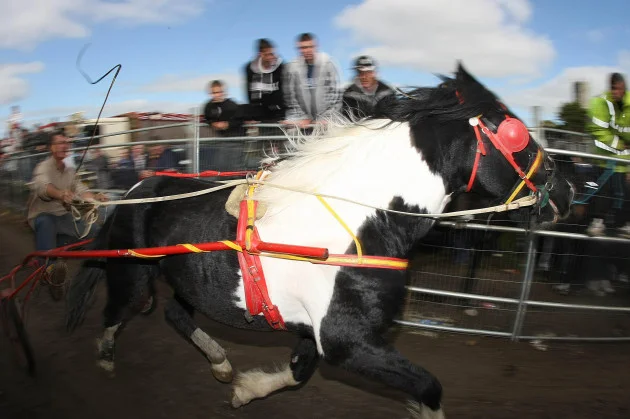
IN APRIL 2026, a German public broadcaster travelled to Ireland to document the issue of sulky racing. The resulting documentary, broadcast as part of Tiere suchen ein Zuhause, showed horses being struck, driven at speed through busy urban streets and raced on public roads. The footage caused international outcry.
Ireland’s debate around sulky racing has too often become polarised. Discussions quickly turn into arguments about tradition versus welfare, insiders versus outsiders and personal experience versus scientific evidence. People understandably feel strongly about horses, culture and animal welfare. But when the conversation becomes a culture war, the animal at the centre of it can easily disappear from view. And ultimately, it is the horse that should be at the centre of this discussion.
What follows is an attempt to do something different: to ask the questions the evidence demands without ignoring the cultural complexity that makes them difficult.
To explore those questions, I spoke with Barbara J. Hardman of Bright Horse, a Clinical Animal and Equine Behaviourist with nearly two decades of experience in equine behaviour science. Her expertise helps bring the focus back to the horse and to what behaviour and welfare science can tell us about its experience:
It is important to begin with a distinction that repeatedly gets lost in public debate. Sulky racing, known internationally as harness racing, is a legitimate and formally regulated equestrian sport in countries including France, Sweden, Norway, Australia, Canada and the United States. These industries operate within systems of veterinary oversight, stewards, welfare rules, controlled racing surfaces and anti-doping regulation. They are not perfect. No form of racing is. But there are systems in place to monitor what happens, ask questions when things go wrong and, importantly, hold people accountable.
What generates much of the controversy in Ireland is fundamentally different: informal, high-speed racing on public roads without an equivalent regulatory structure. There is no mandatory veterinary oversight specific to the activity. There is no equivalent system of stewards, mandatory fitness assessments or structured injury monitoring. Some horses involved will undoubtedly be well-fed, well-handled, and deeply valued by their owners. It would be both unfair and inaccurate to suggest that everyone involved does not care about their horse. The difficulty is that an unregulated system cannot rely on individual goodwill as its primary welfare safeguard.
In 2026, an exhausted horse collapsed and died in Clonmel following an illegal sulky race on a public road. A year earlier, a race on a busy road in Co Limerick ended in a violent collision that injured multiple horses. The ISPCA has documented further cases of ponies abandoned with serious injuries linked to trotting.
The same welfare and safety concerns have surfaced repeatedly. Something has to change.
Irish law already restricts racing on public roads without authorisation, and some local authorities have introduced specific controls around horse-drawn vehicle racing. But road traffic legislation is not the same thing as a comprehensive welfare framework for horses used in informal racing.
Public roads are designed for vehicles, not horses travelling at racing speeds. Tarmac is a hard surface, and the welfare concern is not road work in itself but the speed, intensity and repetition involved.
Hardman is careful to point out that some work on firmer surfaces can have benefits for hoof conditioning and bone density. The problem comes when we compare ordinary ridden exercise with high-speed sulky racing.
“The average trotting speed of a normal horse out hacking is around 12 kilometres per hour. A sulky horse on a road can exceed 40 kilometres per hour. These are not comparable activities.”
At those speeds, while pulling a sulky, the repeated forces placed on the horse’s limbs are substantial. Joints, tendons, ligaments and hooves are repeatedly loaded, with additional risks from slipping or losing footing on wet roads. Even in regulated harness racing, musculoskeletal injury is a recognised concern. One study of 356 Standard bred trotters recorded 429 musculoskeletal injuries. Importantly, 41% occurred during racing and 53% during training. The risk, therefore, is not confined to race day. It exists every time a horse is worked at speed.
In formal racing, horses can at least be monitored and injuries investigated. In informal road racing, there is no mandatory-structured system for identifying a horse that is sore, injured or no longer physically able to cope.
Then there is the road environment itself. Horses do not naturally understand traffic, lanes or road rules. Road safety must be carefully taught through gradual, appropriate exposure. Even then, a road is a complex environment filled with changing vehicles, sounds, movement and unexpected events. Horses are flight animals, and at speed a fear response can escalate rapidly.
The issue is not simply whether a horse has “seen traffic before”. It is whether that individual horse has been properly prepared to cope with an unpredictable road environment while travelling at speed and attached to a two-wheeled vehicle. Or indeed, if Irish motorists should be expected to navigate roads with traumatised horses.
The ISPCA has repeatedly documented serious injuries in ponies recovered following trotting incidents. Chief Inspector Conor Dowling has also warned of the cumulative toll this type of work can have on young horses, including the potential for permanent damage. The issue is not simply that horses are on roads. It is what they are being asked to do on them.
Modern animal welfare is about more than keeping an animal alive, fed and physically capable of working. We also have to consider pain, fear, stress and the emotional state of the individual animal. This matters in sulky racing because signs of stress can easily be misread.
A horse that rushes, sweats, holds its head high and stiff, resists the bit or shows wide eyes and flared nostrils may be described as “keen” or “excited”. But arousal does not necessarily mean enjoyment.
As Hardman explains:
“We often describe a horse as ‘excited’ or ‘keen’ when in reality they may be over-aroused, conflicted or afraid. Arousal is not the same as positive motivation. We have to look at the whole horse.”
Tail swishing, head tossing, mouth opening, rushing or refusing to move forward are not simply “bad manners”. They are communication and may indicate fear, confusion, pain or conflict.
If these behaviours are interpreted as disobedience and met with increasing pressure, the horse’s distress can easily escalate. Pain is particularly easy to miss.
Horses do not always show obvious lameness. Discomfort may first appear through subtle changes in facial expression, posture or behaviour. This is precisely why evidence-based tools such as the Horse Grimace Scale and Equine Discomfort Ethogram have been developed. The fact that a horse is physically capable of racing does not, on its own, tell us that the horse is pain free or experiencing positive welfare.
One of the arguments frequently made in defence of racing is that the horse “wants to run” or “loves racing”. But behaviour alone cannot always tell us how an animal feels about an experience. To understand why, it helps to understand something about how horses learn.
Hardman explains that much of horse training relies on pressure and release, known scientifically as negative reinforcement. Pressure is applied and removed when the horse gives the desired response.
This is not unique to sulky racing. It is used throughout equestrian training. The problem comes when pressure is poorly timed, not released clearly or simply increased when the horse fails to respond.
As Hardman explains:
“Without formal training requirements, we cannot assume that those driving sulkies on our roads have been taught the fundamentals of how horses learn. When pressure and release are applied incorrectly, it can cause confusion, fear, resistance, dangerous behaviour and, in some cases, learned helplessness.”
In some cases, a horse moving forward may simply be performing a well-learned response that reduces or avoids pressure. That does not mean the horse is necessarily distressed. But equally, the behaviour alone cannot be used as proof that the horse is enjoying the experience. Performance is not, by itself, a measure of positive welfare.
On a public road, with a horse pulling a two-wheeled sulky at speed, poor training and escalating pressure are not only welfare concerns. They are serious safety risks.
We also have to look beyond the race itself. Horses are highly social animals designed to spend much of their day moving, grazing and living alongside other horses with whom they form stable bonds.
As Hardman puts it:
“Horses need other horses. Humans often want to believe that we can meet all of a horse’s social needs ourselves. We cannot.”
A horse may race for minutes or train for an hour, but it is still a horse for the other 23 hours of the day.
How is it housed?
Does it have appropriate access to forage?
Can it move freely?
Does it have meaningful social contact with other horses?
Can it rest?
Is pain recognised and treated?
Whole life welfare cannot be judged solely by what happens while a horse is attached to a sulky. When assessing the welfare of these horses, the question cannot simply be: Can the horse run? We need to ask whether the horse is in pain, how it is trained, what its behaviour is communicating and how it lives when the sulky comes off.
A horse can live well into its 20s or even 30s. Its racing career is only one part of its life. So what happens when it can no longer race?
We do not have reliable long-term welfare data for horses used in informal Irish road racing. That, in itself, makes meaningful assessment difficult. Without a dedicated registration and longitudinal tracking system for horses used in informal road racing, it is extremely difficult to follow welfare outcomes over the course of an individual horse’s life.
Horses may be sold or passed from owner to owner. Some ultimately arrive with private individuals or rescue organisations. All too often, rescues are left to pick up the pieces.
They may take in horses that are injured, frightened, poorly handled or carrying the effects of previous training and management. Rehabilitation can require months or years of veterinary treatment, farriery, appropriate training, specialist behavioural support and, above all, time.
As Hardman explains:
“The horse may have physical pain, fear, poor handling history, gaps in training, or behaviours that have developed because of pressure-based training. That can be difficult and sometimes dangerous to rehabilitate. It takes time, money, expertise, veterinary support, farrier and a lot of patience.”
Rescue organisations and private individuals can end up absorbing those costs long after the horse has left racing. That is not a sustainable welfare system. If we use an animal for sport, our responsibility cannot end when the animal stops performing.
The argument is not that horses should never work, compete or run. Exercise is not inherently harmful, and many horses can engage positively in physical activity and human partnership. The issue is the conditions under which they are asked to do it.
Regulated harness racing, with veterinary oversight, welfare protocols, appropriate tracks and accountability, is fundamentally different from informal racing at speed on public roads without equivalent protections. We cannot use safety data from regulated international racing to defend an activity where comparable safeguards do not exist.
If sulky racing is to continue, meaningful regulation has to put the horse at its centre. That means minimum age requirements, veterinary assessment, appropriate locations, enforceable welfare standards and accountability for what happens to horses when they can no longer race.
As Hardman says:
“If you take an animal into your care, you have a responsibility to that animal for their whole life. They are not sports equipment. They are not something to use until they stop performing and then dispose of.”
The question is not whether sulky racing is part of an Irish cultural tradition. It is. Nor is it fair to suggest that everyone involved does not care about their horses. They may care deeply. But tradition cannot put an activity beyond scrutiny, and individual care cannot replace a system designed to protect every horse involved.
If horses are being raced at speed on public roads, we have a responsibility to ask whether their welfare is protected, whether the public is safe and what happens to those horses when they can no longer perform.
Suzi Walsh is an expert dog behaviourist and dog trainer. She has an honours degree in Zoology and a Masters in Applied Animal Welfare and Behaviour from the Royal Dick School of Veterinary. She has worked as a behaviourist on both TV, radio and has also worked training dogs in the film industry.
Expert Contributor - Barbara J. Hardman is a Clinical Animal and Equine Behaviourist holding an MSc in Equine Science and a BSc in Zoology. She has worked in equestrian behaviour science since 2008 and specialises in applied equine learning theory, behaviour modification and welfare assessment.
To embed this post, copy the code below on your site