Changing a life can cost less than a secondhand car
MANILA, Philippines — In a remote barangay in Cebu, a mother ran out of ways to help her 16-year-old son.
He had tantrums that frightened her. He hurt himself. Sometimes he hurt the people around him. She knew he needed therapy—the kind of specialized, consistent rehabilitation care that could teach him to regulate, to communicate, to live.
But to many less-fortunate families in the Philippines, rehabilitation can feel like a privilege, not a right. Only a fraction of licensed physical therapists work in public health. Most barangays have no rehab facility at all. For families like hers, the arithmetic can be severely unkind: therapy exists, but not for them.
Article continues after this advertisement
Then one Sunday in May, therapy came to her.
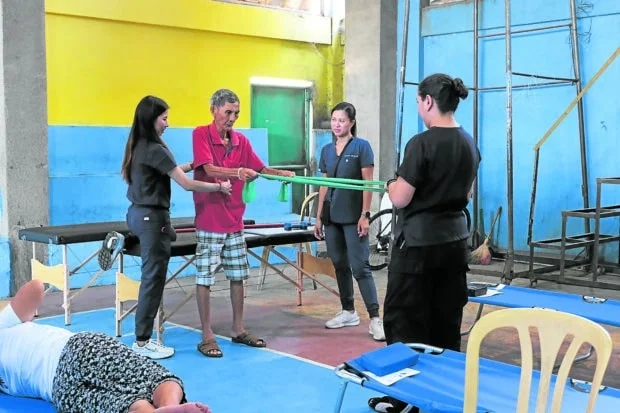
Sixty-four patients—stroke survivors who had never followed up consultations, children with cerebral palsy, elderly patients relearning how to hold a spoon—were assessed and treated in a single day by 81 volunteer physical, occupational and speech therapists in a pop-up rehabilitation hub set up in the barangay.
No hospital was built. No ribbon was cut by a politician. The whole operation ran on a P100,000 grant and the magnificent audacity of a Rotaract Club.
When Rotary Club of San Juan Supreme president nominee designate Jericho Ramos asked that mother to describe what the day meant to her, she used two words amid tears: “life-changing.”
I have spent more than 30 years as a journalist telling Filipinos the truth about money—that it is not the amount that transforms lives, but where it goes and who is trusted with it. I have never seen that truth argued more convincingly than by the young people of the Rotaract Club of Cebu Fuente, whose Sug Kusog Hub was named the first-ever champion of The Impact Challenge.
Article continues after this advertisement
The Impact Challenge is a project of the Rotary Club of San Juan Supreme, where I served as president in Rotary Year 2025-2026. It is our club’s service project wrapped around a television show aired over 10 episodes on ABS-CBN News Channel. When we pitched the project to a long list of individuals and companies, the polite skeptics—and there were many—said the same things: too risky, too ambitious, too much money to hand to youth groups with no track record.
Here is what actually happened. Seventy-eight youth organizations from across the country submitted proposals. Twenty-one were shortlisted, three for each of Rotary’s seven areas of focus, namely basic education, peace-building, environment, disease prevention, growing local economies, water and sanitation, as well as maternal and child health.
Article continues after this advertisement
They pitched live and unscripted to judges who do not clap easily — a Ramon Magsaysay awardee in microfinance, the secretary-general of Philippine Red Cross, the president of the University of the Philippines, Forbes-listed business leaders, venture capitalists, finance experts and Rotary’s national leaders.
Seven groups won P100,000 each. But that’s not all. They went through a grueling test: 70 days to turn a proposal into proof, with our club members traveling as far as 12 hours by bus, ferry and tricycle to mentor them on the ground.
An interesting list of companies supported the projects not just with funding, but also with mentoring support — proof that the future of corporate social responsibility may be chancing. There’s PayMongo as title sponsor, CreativeImpact Inc. and Empower and Transform as strategic partners. Others include CARD MRI, COL Financial, Domo Domo, SM Investments Corp., Tala Philippines, UnionDigital Bank, Astoria Hotels and Resorts, Executive Genesis, 7AM Productions, JBL, Philippine Franchise Association Inc., RAF International Forwarding Phils., SPDeloraya Job Contracting & Consultancy Services Inc., Global Dollarstore, University of the Philippines, Italpinas Development Corp., Airspeed International Corp., Lobien Realty Group, Metrobank Foundation, Nurture Wellness Village, Destileria Limtuaco & Co., Inc. and Edsa Shangri-La Hotel.
The results returned to our finale stage like receipts.
In Macabebe, Pampanga, a town that spends half of every year underwater, Kaya Natin! Youth planted 1,000 mangrove seedlings with a 70-percent survival rate — better than the benchmark of the Department of Environment and Natural Resources itself.
In Floridablanca, a medical fraternity from UP deployed 33 water filtration units that now serve 2,400 people who used to trek down a mountain for water.
In Mansalay, Oriental Mindoro, a youth group built a native chicken “reproduction relay” where every beneficiary passes 20 percent of the flock’s offspring to the next family — a livelihood program designed to multiply itself. In Laguna, Rotaractors wrote a maternal health workbook in four languages, myth-busting the pamahiin (superstition) that still sends mothers to unsafe births, complete with a financial road map of Social Security System, PhilHealth and benefits of Pantawid Pamilyang Pilipino Program or 4Ps, a state-run conditional cash transfer initiative.
In Rizal, a band program meant for 80 young musicians reached 219. In the mountains of Mindoro, Mangyan children displaced by conflict — who once had a graduation canceled by explosions — learned to read in a program that treats literacy as the first infrastructure of peace.
Add it up and you arrive at a number that challenges institutions that say change requires millions. In The Impact Challenge, we saw seven communities measurably better for P700,000.
Capacity, not charity
But numbers are only half of the financial truth. The other half is behavior. What struck the judges was not just what these young people had built, but how they had accounted for it. They tracked their budgets. They named their partnerships. They stood on national television and did not get babied by polite questions. They answered tough ones about sustainability, scalability and unit costs, the way founders answer brutal questions from venture capitalists.
UP president Angelo Jimenez challenged a farming group: are you ambitious enough? The team’s 22-year-old leader looked at him and answered, in effect, “Sir, we’ve done this before. We built a system, and it will not stop when you stop watching.”
That is not charity. That is capacity. And it is sitting, largely unfunded, in barangays all over this country.
Paymongo CEO Jojo Malolos, a known venture capitalist, says he expected more impact from the Impact Challenge winners than many startup founders in the country.
Rotaract Club of Cebu Fuente took home an additional P100,000 grant to expand Sug Kusog Hub, plus a shot at a Rotary Global Grant to scale it further. But the more important prize, I think, was awarded to all of us watching: evidence. Evidence that the question we should be asking Filipino youth is not “what do you know about running a project?” but “what could you do if someone finally trusted you with the resources?”
Weeks ago, our show opened with a question: what if the next generation could change everything? I now suspect we had wrongly phrased it. They are not the next generation of nation-builders. They are the current one. The rest of us are simply late.
The Impact Challenge will return — in schools, in communities and on screen. But you do not have to wait for a television show. Somewhere near you is a youth group with a plan, a budget and nowhere to take it. Fund it. Mentor it. Measure it. Because what this season proved is a lesson I have been writing about my whole career, now confirmed in mangroves and water filters and one mother’s two words in Cebu: money, in the right hands, is never just money. INQ
(Salve Ibañez hosts Business Outlook on ANC and cohosts a program on DZMM Teleradyo. She runs Empower and Transform, OPC, a financial literacy and inclusion platform.)