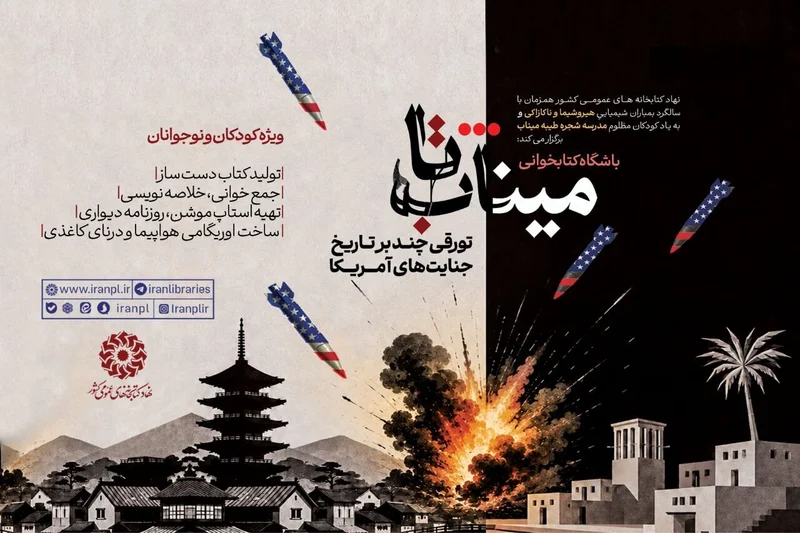
Iranian public libraries host “Toward Minab” reading club for children, teenagers
TEHRAN- Public libraries across Iran are currently hosting a special reading club titled “Toward Minab,” coinciding with the anniversary of the US atomic bombings of Hiroshima and Nagasaki and commemorating the children killed in the attack on Shajareh Tayyebeh Elementary School in Minab.
Organized by the Public Libraries Foundation of Iran, the nationwide cultural program is being held under the theme “A Glimpse into the History of US Crimes,” with the aim of familiarizing children and teenagers with historical events and the human consequences of war, violence and attacks against civilians, IRNA reported on Saturday.
The program has been designed in memory of the children of Shajareh Tayyebeh School in Minab, who were killed during an attack on the school in February 2026. The initiative seeks to use books and creative cultural activities to encourage younger generations to learn about historical events and reflect on the human costs of war.
As part of the program, children and teenagers are taking part in a range of book-centered and creative activities, including making handmade books, group reading sessions, writing summaries, producing stop-motion videos, preparing wall newspapers, and making paper airplanes and origami cranes.
The activities are being organized through the country’s public library network as part of efforts to promote reading, historical awareness and cultural engagement among children and teenagers.
The program also seeks to provide younger generations with an opportunity to explore historical events through books and creative forms of storytelling.
The “Toward Minab” program comes as Iran and other countries commemorate the atomic bombings of Hiroshima and Nagasaki, which remain among the most devastating attacks in modern history.
On August 6, 1945, the United States dropped an atomic bomb on Hiroshima, followed three days later by a second atomic bomb attack on Nagasaki on August 9. The US State Department’s historical records confirm that the two weapons were used against the Japanese cities during World War II.
The bombings killed and injured large numbers of civilians and left long-lasting consequences, including radiation-related illnesses and deaths. They also ushered in the nuclear age and have since remained a major subject of debate over the humanitarian consequences of warfare and the use of weapons of mass destruction.
In a contemporary reminder of the vulnerability of children during armed conflicts, Shajareh Tayyebeh School in Minab, in southern Iran’s Hormozgan province, was struck on February 28, during the opening hours of the US-Israeli military campaign against Iran. During the coordinated attack by the US and Zionist regime 168 people were killed, with the victims primarily schoolchildren and school staff.
Despite attempts by US and Israeli authorities to distance themselves from the carnage as images of the tragedy spread across social media, detailed forensic and digital investigations have painted a starkly different picture.
Human Rights Watch said its review of satellite imagery and other evidence indicated that the school itself was directly struck and called for a thorough investigation.
An analysis by Al Jazeera’s digital investigations unit, utilizing over a decade of satellite imagery and recent video clips, revealed that the school was a clearly distinct civilian facility, separated from any adjacent military sites for at least ten years. Furthermore, witness accounts and satellite-based analyses confirmed that the school was triple tapped by three separate, deliberate strikes, leaving no doubt about the nature of the attack.
The international community has faced mounting evidence regarding the responsibility for this atrocity, with investigations from major global outlets including The New York Times, BBC Verify, CBC, and NPR all concluding that the United States was responsible for the strike.
These findings have raised fundamental questions about the intelligence used to justify the bombing, as the patterns of the strike suggest a direct targeting of a civilian educational institution. The Minab school tragedy now stands as a somber testament to the immense human cost of the aggression and a focal point for those demanding international accountability.
SAB/