It begins, not unexpectedly, with chaos.
As I approach the taxi rank at Napoli Centrale, after a zippy Frecciarossa train ride from Rome, there’s a tussle between a cab driver and an aggrieved customer. Insults are hurled. Fists raised. This pantomime consumes the assembled fraternity of cabbies and queuing passengers. Eventually, a young policeman steps forward and the melee subsides – a brief yet telling glimpse of turbulent, combustible Naples. The Naples of legend.
And yet, the moment I climb in with my scruffily bearded taxi driver, it’s all Neapolitan charm. He belts out a tune about “Naples of a thousand colours” as his last-century cab rumbles over the cobbles of the city’s famously narrow streets. Rather than adhere to the set fare, he offers an apology for the fracas at the station and undercharges by a couple of euros. A tourist tip, instead of a tourist tax.
During my first visit to Naples, in 2004, a driver at the same cab rank took me for a spin way out of town – onto the freeway and back again – clocking a preposterous €100 ($160) fare. It was a bad time to be in town, at the height of a Camorra feud that killed dozens of gang members and innocent bystanders, often in public. In those years, the traditional proverb “See Naples and die” – originally coined to praise the city’s astonishing beauty – assumed a distinctly sinister undertone.
I tell the story of the two rides, 20 years apart, to the concierge at my waterfront hotel. “Ah, but the taxi drivers were hungry then,” he explains. “They are fat now. Just look at all the tourists!”
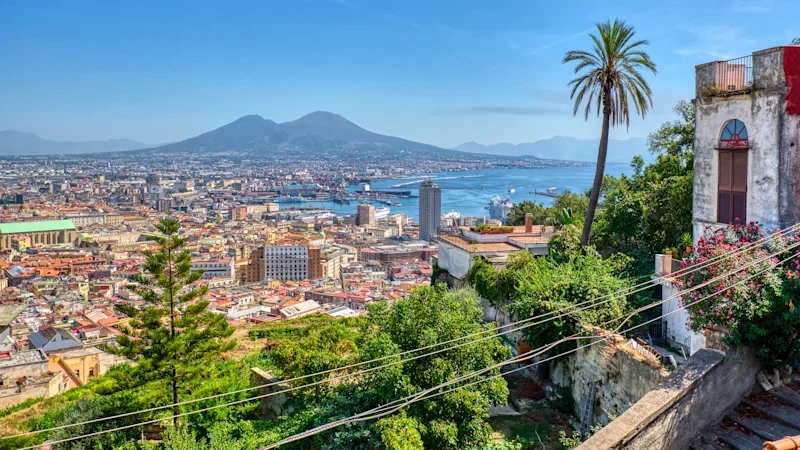
And he’s right. The crowds waiting nearby for ferries to Capri and Ischia, beneath a cloudless late spring sky, are heaving. But there’s a lot more going on in this grungy, glorious bayside city – the brooding cone of Vesuvius an ever-present danger and memento mori – than the seasonal tourist upswing.
Get exclusive travel deals delivered straight to your inbox. Sign up now.
The remake
As host city of next year’s America’s Cup, and in anticipation of an image reboot, Naples is being reconstructed at a frenzied pace. Chief among its harbourside projects is a €2.8 billion ($4.6 billion) development transforming an old steel factory at Bagnoli, on the harbour’s south-west industrial edge, into a swish sailing hub and urban park.
Fabrizio Cattaneo della Volta, a lawyer and president of the Royal Yacht Club of Naples, is predicting a long-term injection of €1.2 billion and an immediate €690 million boost, most of it from tourism. “But this is not only about hotel occupancy or increased activity for restaurants and hospitality businesses,” he says. “The event will also generate a global reputational effect. Images of the races between Castel dell’Ovo, Posillipo and Mount Vesuvius will be broadcast around the world, strengthening the image of Naples as a Mediterranean capital of the sea, culture and nautical elegance.”
Since my first visit, the city’s metro network has morphed into a series of sprawling subterranean art galleries, each station the work of a renowned architect. The jewel is Toledo station, designed by Spaniard Óscar Tusquets Blanca with a cleverly lit, moulded well-shaft hovering over the main escalator, lifting commuters towards a heavenly glimpse of bright Neapolitan sky.
The metro makeover culminates next year with the opening of Capodichino station at the international airport, a 50-metre-deep corkscrew of a thing designed by Rogers Stirk Harbour + Partners, a British firm founded by Richard (Pompidou Centre) Rogers.
But Naples’ renewal is not all about top-down infrastructure projects designed by global starchitects. Pockets of the old town are swept up in their own grassroots revival, a mix of precocious Neapolitan enterprise, generational change and generosity of spirit.
Diving into Sanita
There’s no better place to see this groundswell than the district, or rione, of Sanita. Lying just beyond the frescoed 10th-century Porta San Gennaro, dedicated to the city’s patron saint and embedded in the old city walls, Rione Sanita was once a sparsely populated valley with sweet country air, hence its name. It’s now a miasma of traffic and fumes with an almost subcontinental human crush. Sanita by name, though no longer by nature.
Only five years ago taxi drivers, I’m told, would drop their rides at the crime-stricken district’s edge. Now they prowl for work in Sanita. The biggest threat to personal safety these days is the speed at which taxis careen through streets embroidered with balcony-draped bucato, or public laundry.
My first stop in Sanita is its market, Mercato dei Vergini. I pass groceries splashed with the vibrant red of fresh San Marzano tomatoes, stalls selling cheap underwear and Maradona T-shirts, alimentari bearing pyramids of Parmigiano Reggiano, glistening white spheres of buffalo mozzarella, and vermillion haunches of prosciutto. Amid the characterful chaos are three ventures putting a new face on the city’s most famous, and famously troubled, enclave.
At pizzeria Concettina ai Tre Santi, each table is adorned with a consumable basil plant and its pizze – regarded by many as the city’s best – are carefully composed and seriously delicious, with sometimes theatrical twists on this Neapolitan staple. At the pastry shop Poppella, the fuss IRL and on social media is all about its wildly popular fiocco di neve, or snowflake, a soft little bun filled with ricotta and cream, dusted with a snowdrift of icing sugar. And at wine bar Antica Cantina Sepe, crowds from across town and abroad peak for Thursday night’s aperitivo hour.
All three ventures are run by young entrepreneurs with deep generational roots in the neighbourhood, a shared determination to strike out afresh, and a sense of communal purpose.
Beside the market, a baker invites me inside to inspect his antique oven. Along the way he offers a slice of the morning’s mozzarella delivery and a traditional tarallo. A savoury, peppery almond-filled biscuit, taralli were originally made with scraps of leftover bread dough fortified with lard for poor families. There are no austerity measures at nearby Poppella. I take an espresso at the bar teamed with a softly yielding, vanilla-scented snowflake, urged on by the patron and proud inventor of the fiocco di neve, Ciro Scognamillo.
In gravelly Neapolitan tones, Scognamillo tells how Poppella was founded about a century ago by his grandparents, Raffaele and Giuseppina. After the hard years of World War II, the bakery was left to their son, Salvatore, who in time passed it to Ciro. He presides over display cases filled with delicate pastries, but his genius move was to develop irresistible variations on Neapolitan favourites such as sfogliatella, a layered shell (sfoglia means leaf) filled with ricotta, semolina and candied fruit. Enter Scognamillo’s snowflake – delicious, affordable, and now in pistachio and chocolate.
It’s mid-morning and there’ll be time for pizza at Concettina ai Tre Santi and aperitivo at Antica Cantina Sepe. For now, though, there’s a much graver matter to explore. It’s a deep descent, literally and figuratively, into the city’s past.
The first settlements along the gulf of Naples were founded by Greek colonists some eight centuries before the birth of Christ. In Homer’s Odyssey the cultural memory of these westward migrations is preserved in the aspic of epic verse. The episode in which the wayward hero Odysseus resists the lure of sweet-singing sirens was linked, from the beginning of mythic time, with Naples – named Parthenope after one of the three siren sisters. While I’m in town, the National Archaeological Museum of Naples, one of the antiquarian world’s great wonders, is staging an exhibition titled Parthenope: The Siren and the City. It’s the perfect prep for what I’m about to experience.
Legend relates how Parthenope, rather than take her failure to seduce Odysseus lightly and move on, throws herself into the crashing waves. Her body washes up on the islet of Megaride where the city’s oldest fortress, Castel dell’Ovo, still stands. These mythic vapours get the story half right: Greek-speaking colonists settled on and around Megaride, founding a city called Palaeopolis, or old city, before shifting to a new city – Neapolis, later Naples – further along the shore.
Life and death
Lying more or less beneath the Mercato dei Vergini in Rione Sanita, 12 metres below ground, is a freshly excavated array of hauntingly beautiful ancient Greek burial chambers that take the visitor time-travelling down, down, down to the city’s earliest foundations in the 4th century BC. Though locals had long heard stories of what lay beneath their feet, the tombs of the Ipogeo dei Cristallini were excavated only recently and opened to the public in 2022.
I’ve spent half my life poking around ruins, from Olympia to Ephesus, Apamea to Aphrodisias, but I’ve not seen anything like the Ipogeo’s painted Medusa’s head in the best-preserved of the four chambers. The Medusa’s cheeks and brow still bear traces of original colour, an exceedingly rare feature. She has parted lips and wears a wreath of snakes. Her astonished eyes dissolve time.
The entire room is a work of illusionistic antique art. The floor is painted in imitation of terracotta tiles and the wall frescoes depict a leafy garland, a hanging serving bowl, a bronze candelabra. The dead were placed on sculpted sofas, or kline in Greek, the ancient source of our“recline”.
Suggesting a symposium, or philosophical dinner party, these benches were decorated with pillows sculpted from the volcanic tuff and painted blue and yellow. Alessandra Calise Martuscellia, the owner of the property who has overseen the excavation and preservation of the site, points to a seemingly insignificant detail. “Look,” she tells me, “there’s a little slot where visitors would place letters to the dead, keeping them abreast of things – bringing news. These burial spaces were conceived with the same care and sensibility reserved for noble houses above ground.” Though of the deepest antiquity, the tombs deserve their own chapter in the story of Naples’ rebirth.To shake off the sepulchral mood I take a walk through the teeming backstreets of Sanita where life and laundry are on public display. Like a tropical aviary, the streets are loud, densely packed and richly coloured. Small corner shrines, baroque facades, street graffiti and towering murals all compete for attention.
A pizza-led revival
It’s a little early, by Neapolitan standards, for lunch. But at this hour we manage to find a table at the enormously popular Concettina ai Tre Santi, through a half-height door into a narrow cloistered courtyard. I order three dishes: a pizza topped with yellow tomato, buffalo mozzarella and mountain oregano; an intensely flavoured calzone, and an upside-down pizza special named sott’ e ngopp in Neapolitan dialect. The latter is prepared at the table. The waiter applies a thick dollop of tomato sugo onto waxed paper and adds a dash of olive oil, a sprinkling of salt and parmesan, and a few leaves of basil. When a freshly fried and puffy pizza base is placed on top, I’m invited to tear the pastry apart and mop up the sauce. This pizza-with-a-twist would be little more than a gimmick if the ingredients weren’t so damn good.
The 33-year-old managing pizzaiolo, Ciro Oliva, joins me at the table. He started working at his family pizza business, established in 1951, at 14, and full-time since he left school. He describes this beloved neighbourhood as “very complicated”, infamous in the past for the gang warfare of the Camorra. “But this – me and my guys at Concettina – is a project for change,” he says emphatically. “I want to improve the lives of real people, simple people, the people of the neighbourhood.”
A city on the edge
Naples goes about its business with a pace and chaotic verve that belies its size and population of less than a million. Aristocratic piles visible from the city’s labyrinthine alleys command the heights of Vomero, Posillipo, and Capodimonte; the latter crowned by a world-class museum rivalled only by the Florentine Uffizi and the Vatican Museum in Rome. But enough of the city’s former palatial grandeur encrusts the shoreline and streets of the historic centre to impress upon any visitor the grandeur of the old Bourbon capital. Many of the 18th- and 19th-century palaces in the centre are painted scarlet in a nod to the famous Vesuvian red much-loved by the residents of Roman Pompeii, Oplontis, Bosco Reale and Herculaneum.
Without doubt there is an unkempt, abandoned, decaying air about much of the old city, as if little had changed since the bad days of the war and its aftermath. British travel writer Norman Lewis was sent to Naples as an intelligence officer as the Nazis withdrew and fascism crumbled, and in his moving account of that time, Naples ’44, he writes: “It is astonishing to witness the struggles of this city so shattered, so starved, so deprived of all those things that justify a city’s existence …”
Children were put to work prising limpets from rocks, “all the winkles and sea snails having long been exhausted … Nothing, absolutely nothing that can be tackled by the human digestive system is wasted in Naples. The butcher’s shops that have opened here and there sell nothing we would consider acceptable as meat … ”
There was no postwar economic miracle for Naples, no dolce vita. By the mid-1980s, when Argentinian soccer star Diego Maradona arrived to rescue the fortunes of SSC Napoli, the city was one of Italy’s, if not Europe’s, poorest. But in the new, or at least emerging Naples, the absence of commercial pressure on rental properties and abandoned industrial, residential and public buildings has managed – as it did in ’90s Berlin – to catalyse cultural entrepreneurship.
The most powerful expression of Naples’ cultural revival, wrapped in scaffolding on the week of my visit, is the €158 million redevelopment of the grand Real Albergo dei Poveri, or Bourbon Hospice for the Poor. A 354-metre-long 18th-century architectural masterpiece – famously left incomplete in 1819 – it’s slated to reopen later this year as a branch of the archaeological museum focused on the story of Pompeii.
A more modest, certainly more accessible, urban regeneration project stands in the heart of the steeply tilted Spanish Quarter, where an abandoned convent-cum-military hospital has morphed into a cultural and community hub. It’s market day when I visit Santissima, and the place is humming with a festive air. In and around a handsome 28-arch portico, a chilled weekend crowd browses for second-hand clothes, local artisan wares and, of course, lunch. I demolish a plate of traditional Neapolitan pasta and beans.
On the three upper levels, long and vaulted corridors give onto event spaces, exhibitions, art studios and a small cinema. From the lower levels there are teasing glimpses of Vesuvius and the bay through a leafy urban parkland. From the upper levels these views open into million-euro panoramas.
My visit to Santissima is arranged by Francesca Buccafusca, head of tourism and events network Destination Naples. And that night she invites me, along with her husband, Lauro, an orchestral composer, for seafood at Transatlantico on Megarida islet outside the biscuit-coloured buttresses of the 12th-century Castel dell’Ovo. We’re dining at the site of the city’s mythic origins – Parthenope’s resting place.
We take a table outside, with views across the bay towards Vesuvius and its benign neighbour, Mount Somma. Naples spreads out below, sinking into a violet light. I get lost in conversation, look up again, and the city is engulfed in pinpoint lights spreading across the flanks of the twin peaks.
Naples once was – and could be again – a wonder. “The locals are prone to nostalgia,” Lauro tells me. “Stay for any length of time and you will hear the phrase Napoli com’era.” Naples as it was. He flips open his phone and, with a wistful air, shows photos of 19th-century streetscapes.
Return to Sanita
On my last day in town, I’m drawn back to Sanita where young Neapolitans are leading the charge towards the future.
I take a seat on an upended wine barrel outside Antica Cantina Sepe and toast this extraordinary city with a glass of simple Campanian red, the house wine, just €3 a glass. Vespas course chaotically through the Mercato dei Vergini in the gathering twilight. I manage to get the attention of Francesco Sepe, the live-wire owner, modishly moustachioed and in almost pop-star demand from every table – a sure sign that the clientele is mostly local. “We are here for four generations,” he tells me. “The wine business started with my great-grandfather. One hundred years ago.”
The fame of Francesco’s Thursday night Aperi-Sepi, his riff on the standard Italian aperitivo hour, has spread far and wide. But he resists the lure of late-night bar hours, generally closing at 9pm even on these crazy-busy nights, and opening at 10 the next morning “so all the local women can come and buy their olive oil and wine”. Sepe, who claims to have seen three homicides in Sanita, is both an agent and a beneficiary of change. And yet he insists on the need to “stay together, the old and the young. It’s my mission to change, and to continue, not to break.” He surveys the throng before him. “If you don’t look behind you,” he says, “you can’t see the future.”
**FIVE INVALUABLE INSIGHTS INTO NAPLES **
Neapolitan novelsElena Ferrante’s Neapolitan quartet –
My Brilliant Friend, The Story of a New Name, Those Who Leave and Those Who Stay, and
The Story of the Lost Child– traces in evocative detail the lives of two young women growing up in postwar Naples. These much-loved works – the full set has sold 5.5 million copies – are published under a nom de plume, though Neapolitan-born translator Anita Raja is the prime literary suspect.
Naples ’44Norman Lewis’
Naples ’44is a searing account of life in the liberated city after the destruction of World War II and the moral debasement of the fascist years. One of the great travel writers of the 20th century, Lewis was in the city as a British intelligence officer and here he observes the antics of the Neapolitans and the occupying Allied army with a coolly detached eye. Wryly amusing, when not utterly tragic.
Journey to Italy
This 1954 film by Italian neo-realist director Roberto Rossellini regularly lands in “all-time best” lists of cinema classics. Journey to Italy stars Ingrid Bergman, then married to Rossellini, as a woman stuck in a sterile marriage, swept away figuratively and literally by the vibrancy and pathos of Naples. The surging crowd scene during the procession for San Gennaro is justly famous.
Parthenope
This 2024 film by Neapolitan-born director Paolo Sorrentino is a languid celebration of the beauty of Naples – of beauty itself. His other coming-of-age Neapolitan film, The Hand of God, is more richly autobiographical and, at the same time, more revealing of the city’s love-hate relationship with the Argentinian footballer Diego Maradona.
Diego MaradonaIn painful, painstaking detail assembled from previously unseen footage, this 2019 documentary by British director Asif Kapadia charts how Maradona almost single-handedly changed the fortunes of the languishing football club SSC Napoli, and of Naples itself. It helps explain the complicated hero-worship of Maradona still evident everywhere in the city.
THE DETAILS
FLYEmirates code-sharing with flydubai flies one stop from Sydney and Melbourne to Naples. See emirates.com
TRAINFrequent direct trains run daily between Rome and Naples in a little over an hour.
STAYThe harbourfront art hotel Romeo Napoli, walking distance from the main ferry terminal, has peerless views of the Bay of Naples and Vesuvius, with rooms from €555 a night; see slh.com; theromeocollection.com/en/romeo-napoli/ Or stay in the upmarket, centrally located neighbourhood of Chiaia in the well-run Monteroduni 22–Chiaia Design Rooms, from €138 a night; see monteroduni22.com
MOREitalia.it/en
The writer travelled with assistance from the Italian National Tourist Board, Romeo Napoli and Destination Naples.