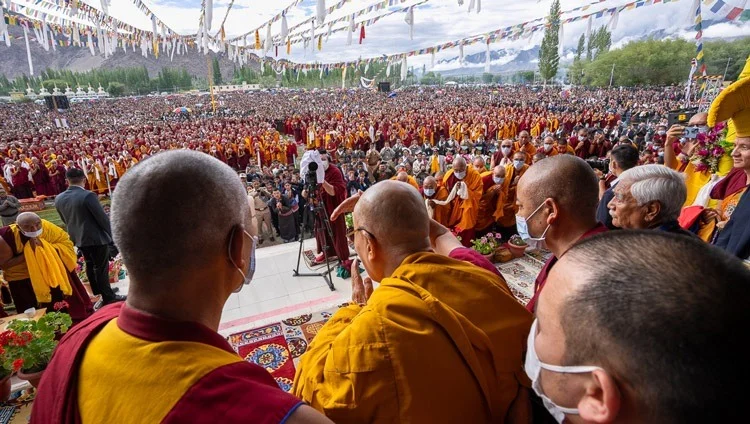
His Holiness the Dalai Lama (the 14th) gives annual public teachings at his temple in Dharamsala. This year, they were given every day for about two and a half weeks at Namgyal Monastery Temple and attended by several thousand people roughly divided into three categories: monks and nuns, Tibetans, and Western sangha (community of spiritual practitioners). People trekked and travelled far and wide to get to Dharamsala, walking for miles or sitting on buses for days. Westerners flew in from all corners of the globe.
We had all come to see and hear the spiritual leader of Buddhism and be blessed by his holy presence â to receive profound teachings on the path to enlightenment and how to achieve freedom from cyclic existence and liberation from suffering.
There was a strong atmosphere of spirituality and peace, which coexisted with the noise, dirt and dust of samsara (cycle of birth, death and rebirth in Buddhism), which is very visible in India. High-ranking lamas, monastics, lay disciples, travellers and seekers of truth and enlightenment, ordinary persons, beggars and lepers all coexisted in a country where samsara and nirvana (release from suffering) are both accessible, depending on your state of spiritual evolution.
We had a busy schedule. After a breakfast of banana porridge, muesli with fruit and honey, orange juice and coffee, we walked down to the temple, weaving our way between potholes, taxis and beggars, in good time to clear security and secure our seats. It was necessary to get to the temple about an hour before in order to get through the tight security.
This entailed standing in long queues in the hot sun, waiting your turn to go through the metal detector and the body and bag search. It took time. Once seated in the temple courtyard, you couldnât budge for the next couple of hours, even to go to the toilet, as there were just too many people to squeeze through.
The arrangements in the temple consisted of three separate seating areas: up front for the monks and nuns; the Tibetans on one side under some trees; and Westerners on the other side under a roof. It was possible to âreserveâ your seat before the teachings started by writing your name on a large piece of cardboard and taping it to the floor. This served as your âseatâ for the next two weeks.
I was lucky and managed to secure a place on the edge of the Western area, in front of a pillar, which gave welcome support to my back. Maurice sat in front of me. It was nice being on the edge as there was a bit of space, so you didnât feel hemmed in on both sides by the people who squashed into the temple like sardines.
Reverence and joviality
The large temple was filled to overflowing. The atmosphere was reverent and jovial, with Tibetan families bringing packed lunches, which they generously shared with those sitting near them.
Conditions inside the temple were tough. You sat on a cushion on your little piece of cardboard on the hard concrete floor, with no space to stretch your legs. Most people didnât have any back support (there were only a few pillars that supported the roof).
In the afternoons, the hot sun streamed under the roof, and if it rained, the wind blew the rain under the roof. This was one disadvantage of being on the edge. A few times we used umbrellas, but the rain still dripped off them and made us wet. A lot of merit must be accumulated attending teachings in such conditions.
Sometimes, we sat outside in a grassed courtyard to avoid the crowds squashed into the main courtyard and bypass the long queues to pass through security. It was more comfortable and there were stunning views of the snowy mountains, but you couldnât see the Dalai Lama and missed the atmosphere inside the temple courtyard.
The dust and dirt, pollution, overcrowding, noise of taxis and tour buses (Indians love their hooters), travelling on dreadful roads that bump and jolt you to pieces, sitting on the hard temple floor for hours with hardly any room to move â what made it all worthwhile was receiving the most wonderful and profound teachings directly from the Dalai Lama, being in his presence and seeing him every day.
Profound teachings
The day started with chanting of prayers and mantras by the monks. The Tibetan monks chanted with low, growling undertones, which reverberated through my body and mind, and vibrations emanated from the temple in all directions.
Listening to this was a powerful experience. Everybody stood up and bowed as the Dalai Lama entered. He walked up a central aisle to a large platform in front of the temple. As he passed by, people offered him white khatas (blessing scarfs).
He walked in a humble posture with a half bow. He chatted to some people, patted some on the shoulder, and blessed objects held up to him. There were security personnel with guns in front and behind him. He prostrated three times before the throne, then climbed up some steps and sat on the throne, which was like a large high chair, covered with richly coloured embroidered silk cloth.
He sat at the entrance to the temple and was surrounded by senior lamas, monks and nuns. The audience stood and prostrated three times to him and then paid homage to the lineage and all buddhas (awakened ones) and bodhisattvas (enlightened ones who help sentient beings end their suffering).
The teachings were in Tibetan, but simultaneously translated into most major languages. We listened with small transistor radios and earphones. The Dalai Lama spoke for about four hours â there was a tea break in the middle and the monks served everybody from huge stainless-steel teapots. If you donât like butter tea (definitely an acquired taste), hide your cups away.
The teachings were profound and totally opposite to the ânormalâ worldly way of thinking, so they really blew our minds. The Dalai Lama is a very sophisticated teacher, so much of what he said went over our heads, but we were assured that it penetrated our deeper consciousness and made an impact on us, even if we didnât understand at a conscious level.
Falling for Buddhism
This was our introduction to Buddhism, and we certainly fell in at the deep end. The Dalai Lama does not believe in âinstant enlightenmentâ. The Lam Rim path to enlightenment is a gradual, graduated path.
âWhen we plant a seed or a sapling, we do not expect to get fruit and flowers immediately. We must let nature take its course. If we try to violate the law of nature and expect sudden and instant enlightenment, we will be disappointed,â the Dalai Lama told us at the outset. He told the Western sangha to practise the perfection of patience, and jokingly said that we must stop looking for âpush-button enlightenmentâ.
He continued: âYou Westerners come from an instant-coffee society, but enlightenment is not like instant coffee. Enlightening experiences are unstable, like the Tower of Pisa, and you will come crashing down. You are too impatient and ambitious, and try to get to the top too quickly. This doesnât work, because you have to start at the bottom and slowly work your way up.â
I learnt that small awakenings are given as acts of grace on the spiritual journey (perhaps as enticements), but much hard work and purification follows before the mind and heart are transformed and the enlightened nature is fully manifested.
I really connected with this approach, as I have had enlightening experiences or satoris, but they didnât last and I came crashing down. It was reassuring to hear that we shouldnât have unrealistic expectations. Some transformation did happen with these experiences, and they have the power to change the course of your life. But old mind patterns and negative emotions are deeply rooted and will return to haunt you.
Enlightenment and purification are slow and often painful processes. You canât just get from here to there, samsara to nirvana, in one easy step. There is a path or journey to enlightenment, and it consists of progressive stages, the one leading to the next. You have to walk this path, step by step, and there are no shortcuts. Buddhism provides a beautiful path.
I have found Buddhist philosophy extremely helpful. Buddhism is non-theistic (neither theistic nor atheistic), although it may be said that nirvana is another word
for heaven. The Buddhaâs teachings are concerned with finding the peace and freedom of the enlightened state of being, our âBuddha natureâ. It is an extremely practical and helpful religion and philosophy of life because it teaches the causes of suffering and the path leading to the end of suffering. Something we all want to know.
We needed a solid framework and guidelines that we could trust, and we found what we were looking for in Buddhism.
So, Maurice and I became Buddhists. This involved taking refuge in the âthree jewelsâ: the Buddha, the dharma (the teachings or laws of the Buddha), and the sangha. We need wisdom and guidance, so we take refuge in the Buddha. We need a spiritual path to protect us and keep us safe, so we take refuge in the dharma. We need the support of spiritual friends to keep us on the path, so we take refuge in the sangha.
This officially made us Buddhists. When you take refuge, you are born into the family of the Buddha. You become a child of the Buddha. DM
Buy Leela Verityâs Spirit @ Rest from Audience of One Media for R320 here or on Amazon South Africa here.
For more information, a review copy or to arrange an interview, please contact Jean Pieters on jpieters_za@hotmail.com.
This story first appeared in our weekly DM168 newspaper, available countrywide for R35.