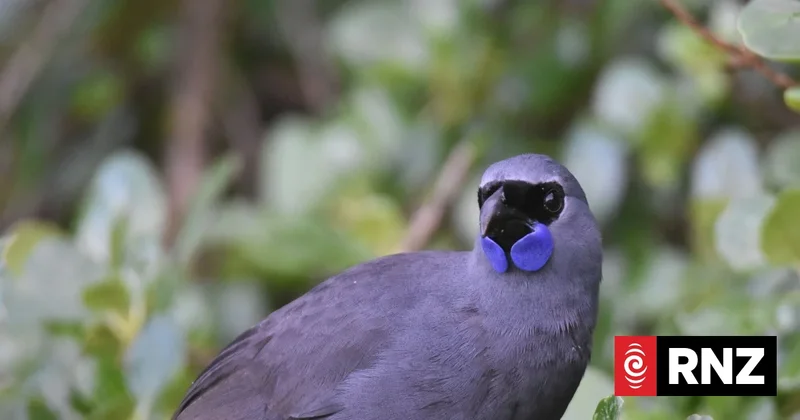
Taranaki Kōkako recovery to get $1million boost
A funding boost will enable a Taranaki conservation group to extend work protecting the region's recovering Kōkako population.
The East Taranaki Environment Collective (ETEC) has received $603,760 from the Department of Conservation Fund.
It will be used for predator control, habitat restoration, and monitoring across more than 46,000 hectares of native forest and ecosystems in north-eastern Taranaki.
Meanwhile, Te Kāhui o Taranaki will receive $432,840 to map, monitor and restore critically endangered coastal turf ecosystems within the Taranaki Iwi rohe.
The Iwi-led project would carry out restoration planting and involve local communities in the long-term protection of this rare habitat.
ETEC welcomed the investment in its North-East Taranaki Kōkako Landscape Project, which was also expected to leverage more than $1 million in additional cash and in-kind support from partners, landowners, organisations and volunteers.
Project partners included Te Runanga o Ngāti Tama, Tiaki Te Mauri o Parininihi Trust, Ngāti Maru, Te Runanga o Ngāti Mutunga, East Taranaki Environment Collective and NZTA Te Ara o te Ata Pest Management Area.
Tiaki Te Mauri o Parininihi Trust chair, Davis McClutchie, said the funding was significant for kōkako recovery in Taranaki.
"The successful recovery of kōkako requires much more than moving birds. It relies on long-term investment in predator control, habitat restoration, monitoring, and strong partnerships between iwi, landowners, community groups, and agencies.
"This funding enables us to continue that work at scale while creating valuable opportunities for our uri and community partners to build skills and knowledge through kōkako surveys, monitoring programmes, field training, and hands-on conservation experience."
McClutchie said building local capability was critical to the long-term success of the kaupapa.
"By involving whānau and communities in monitoring and management, we are growing the next generation of kaitiaki while strengthening the collective effort needed to restore biodiversity across the north and eastern Taranaki landscape.
"Kōkako are becoming a powerful symbol of what can be achieved when people come together with a shared vision for the future of our environment and the wellbeing of generations to come."
The investment came at an exciting time for kōkako recovery in Taranaki, he said.
Monitoring showed encouraging signs that populations were breeding, expanding and potentially reconnecting across the wider landscape, reflecting years of sustained predator control and habitat protection.
ETEC Chair Rob Maetzig said the funding was more than an investment in a single organisation.
"This project focuses on joined-up action to protect kōkako populations in North East Taranaki. It is also a major win for the wider collaboration underway and a step towards the vision of an Eastern Taranaki biodiversity corridor, stretching from Parininihi to Whanganui National Park."
Maetzig said no single organisation could achieve landscape-scale conservation alone.
"The success of this work depends on strong relationships between iwi, community groups, landowners, funders, councils, businesses and government agencies. This funding helps strengthen those relationships and accelerate the work already happening on the ground."
The project demonstrated how government investment can amplify community effort and attract co-investment, he said.
"Together we are creating healthier forests, stronger wildlife populations and a more resilient landscape for future generations."
Conservation Minister Tama Potaka said the Taranaki organisations were valuable allies in the battle to restore habitats.
"This is what good conservation investment looks like. Government backing local ambition, with Iwi, landowners, community groups and volunteers bringing funding, time, expertise, and practical support to the table."
Potaka said that through collaboration, taxpayer funding could achieve greater outcomes.
"From the coast to the ngahere, this is mahi tahi in action. Our government, Iwi, landowners, community groups, and volunteers combining their strengths to deliver lasting gains for Taranaki's environment."
The Taranaki projects were the first to be announced from the 2026 DOC Community Fund, with further announcements to follow across the country.