I have always found used flagship Android phones quite tempting, considering the price and the hardware.
However, the idea was equally difficult to trust. While the hardware could still be excellent and the price lower than most mid-range phones, the discount hid an expiration date.
By the time the device was affordable, it was close to its final Android upgrade or security patch. The Google Pixel 8 and Samsung’s Galaxy S24 changed that equation.
Our Google Pixel 8 review and Samsung Galaxy S24 review show that these former flagships are still top-notch when it comes to displays, cameras, and basically everyday performance.
In comparison, their prices now overlap with some of the best budget Android phones, while having years of software support at their disposal.
Seven years of updates do not make every used phone great, but they remove the main reason I once avoided them. The second user can finally benefit from the rapid depreciation without compromising on the software.
Used Android phones had a timer
And the discount had baggage
Buying a used Android phone is awkward — you’re happy about the price, but the software clock kept ticking, so you couldn’t get the most out of your device.
Samsung’s three-year commitment for the Galaxy S20 series was promising, but buying the same phone a few years later would have given me more anxiety than having it fall off-screen on concrete.
It was two years later when Samsung offered four generations of Android and One UI upgrades plus an additional year of security updates.
Even then, waiting a year or two for a better deal would have lost a significant chunk of time from the supported period.
The hardware is typically fine on these phones, especially since the silicon race has changed how we view performance.
Older flagship Android phones can outperform a new budget phone, but the latter would have more breathing room than the former, as far as software support and new features are concerned.
This idea is hard to ignore and one of the reasons I always opted for a new one on day one rather than two years apart.
It’s not even about the flashy new features on Lock Screen. I carry banking apps, passwords, messages, photos, and work accounts on my phone. I can live without notification summaries, but not security fixes.
A used phone doesn’t make sense if I have to replace it before the hardware wears out.
Seven years change the math entirely
The second owner gets a turn
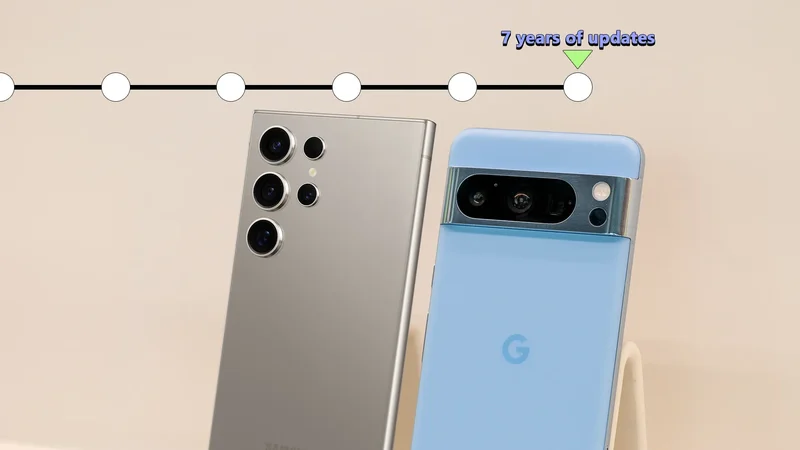
Google has promised seven years of OS and security updates for the Pixel 8 series and all newer models.
The software support clock starts at launch, and while the prices can fall, they will not consume the entire support window.
I bought the Pixel 8 two months after its launch and have peace of mind that it will be supported until 2030.
If you want to buy one today in 2026, it should receive roughly four more years of upgrades, bug fixes, and Pixel Drops. This is an amazing feat for a used phone that launched over two and a half years ago.
The Galaxy S24 lineup shared a similar story. That makes a two-year-old phone easier to consider as well as recommend.
Depreciation finally helps
Flagships become affordable
Android phones are known to drop their original value, and while it hurts when I buy one at launch, it also helps when I look for a secondhand device.
The Pixel 8 launched at $699, and in August 2023, the refurbished model can be obtained for as low as $280, depending on the condition and storage. The same goes for the Galaxy S24, which launched at $799 and can be bought used for about $320.
This only goes on to show that both devices have lost more than half of their original value but still retain years of support.
At this price point, I would compare a used Android phone with a new budget phone.
The new device would give me an untouched battery and warranty. The older flagship, on the flip side, may have better cameras, display, performance, and wireless charging, but software would no longer decide for me.
Refurbished feels safer
The market grew up
Other than my personal inclination towards used handsets, the market gives me more confidence. IDC forecasted a 3.2% growth in used smartphone shipments in 2025, compared to 1% growth in new phones, aided by trade-ins and improved refurbishment.
Google and Samsung now participate in their respective refurbished programs.
Google’s Certified Refurbished program inspects Pixels, checks their batteries, uses genuine parts, and includes a full year’s worth of warranty.
Samsung does the same, and even though these phones cost more, it comes with peace of mind.
For me, a “used” phone could only mean being cleaned and reset, but a refurbished phone is thoroughly inspected, tested, and above all comes with assurance.
The seller matters the most when buying an older phone, and it can make the difference between finding a good bargain and inheriting somebody else’s problem.
Software updates cannot fix hardware
Batteries still get old
Make no mistake, a healthy phone is not defined by the number of years of software support left. A bad battery or a faulty charging port cannot be fixed with seven years of software updates.
Before buying an older model, I would always conduct my model-specific research on faults that came bundled with the package at launch.
Google has an extended repair program for some Pixel 8 phones that were affected by display lines and flickering. While it doesn’t make all models prone to display issues, I would still conduct a thorough screening from my end.
Battery health and a phone’s repair history are almost as important as the software update deadline.
I would check the display, charging port, cameras, speaker, and IMEI number before buying, which are some things that are in my control.
I can also select a seller who clearly explains the situation with the battery and offers a proper return window just in case.
However, hardware problems can be easily addressed compared to expired software support. This means I can easily replace the worn-out battery or replace a phone with a faulty display.
However, I cannot convince Google or Samsung to send me more OTA updates after the device reaches the end of its support period.
Companies are also improving their repair programs.
Google has promised to make replacement parts available for the Pixel 8 for seven years. So, no matter how long the updates run, it will not keep the hardware healthy, but available parts and a reputable seller can prevent older phones from becoming a risky purchase.
Count the years left
Cheap can cost more
Don’t make a mistake. The seven-year promise a company makes on its product page is not the number I care about when buying a used Android phone.
The main thing I want to know is how long it will be before the software support ends.
The $280 Pixel 8 is a rough example of what I mean. With four years of support left, it costs $70 per supported year.
On the contrary, a $150 phone with only one year of software support remaining is cheaper at checkout but could be worse value if I plan to keep it longer.
However, that calculation cannot measure the battery health of a used phone or the camera quality. It can only project the software support against the buying price.
New phones should age better
Longevity goes beyond updates
The future is better with respect to used Android phones, as smartphones are getting more powerful, more efficient, and better equipped to handle long-term use.
This does not only apply to the internals but also to the design. Flagship models now use harder build materials, and displays are more efficient and consume less energy despite being brighter.
On the inside, silicon-carbon batteries can fit more capacity into the same space, and adaptive charging is set in place to protect against aging.
Flagships are also putting enhanced thermal solutions in place to keep the device and the battery cool. There are also various battery protection features, which can reduce unnecessary wear.
More efficient processors and kernel-level improvements also help devices consume less power and produce less heat.
All of this matters because extended software support is only useful if the hardware can keep up.
If new phones can hold up better against aging when it comes to battery and performance, they should become stronger candidates for secondhand options.
By the time current phones reach the same stage as the Pixel 8 and the Galaxy S24, they will be in even better shape thanks to all the advancements.
The used phone era is just starting
For many years, I have treated Android’s weak resale value as one of the major drawbacks of the platform. Now, the seven-year support is starting to turn that weakness into an advantage.
A phone can finally lose most of its original price, but without losing most of its useful life. I no longer have to pay a hefty price to get capable hardware that will last me years to come.
I think buying a previous generation flagship could become a smarter default for many users, and it’s only the beginning.
That shift could also change how I think about upgrading. I can either keep the phone longer or pass it on knowing that it will remain secure.
This kind of support not only benefits the first owner; it gives the device a second life later on.