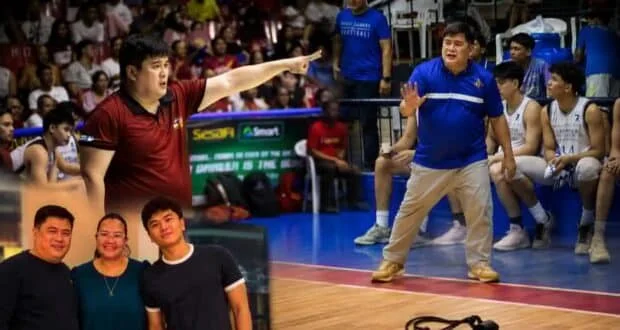
CEBU CITY, Philippines — Coach Rommel Rasmo celebrated another Cesafi juniors basketball championship in 2025, marking his 21st year leading Sacred Heart School-Ateneo de Cebu.
But this triumph, he said, was different from the rest.
Every previous championship, he said, had grown out of the same rigors — sleepless nights, coaching staff arguments, and seasons that were never as smooth as the final scores suggested.
“Every year is really the same. We really work hard. A lot of sleepless nights, a lot of arguments,” he said.
But in 2025, the first time, he lifted the trophy alongside his own son, Keenan, who suited up for the team.
“That’s a big [thing] for me,” Rasmo said.
READ: FACES OF CEBU: Lawrence Mangubat, Basketball MVP
Not from here
Rasmo, 47, is not originally from Cebu.
He was born and raised in Bacolod City, one of four brothers.
As a boy, he would draw basketball courts on cardboards and stage make-believe practice sessions using his older brothers’ empty deodorant and cologne bottles as players. He later transitioned to using chess pieces to craft play plans and defense diagrams, well before he ever held a coach’s clipboard.
“I think it started there,” he said.
By his second year of high school at St. Joseph-La Salle, Rasmo was already playing at the junior varsity level,which meant he wasn’t allowed to join intramural basketball matches.
Rather than switch to a sport like volleyball, however, he began coaching his own classmates’ intramural team instead, a role he would keep taking on, informally, for years.
He got his first shot at college basketball after high school, trying out in Manila in 1996 for the fledgling program of Philippine Christian University, then a new name in the National Collegiate Athletic Association. The team remained winless during that first season.
Two years later, seeing no clear path forward in Manila and intent on continuing his studies without needing more money from his for tuition, Rasmo returned to Bacolod and tried out for the University of Negros Occidental-Recoletos (UNO-R), where he stumbled into a coaching career almost by accident.
Drawn by free tuition
Rasmo agreed to become an assistant coach for UNO-R’s grade-school team, later realizing the role also came with free tuition.
“Kailangan ko mag-report sa practice para makalibre… para mapasok ako, mabigyan ako scholarship,” he recalled asking the school’s athletic director.
(I needed to report to practice so I could study for free, so I could get a scholarship.)
Somewhere along the way, however, something changed.
“More than that, I think it’s more on [the fact that] na feel ko talaga na gusto ko talaga mag-coach,” he said.
(More than that, I think it’s more that I really felt like I really wanted to coach.)
That was in 1998.
Rasmo spent the next seven years coaching age-group teams at UNO-R, starting with 10-and-under and 12-and-under squads and eventually moving to older teams, before an opportunity in Cebu changed the course of his career.
Coming to Cebu
In February 2005, Rasmo received an invitation to serve as coach at Sacred Heart School-Ateneo de Cebu. He moved to Cebu that May.
He arrived expecting to split his time as a physical education teacher and basketball coach, but found himself unable to commit to a role where his heart was not.
“Hindi ko nakikita sarili ko na I’ll be there by 7:30… [and stay for] eight hours,” he said.
(I didn’t see myself being there by 7:30 a.m. and staying for eight hours.)
He eventually convinced the school to let him focus solely on coaching.
He started as an assistant across several Sacred Heart age-group teams before being named head coach of the grade-school program within a year, part of what he calls a slow, steady progression rather than a single big break.
Runner-up no more
Since then, Rasmo’s Sacred Heart-Ateneo program has become one of Cesafi’s most successful, winning five championships through the 2010s on top of a run of Milo Best titles at the local, regional, and national level.
But the run was rarely smooth. In 2011, his team blew a 10-point lead at the end of a bruising five-game series and lost the Cesafi finals by three points.
In 2018, Sacred Heart missed the playoffs for the first time since 2009, a 4-5 finish that Rasmo said came down mostly to close losses rather than being outplayed.
Even that season, he explained, was part of a larger plan.
After 2018, Rasmo and his coaching staff sat down and mapped out a five-year rebuild good until the 2023 season.
Then the pandemic struck.
Close to quitting, Covid bubble
When Covid-19 lockdowns shut down contact sports in March 2020, Rasmo said he genuinely believed his coaching career, and Sacred Heart’s program, might be over.
“I really thought, to be honest, I really thought, tapos na. Wala na,” he said.
(I really thought, to be honest, I really thought, this is over. It’s gone.)
What kept the program alive, he said, was a longtime benefactor of Sacred Heart’s basketball program. When Rasmo mentioned he assumed their monthly sponsorship had stopped, the benefactor told him it never had.
With that support, Rasmo shifted training online, running dribbling and shooting drills over video calls while players logged in on camera, much like an online class.
By mid-2020, he had moved a small group of recruited players into the Sacred Heart dormitory to live and train together, enforcing a strict quarantine and testing protocol for anyone joining what had effectively become a basketball bubble.
“Thankful talaga ako doon,” he said of the arrangement, which allowed his players to keep training together while other programs restarted from scratch when contact sports returned in 2022.
(I am really thankful for that.)
A newer, harder build
In 2023, Rasmo took on a second head coaching role at the University of the Philippines Cebu men’s basketball team, a program still building its foundation in Cesafi.
The team won only two games in its first Cesafi season. For much of 2024, the team played few tune-up games, focusing instead on internal practices as the roster worked to build chemistry.
“Ang isang philosophy ko dyan… when going to the season, at least maka-20 games,” Rasmo explained, emphasizing the importance of shared court experience.
(One of my philosophies is that going into the season, you should have played at least 20 games.)
Sacred Heart typically plays 32 to 33 games before the season. UP Cebu had eight before its 2024 Cesafi opener.
That patience eventually paid off. By the time the State Colleges and Universities Athletic Association (SCUAA) tournament rolled around, UP Cebu’s roster had enough shared minutes from Cesafi to click, capped with a national SCUAA championship.
Budget constraints remain UP Cebu’s biggest obstacle, Rasmo said, including a stretch in mid-2025 when the school’s free canteen support for the team lapsed, sidelining practice for weeks while several players turned to paid “panalay” games just to get by.
Ready for adversity, not just victory
Talent, Rasmo emphasized, is not what has kept both programs competitive for so long.
“Planning and preparation,” he said. “That’s the key.”
He welcomes tough tune-up games over lopsided blowouts, even if it means losing a few games, so his players learn how to execute in tight games and overtime finishes before it truly counts.
“Mas gusto ko talaga, hinahanap ko dyan, maka-experience kami [ng] close fight,” he said. “Kasi doon na ma-develop. You’re developing them, character.”
(I really prefer it, I look for that, so we can experience a close fight. Because that’s where they develop. You’re developing them, their character.)
He also insists on rotating playing time deep into his bench, even when his starters are performing well, so that a “next man up” is never caught unprepared when a starter has an off night.
When his teams face tough stretches, Rasmo leans on a famous lesson shared by a fellow coach following Sacred Heart’s grueling 2018 season, a principle attributed to NBA legend Gregg Popovich: a stonecutter may hammer at a rock a hundred times without a single crack showing, but on the hundred-and-first strike, it splits, not because of that final blow alone, but because of every strike that came before it.
“Padayun lang,” he said. “Mabuak mo rin yan.”
(Just keep going. You’ll break through eventually.)
A 24-hour job
Rasmo said he did not finish college, and that it’s part of what pushes him to work harder at his craft.
Coaching, he explained, isn’t something you simply clock out of at the end of the day; it’s something that follows you home.
“Sabi nila, coaching lang, kala niya 4 hours job. For me, it’s a 24 hours job,” he said.
(They say it’s just coaching, they think it’s a four-hour job. For me, it’s a 24-hour job.)
That has only worked, he said, because his wife and son have learned to recognize when his mind is still on basketball, even during family time, and to give him that space.
“Very important talaga naman na maintindihan ng partner mo,” he said.
(It’s really very important that your partner understands you.)
More than basketball
Rasmo said his proudest legacy isn’t just each player who went on to play professionally or in the UAAP, though he’s proud of them too, but also the ones who quietly became engineers, architects, doctors and lawyers using lessons learned on his court.
“I’m just using basketball as a tool to teaching life,” he said.
Two of his former Sacred Heart players, Lucky Ecarma and Gio Laguyo, have since joined his coaching staff, balancing coaching with other work.
Staying in Cebu
Rasmo said he sometimes dreams of coaching at a higher level, but prefers to stay close to his family in Cebu.
“Ayoko mag-base sa Manila,” he said. “I’m more [focused] now on my family.”
(I don’t want to be based in Manila. I’m more focused now on my family.)
For now, both his programs head into another season the same way they always have: with games logged, minutes earned, and no shortcuts.
“Winning the right way.”
That, he said, is the goal.
“Not only in Sacred Heart, even in UP.”