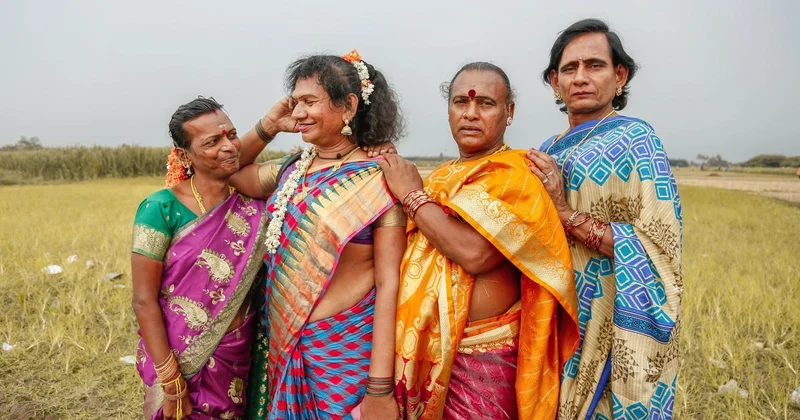
The complexity of South Asian gender and queer expressions can’t be contained by the Anglophone queer theorisation. First, because any such exercise makes one engage with South Asia’s rich and textured myth-historical past. Second, it’s this inheritance that renders the contemporary, contextual meaning to modern-day queerness, making the latter always in conversation with its past, enabling imagination of collective queer futures.
It’s not that South Asian queerness refuses to offer a comprehensible template. It just doesn’t offer an easy one, which is why artists must invent ways to engage creatively to effectively and authentically portray queer expressions. One such work is Shino Cherian’s debut photobook Souls of Someone: Myth, Magic and Mourning in Koovagam.
“Art is born out of an ill-designed world” reads a part of the epigraph that quotes Andrei Tarkovsky in the book. Activist Grace Banu in her Foreword to the book expands on the idea, and Cherian’s desire to explore and document the Koovagam festival.
Banu writes, “The brilliance of this work lies in Shino’s willingness to ‘unbecome’ the person he thought he was. He admits to his early hesitations, the knot in his chest and the queasiness of overthinking.”
This overthinking aspect stems from the fact that the “authenticity” of the one looking at the other is often questioned. Their intention is scrutinised by critics, and naturally so, because in all fairness, these questions must be asked. However, it’s better when these questions bother the artist, and don’t come from the critical gaze of the observer analysing the artist’s works. For example, it was Cherian who thought: “Do I deserve to document these lives? Will they see my camera as just another outsider’s gaze? Will they consider opening up to me?” These doubts can sometimes hinder one’s decision-making, discouraging them to create art. It’s in such moments that an artist can benefit from some external validation.
In the Prologue to this book, Cherian notes this coming from his collaborator, Ram Manu Prasad, while pursuing to cover the Koovagam festival. They would usually align in the “darkroom, where light and shadow revealed a shared desire to capture the ‘truth’.” A friend from NEO Film School, Manu Prasad had shown “Instagram images tagged #HumansOfKoovagam – radiant photos of transgender people in paddy fields, their saris blazing like the countless shades of a glorious sunset.” It was he who had said, “Let’s do it”. Something that “set [Cherian’s] heart racing” and the duo found themselves agreeing to go and cover the festival, though they could only manage to witness the last two days of the 18-day celebration.
Koovagam festival
The mycelial legacies of the festival are effectively established in the book. To summarise, the son of Arjuna with Naga princess Uloopi, Aravan, had to sacrifice himself in order to enable the Pandavas’ win in the Kurukshetra war.
Per the Mahabharata, the man who had to agree to sacrifice himself must exhibit exceptional qualities. The ones that fit the bill – Arjuna and Krishna – couldn’t be sacrificed, so it was Aravan, a minor figure, who had to agree for the cause. But no story from any epic or otherwise in South Asia comes without a caveat. In this one, it came with Aravan’s wish to get married. “So Krishna married Aravan by taking the form of a woman named Mohini; the only female avatar of his original form of Vishnu.”
In “The Sudden Blaze of a Flash”, Cherian describes meeting Madhu who was also taking pictures of trans women at the festival. A frequent chronicler of the festival – or someone who is drawn like so many others to Koovagam each year, Madhu told the curious duo that the “transgenders and transvestites are considered the wives of Aravan, which, as you might be able to guess, is where the term ‘aravani’ comes from.”
At this festival, “the aravanis first marry Lord Aravan – who also came to be known as Koothandavar – and revel in their joy of being married, tying thalis around their necks and wearing colourful bangles on the first night. But as the procession of Aravan goes through the village the next day, the brides break their thalis and bangles and mourn their widowhood through ritualistic dancing: this whole cycle re-enacts the ancient story of Aravan’s sacrifice during the Kurukshetra war.”
Much like the diverse community of trans people who must go through a whole cycle of rituals, celebrating their personhood, melding with the milieu to participate in workshops organised by several NGOs raising awareness about HIV/AIDS or attempting to minimise and erase the societal stigma around trans and nonbinary identities, and celebrating trans joy by participating in a beauty pageant, Cherian and Manu Prasad did have quiet a journey arriving at Koovagam festival.
Arriving in Koovagam
The journey preceding their arrival in Koovagam is effectively narrated in the photobook because of a school-time habit that Cherian had, making notes and documenting his everyday life in his diaries. But the emotional register of this book shines through the pages from the chapter titled “Arriving in Koovagam.”
In it, Cherian describes meeting the “old man wearing a red shawl and loose dhoti sitting next to [him]” in a train. This man had told him almost everything about the festival. Before their arrival in the magical land, the magic had presented itself. Try this: “The familiar cocktail of emotions stirred again: terror swirling with joy. The old man walked out of the train and was nowhere to be seen, gone as surely as dust motes in the rays of the sun.”
There are striking images that precede the chapter. One is of a transwoman whose odhni markedly filters the light coming from the setting sun, which is a perfect sphere in the snap. There’s one image of the thali, the mangalsutra. Then, the chapter features a sari-clad transwoman and a signboard screaming “Koovagam” on the left of the picture.
The last chapter before Part 2 positions itself differently in this two-part photobook and effectively contextualises the history of Koovagam. It’s in “Folklore” that perhaps readers can sense why Cherian has managed to capture the trans joy in his photobook. It’s because of an interaction with a few trans women bathing in the pond.
When Cherian had asked Manu to join him in talking to the women bathing in the pond, Manu replied that it could come across as a form of harassment. Of course, these women felt uneasy when the two men approached them with their cameras, but when Cherian asked, “Akka, ungala oru photo eduthukava? May I click a picture of you?”, the women enquired if they were from the media. Upon hearing a no, they said: “Then take as many as you please.”
Though in most cases it is considered – and can be – a burden to explain one’s queerness to the curious one, often when such questions are asked out of a place of empathy and care, queer and trans people do open up. And it’s the same thing that Cherian and Manu Prasad witness. When one of the women shared about her gender-affirmation surgery, the moment of vulnerability wasn’t lost on its listeners, who did eventually thank her before leaving. These are moments that set aside this book apart from others that would attempt to capture these moments of fragility and tenderness.
But if one wants to read about the reality facing trans people, then it’s most obvious in “The Lessons on the Infinite”. When Cherian was admiring the beauty of a wonderfully dressed woman, donning well-done makeup and wearing a “lovely smile”, she asked him: “How do I look, tambi?” Cherian replies: “Like a princess.” In response, this was the woman’s submission: “I am a queen just for this day. Tomorrow, I will go back to being neglected.”
Had this book been the one that presents trans people’s beauty and the rituals they observe at the festival from the lens of the exotic outsider basking in an overwhelming, extravagant happening, the book would be a drastic failure. It’s because Cherian was true to himself that he was able to write about those who also were.
Towards the end of the book, there’s a poem by the author. The kind that’s not only a product of deeply reflective thinking but also helps regenerate another artistic impulse. Whenever Cherian would decide to take on another project, one is sure he’d do it with the absolute involvement that he did with this one, finding himself changed in the process of asking himself what he is to anyone else in this world. And perhaps the answer would be the same: I am the very soul of someone.
Souls of Someone: Myth, Magic and Mourning in Koovagam, Shino Cherian, HarperCollins India.
We welcome your comments at letters@scroll.in.