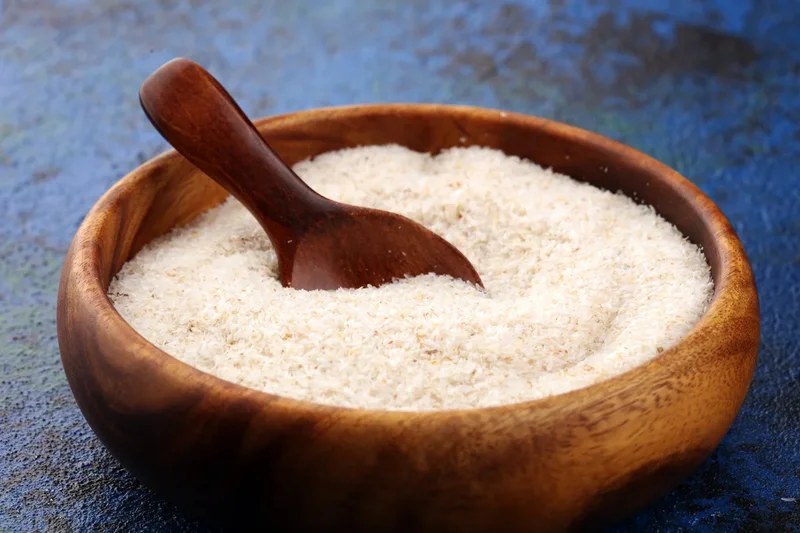
From creatine to magnesium, there’s always a supplement of the summer, and this year wellbeing enthusiasts and gut experts are all talking about psyllium husk. The fibre-rich supplement, made from Plantago ovata plant seeds, is predominantly produced in South Asia, particularly Gujarat, Madhya Pradesh and Rajasthan in India. Benefits are reported to include smooth digestion, a lowering of cholesterol and blood sugar levels – and weight loss. Some on social media have even taken to crowning it “nature’s Ozempic”.
Psyllium husk has long been the go-to fibre supplement for gut health specialists to recommend to struggling patients. But as fibre has become fashionable after the troubling revelation that 96 per cent of the UK population are missing the 30g daily intake target, perhaps it’s no surprise that there are more than 26,500 posts under the psyllium husk tag on TikTok and an additional 63,300 posts about the product on Instagram.
The supplement contains high levels of mucilage, a type of soluble fibre that turns to gel when combined with liquid. When it travels through the stomach and intestines, it absorbs water to form the gel, which softens and bulks out stool, which can ease constipation and bloating, including for those with Irritable Bowel Syndrome (IBS).
“I’ve been using psyllium husk for a very long time with my clients, especially those with IBS,” says nutritionist and gut health specialist Marilia Chamon. “It’s extremely effective, especially for that niche group, which is something that’s not talked about enough.”
Husks come whole, ground into a powder, or in capsules – but Chamon recommends the powder as you can control the amount and slowly build up your fibre intake, rather than overwhelming your gut with a 10g tablet. “That will likely make you bloated and can change your bowel movement for a couple of days,” she says. “With the powder, you can start as low as 3g and build up based on how much you can tolerate.”
It’s important to consume psyllium husk with sufficient water: approximately 500ml to every 20g of fibre. “If you didn’t, you’d likely choke,” says Chamon. There can also be a risk of gastrointestinal obstruction if not taken with appropriate hydration. As such, some like to add the gel into smoothies with frozen berries, yoghurt, honey and milk, or turn the product into a jam by mixing it with pomegranate juice, to add into a breakfast yoghurt bowl with granola and fresh fruit.
As well as digestion, there’s been evidence to suggest that psyllium aids high cholesterol and blood sugar levels. In a 2018 analysis of 28 trials, predominantly involving people with high cholesterol, researchers found that those who took 10g of the product per day for at least three weeks had drops in their low-density lipoprotein (LDL) – the type of cholesterol you don’t want. Meanwhile, a 2024 review of studies, mainly focused on those with Type 2 diabetes or related conditions, found that taking psyllium reduced blood sugar levels.
One of the most headline-grabbing claims about the husk is that it’s “nature’s Ozempic”. “Psyllium and GLP-1 medications both contribute to making you feel fuller,” explains Chamon of the link, “But it’s a different mechanism. Fibre will slow down your digestion, whereas a GLP-1 medication is a drug that will reprogramme your appetite hormones.”
In a 2020 review of trials involving overweight and obese adults, researchers found that taking psyllium had no greater impact on body weight, body mass index or waist circumference than a placebo.
Additionally, the supplement might not suit everyone. Those with Crohn’s disease, for example, or anyone on existing medication should consult their doctor, as psyllium can decrease absorption of pills. “Also, if you have symptoms that require a doctor, not a supplement, then book an appointment,” says Chamon. “Red flags are things like changes in bowel movements, blood in stools and rectal bleeding. But other than that, psyllium is fairly well tolerated and widely recommended.”
The nice thing about psyllium is its simplicity. Unlike other popular supplements, most iterations of the product are pure, so when looking at the back of the packet, as long as it says 100 per cent psyllium husk powder, you’re on the right track. Currently, the gut saviour’s price point is also a draw, with 100g costing as little as £4.
But, like with most sources of health hype, Chamon warns that putting some powder in your yoghurt each morning isn’t going to suddenly make all your stomach problems go away if your diet is still working against you.
“Although it’s a great supplement, it’s just one type of fibre,” she says. “Our gut bacteria thrive on variety, which you get from a diverse and fibre-rich diet. So, my approach is always food first, unless you’re targeting a specific condition like high cholesterol or IBS. After food, you can try a supplement, which is an add-on – exactly as the name suggests.”