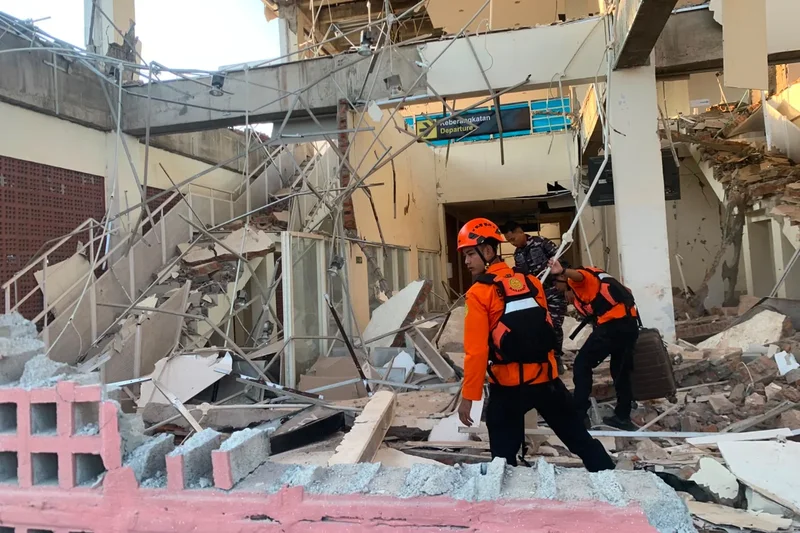
Rescue workers sifted through flattened buildings and landslide debris in eastern Indonesia on Sunday, searching for bodies and possible survivors a day after a powerful earthquake killed at least 51 people, injured over 100 and displaced thousands.
The National Disaster Management Agency said at least 24 people died in Manggarai regency and 17 in neighbouring East Manggarai, alongside further deaths in Sikka, Ngada, and Ende regencies. Emergency personnel continued searching for villagers feared trapped under quake-triggered landslides across six regencies on Flores, a mostly Catholic island in Muslim-majority Indonesia.
The magnitude 7.7 earthquake occurred nearly 68km north-northwest of Ende in East Nusa Tenggara province. Originating at a depth of roughly 10km off the coast of Flores, the tremor shook much of the island and sent panicked residents fleeing into the open. Shaking was also experienced in neighbouring West Nusa Tenggara and areas of southern Sulawesi.
Officials from the disaster agency said the earthquake destroyed upwards of 900 homes and damaged another 450, forcing around 5,000 people into emergency shelters. A total of 167 public facilities such as schools, healthcare centres and churches, were also damaged.
Thousands of people spent the night outside fearing severe aftershocks. “The shaking was terrifying, so intense that my house nearly collapsed," said Anastasia Imad, a farmer in Labuan Bajo, speaking from a makeshift green tent beside her damaged home. "We feared the aftershocks would bring it down on us while we slept."
Aid workers started distributing rice, pre-cooked meals, fresh water, blankets and medical supplies, alongside establishing emergency shelters for the people made homeless, on Saturday.
Re-establishing electricity and communications as well as supplying remote communities cut off by landslides remained primary obstacles, authorities noted.
The tremor also affected Labuan Bajo, the main entry point to the Komodo National Park, a prominent tourist destination. Landslides obstructed parts of the Trans-Flores Highway, a 700km road connecting settlements across the mountainous island.
Emergency workers restarted search operations on Sunday in districts that were cut off since the disaster, notably in Manggarai, East Manggarai and Nagekeo regencies.
"We have cleared most landslides and reopened roads to previously isolated villages, although communication disruptions and power outages continue to hamper search efforts," said Fathur Rahman, head of the Search and Rescue Office in Maumere, the capital of the Sikka regency.
He explained that crews were prioritising search through fallen homes and structural ruins for potential survivors.
Indonesia, an archipelagic nation of almost 17,000 islands, is highly susceptible to earthquakes and volcanic activity owing to its location along the Pacific “Ring of Fire”, an arc of seismic faultlines and volcanoes.
Flores has endured several of the nation's most catastrophic events, including a severe earthquake and tsunami in 1992 that claimed around 2,500 lives.
In 2018, a magnitude 7.5 earthquake caused a tsunami on Sulawesi that killed over 4,400 people while a magnitude 9.1 tremor off Sumatra in 2004 triggered a massive tsunami that killed 230,000 people in 12 countries.