Senior Constable Mark Patterson is the kind of country cop colleagues adore and small towns desperately cling to.
Once, determined to apprehend a bloke he wanted a word with, Patterson chased the would-be absconder into the waters of Blowering Dam, one of NSW’s biggest. Back on dry land, Patterson proudly told his boss he’d nabbed the suspect. His gun, though, had gotten a touch wet.
For more than a decade, Patterson’s focus has been protecting the town of Tumut in the foothills of the Snowy Mountains; following in the footsteps of several family members who served as police officers was an easy career choice. As a member of the Riverina Police District’s highway patrol, keeping motorists on the hundreds of kilometres of road around his home safe has been his top priority.
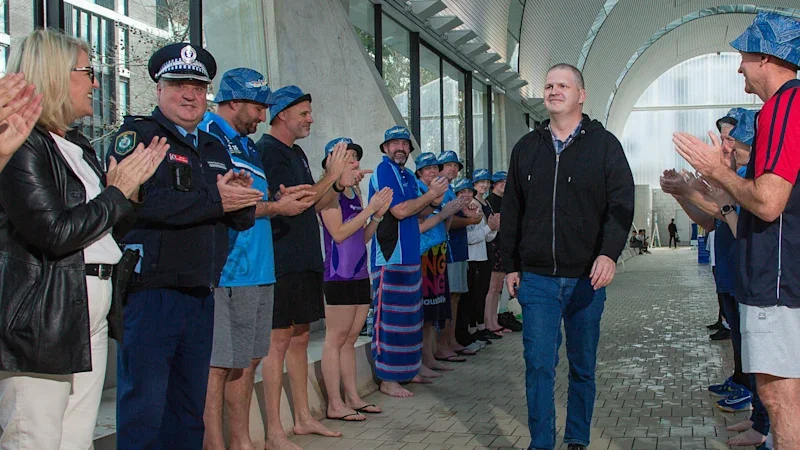
On Sunday, it was his community’s turn to look after him, as dozens of colleagues and supporters gathered at the Ian Thorpe Aquatic Centre in Ultimo for a 12-hour relay swim to raise money for the 39-year-old, who is battling his second cancer diagnosis.
Patterson was diagnosed this year with pancreatic cancer a month after surgeons removed a tumour from his bowel, and is undergoing immunotherapy following an intense chemotherapy regime; part of Patterson’s pancreas and his entire spleen have been removed.
Almost 80 Australians die each week from pancreatic cancer, which is the third-deadliest cancer in the country, according to Cancer Australia. The five-year survival rate for pancreatic cancer sufferers is 14 per cent.
“We’re slowly starting to make inroads in that and improving how patients respond to treatment and how long they can survive,” said Dr Kendelle Murphy, a pancreatic cancer researcher at the Garvan Institute of Medical Research who took part in Sunday’s swim.
“It is a silent cancer, not only in terms of symptoms but also in people’s awareness. No one really knows about it and I think just getting the word out there, making people aware that this exists and how poor, sometimes, survival is and how harsh some treatments are … is really important.”
Recent scans that detected shading on Patterson’s lungs are undergoing further investigation, but Patterson has returned to work three days a week, albeit behind a desk.
“It’s good to be back, even just on limited duties,” he said.
“I’d much rather be out and about out on the road doing my bit to try and improve road safety and doing my job, but [it’s] one step at a time at the moment, and I’m determined to get back there.”
Patterson is such a valued part of the Riverina policing community, his colleagues have taken turns driving him to medical appointments. Last year, he was one of several local officers recognised for their work combating illicit tobacco trafficking in the region.
“He’s the sort of bloke who just loves life, loves work. He gets so much enjoyment out of his work and out of everything he does,” said Inspector Josh Broadfoot, who drove Patterson from Tumut to Sydney for Sunday’s swim.
“He’s always positive, he’s always happy to be there, always got a smile on his face, and he just gets everything out of every day.”
Despite his prognosis, and with an army of support behind him, Patterson is far from rolling over.
“I’ve had my ups and downs, as anyone would, but I’m determined to win this fight,” he said.
His father, Terry Patterson, shares his optimism.
“Don’t worry, my son,” he told the 39-year-old during a quiet moment on Sunday.
“You’re going to beat this thing.”