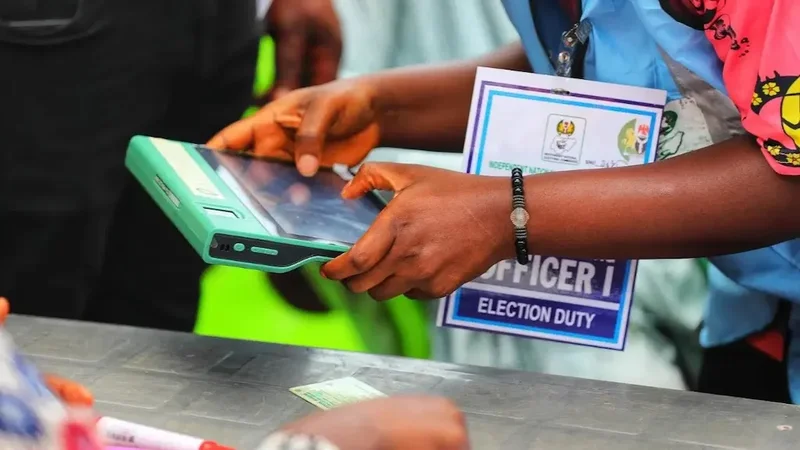
The performance of the Independent National Electoral Commission’s Result Viewing Portal (IReV) during the 2026 Osun governorship election offers an opportunity to evaluate the platform’s preparedness ahead of the next general election cycle.
IReV was launched to make electronic copies of polling-unit result sheets publicly accessible, providing citizens, political parties, journalists, and election observers with an additional way of tracking the results process and comparing polling-unit records with figures subsequently presented during collation.
Its usefulness, therefore, depends not only on whether results eventually appear on the portal but also on how quickly they become available, how consistently transmission occurs across locations, and how transparently INEC accounts for polling units whose results are not displayed.
The Osun State governorship election involved 3,763 polling units across 30 Local Government Areas and 332 Registration Areas/Wards. CJID monitored IReV throughout the election day and into the following morning, alongside its broader observation of voting, counting, and collation across the state. The pattern showed relatively rapid transmission during the first several hours after voting, a period of slower activity later in the evening, and another substantial increase in uploads overnignt.
| | |
|---|
How IReV performed in Osun
Results began appearing on IReV while voting and counting were still concluding in parts of the state. At approximately 4:12 p.m. on Saturday, 437 of the expected 3,763 polling-unit results had been uploaded, representing about 11.6 per cent. The number subsequently increased to 849, or 22.56 per cent, and later to 2,463 results, representing 65.45 per cent.
By approximately 9:30 p.m., 3,292 polling-unit results were available, putting statewide coverage at 87.5 per cent and leaving 471 results outstanding. Considering that the official close of polls was 2:30 p.m., and that voting continued beyond that time in polling units where voters remained in the queue, a substantial proportion of the state’s polling-unit results had therefore become publicly accessible within several hours of voting and counting.
Transmission did not progress at the same pace throughout the evening. CJID observed a period when the number of uploaded results remained at 3,292, with the last upload at that stage recorded at approximately 8:48 p.m. Uploading subsequently resumed, with CJID recording 3,482 results at approximately 11:42 p.m., 3,537 shortly afterwards and 3,5,57, shortly after midnight. By 6:55 a.m. on Sunday, 16 August, the figure had reached 3,681, representing 97.82 per cent, and at approximately 7:42 a.m., 3,690 of the expected 3,763 polling-unit results were available, taking statewide coverage to 98.06 per cent.
The progression from 87.5 per cent at 9:30 p.m. to 98.06 pper centthe following morning shows that transmission continued substantially overn ight ,even after the slowdown observed earlier in the evening. It also means that most polling-unit results were publicly available while collation was still underway, which is particularly important for a platform whose principal contribution to the electoral process is the ability it gives the public to independently examine polling-unit records as results move through the collation process.
The statewide figures, however, conceal differences in transmission across LGAs. At one poin,t when statewide uploads were approaching 95 per cent, Irepodun and Ila were already at approximately 99.2 per cent, Ede South and Obokun at about 99 per cent and Boluwaduro at 98.6 per cent. At the other end, Ilesa East stood at approximately 90.9 per cent, Atakumosa West and Ejigbo at about 89.5 per cent, Orolu at 89.4 per cent and Ola-Oluwa at approximately 80.6 per cent.
The gaps narrowed as transmission continued, but their presence suggests that statewide upload percentages alone are insufficient for understanding IReV performance. Differences between LGAs could reflect the timing of poll closure and counting, network availability, BVAS-related issues, geography, security conditions or the conduct of election officials. Establishing which of these factors accounted for slower transmission would require more detailed operational data from INEC, but identifying where delays are concentrated is useful for determining where improvements may be required before subsequent elections.
What happens to the final few percent?
By 7:42 a.m., 73 of Osun’s 3,763 polling units did not have results displayed on IReV. The final governorship result was announced while the portal remained at 98.06 per cent.
IReV is a public result-viewing platform rather than the statutory collation mechanism through which election winners are determined, so the significance of the 73 outstanding polling units lies principally in the completeness of the public record. Once an election has been concluded, citizens examining IReV should ideally be able to understand what happened at every polling unit, including those from which there is no result to display.
CJID’s field reports from Osun illustrate why this requires more information than an upload percentage can provide. In Ife Central, observers reported that voting did not take place in one polling unit following a disagreement over the number of ballot papers supplied, while the result from another polling unit was cancelled following over-voting and the destruction of ballot papers. In circumstances such as these, the absence of a result on IReV may originate from what happened at the polling unit rather than from the transmission system.
The current presentation of IReV provides limited information for making these distinctions. A polling unit where voting was cancelled can appear in much the same way as one where a valid result exists but has not yet been transmitted. Providing a status for polling units without displayed results — whether voting was not conducted, the poll was cancelled, transmission remains pending or another documented circumstance applies — would make the portal considerably more useful for public scrutiny.
This becomes particularly important as IReV approaches complete coverage. At 60 or 70 per cent, the principal question is understandably how quickly the remaining results are being uploaded. At 98 or 99 per cent, attention begins to shift towards the smaller number of polling units that remain unaccounted for, where they are located and why their results are unavailable.
How Osun compares with Anambra, Ekiti
Recent off-cycle governorship elections provide some context for assessing the Osun figures, although the available records differ in what they allow us to measure. CJID tracked the Osun portal repeatedly during election night, providing a progression of uploads over several hours, while the current IReV records for Anambra and Ekiti provide clearer evidence of where those elections eventually settled than of their complete election-night trajectories.
For the 20 June 2026 Ekiti governorship election, IReV currently shows 2,390 results from 2,445 polling units, representing 97.75 per cent of the expected total. The portal records its last upload at 9:19 a.m. on 21 June, the morning after the election. Almost two months later, 55 polling units remain without results displayed on the portal.
The Ekiti LGA figures show that the gap is concentrated more heavily in some in areas than others. Several LGAs are recorded as complete, while Ado Ekiti has 339 results from 344 polling units, has Ikole 183 from 189, has Ijero 138 fr,om 145 and Ekitihas East 95 from 112. The statewide figur,e of 97.75, per cent therefore masks a more pronounced gap in particular parts of the state, with Ekiti East alone accounting for 17 of the polling units without displayed results.
The 8 November 2025 Anambra governorship election is closer to complete coverage. IReV currently shows 5,711 results from 5,720 polling units, representing 99.84 per cent, with nine polli displayedng units without displayed results. Most LGAs have complete records, while the remaining gaps are distributed across a limited number of LGAs. The portal also records the most recent upload on 23 November 2025, more than two weeks after election day, showing that the public record continued to change well after the election had concluded.
These records bring out different aspects of IReV performance. Osun gives a clearer picture of transmission speed because CJID followed the portal throughout election night and recorded its movement from 87.5 per cent at 9:30 p.m. to 98.06 per cent the following morning. Anambra shows how close the portal can eventually come to complete coverage, while Ekiti shows how a relatively small statewide gap can persist and become concentrated in particular LGAs.
They also point to the value of separating timeliness from eventual coverage when assessing IReV. Anambra’s current 99.84 per cent is higher than the 98.06 per cent recorded in Osun on the morning after the election, but the current portal does not tell us what proportion of Anambra’s results was available at equivalent points on election night. Similarly, the date of Anambra’s most recent upload tells us that the record continued changing after the election, but not the scale of those later additions. A credible comparative framework therefore requires more systematic publication of upload timestamps and performance data across elections.
The unresolved entries across the three elections also strengthen the case for better polling-unit status information.
Anambra currently has nine polling units without displayed results and Ekiti has 55, while 73 were outstanding in Osun at the point CJID recorded the portal on Sunday morning. The figures themselves cannot explain whether the gaps arose from transmission delays, cancellations, non-conduct of elections or other circumstances. As IReV increasingly records statewide coverage in the high nineties, explaining these remaining entries becomes part of assessing the completeness of the transparency system.
The 2023 experience and what has changed
The public significance attached to these questions is inseparable from the experience of the 2023 presidential election, when IReV became one of the most contested aspects of the results process. INEC subsequently acknowledged that its inability to upload presidential polling-unit results as expected generated widespread criticism and affected public perception of the election, while the Supreme Court observed during subsequent litigation that the malfunction contributed to reduced public confidence.
INEC’s subsequent explanation showed that the problem was more specific than a general collapse of IReV. According to the Commission, National Assembly results were uploading while presidential results encountered a configuration problem related to how the different elections had been mapped within the application.
National Assembly contests were associated with states and constituencies, whereas the presidential election was configured as a single nationwide constituency, creating difficulties when the backend attempted to organise presidential result images according to polling-unit locations.
After technical fixes were introduced, INEC encountered a further problem with a backlog of queued uploads, while some BVAS devices had already been switched off and had to be reconnected before pending transmissions could proceed. The Commission later reported strengthening IReV resilience and introducing additional quality-assurance checks and end-to-end testing.
The recent off-cycle elections suggest a more stable operational environment. Across Anambra, Ekiti and Osun, IReV has been able to publish the overwhelming majority of expected polling-unit results, while the detailed monitoring undertaken in Osun shows that more than 98 per cent were available by the morning after voting. The kind of widespread presidential-result upload problem experienced in 2023 was not observed in Osun.
The scale of a general election, however, is considerably different. Osun involved 3,763 polling units, while INEC’s 2023 post-election review records 176,846 polling units nationwide. A general election also requires electoral infrastructure to operate simultaneously across 36 states and the Federal Capital Territory, under widely varying telecommunications, security and logistical conditions, while supporting multiple elections and a much larger number of devices and election personnel.
The experience of 2023 is relevant here because it showed that successful performance under one electoral configuration does not guarantee the same outcome under another. The fact that National Assembly uploads were proceeding while presidential uploads encountered difficulties demonstrates why the performance recorded in state governorship elections cannot by itself establish how IReV will behave during a nationwide general election.
What INEC should address before 2027
The recent elections provide INEC with considerably more operational evidence on which to prepare for 2027 than was available before the last general election. The priority now should be to understand the conditions under which transmission slows, improve the information available about outstanding polling units and test whether the performance recorded in state elections can be sustained under national-scale demand.
One gap exposed by the Osun monitoring is the limited amount of public performance data available from IReV itself. Much of CJID’s assessment depended on repeatedly recording the number of uploaded results at different times. INEC’s backend should contain considerably richer information, including transmission timestamps, unsuccessful upload attempts, retransmissions, processing times and geographical patterns in delays. Publishing an appropriate level of this information after elections would make it possible to distinguish problems associated with the technology from delays caused by late voting, counting, connectivity or other polling-unit circumstances.
INEC could also establish clearer performance benchmarks ahead of 2027, including indicative expectations for the proportion of polling-unit results that should become publicly available within defined periods after counting. Such benchmarks would provide a more consistent basis for evaluating IReV across elections and make it easier to identify when transmission is departing materially from expected performance.
Communication during substantial interruptions also requires attention. When the Osun upload figure remained unchanged at 3,292 for a period during the evening, the public-facing portal offered little indication of what was happening. In a presidential election, a similar period of inactivity would inevitably attract considerably greater scrutiny.
Where INEC identifies a significant technical or operational interruption, timely information about the nature and scope of the problem would reduce uncertainty and allow the public to distinguish a system-wide problem from localised or temporary delays.
The presentation of outstanding polling units should also be improved. Giving every polling unit an identifiable status would allow IReV to distinguish among successfully uploaded results, pending transmissions, cancelled elections, polling units where voting did not take place and other formally recognised circumstances. This would address one of the clearest limitations visible across Osun, Ekiti and Anambra: the portal can show how many results are absent without adequately explaining why they are absent.
The more demanding preparation will be testing IReV under conditions that approximate the 2027 general elections. Stress tests should simulate simultaneous transmission from a volume of devices approaching national election levels, including periods of exceptionally high traffic and transmission from locations with weak or unstable connectivity.
The assessment should cover not only server availability but also processing speed, queued uploads, failed transmissions, retry mechanisms and the ability of the public-facing portal to remain accessible while large volumes of results are being received. Independent technical assessment of this infrastructure before the election would provide an additional basis for evaluating readiness beyond INEC’s own assurances.
Looking towards 2027
The Osun governorship election recorded a strong IReV performance in the period that mattered most for public scrutiny of the results process. Approximately 87.5 per cent of polling-unit results were available by 9:30 p.m., and the figure had reached 98.06 per cent by the following morning, while the portal continued receiving results after the temporary slowdown observed during the evening.
Recent experience in Anambra and Ekiti also shows that IReV is routinely reaching very high levels of polling-unit coverage in off-cycle governorship elections, although the persistence of outstanding entries demonstrates that near-complete coverage does not always produce a fully explained public record.
The more important question ahead of 2027 is whether these improvements can be reproduced under the scale and complexity of a general election. The next test of IReV will involve far more than keeping the portal online. It will require rapid transmission from a vastly larger number of polling units, consistency across very different parts of the country, clear information when transmission slows, and an ability to account for polling units whose results do not appear.
Nigeria now has several years of practical experience with BVAS and IReV across general and off-cycle elections, including the problems encountered in 2023 and the considerably stronger performance visible in more recent governorship elections. The preparation for 2027 should use that experience to move beyond assurances that the technology will work and towards measurable evidence of how it performs under pressure, where its weaknesses remain and how those weaknesses will be addressed before the next nationwide election.