Conor here: Replicating the failed strategy against Russia, this time against a foe that dominates a wide range of global critical minerals necessary for weapons production. What could go wrong?
Meanwhile, the AUKUS Public Inquiry in Australia continues its hearings on the so-called security pact that features Canberra shelling out hundreds of billions ostensibly for nuclear-powered submarines that may never arrive. Here’s a AUKUS assessment from imperial-friendly source Bryan Clark, a senior fellow at Hudson Institute and a former submarine officer who runs war games for the Navy and its allies:
From the US perspective AUKUS is a great deal. Australia spends money on our submarine industrial base, which needs help. They’re building a maintenance facility at Henderson and have built out the pier infrastructure so we can base submarines out of Australia, as part of Submarine Rotational Force–West. If you have a submarine out there, it gives you twice the operational availability of having it back in CONUS. And boats needing repairs don’t have to go back to Guam or Hawaii. The Australians are paying for all of it.
From the Australian perspective it’s maybe not such a great deal, because it’s going to consume a lot of the funding that would otherwise go to the rest of their military. They’ll have submarines, a relatively small fighter wing, a couple of tankers, a few AWACS, and a small army for border protection in the neighboring islands. And that’s it.
So if the Chinese send the maritime militia down to surround Christmas Island and say “we’re treating this as a new zone for us to operate in” — the Australians have a couple of ships they can send, readiness is not high, and it would consume their entire fleet to do that one operation. They’d have nothing left for shipping protection.
So it’s a tale of two cities. Australia is setting itself up to be dependent on the US for its defense because of AUKUS — while expressing concerns about the willingness and ability of the US to provide that defense.
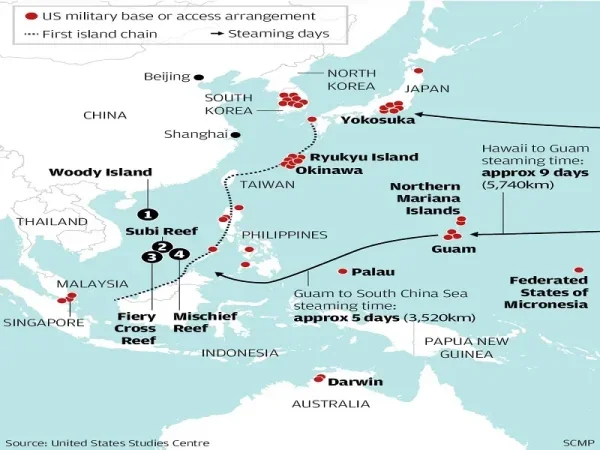
And the US is depending on Australian basing being available and defendable if we get in a fight with China, because it’s the only place you can operate from at a survivable range — Japan will be under threat the whole time. Yet nobody is investing in the infrastructure or defenses that basing out of Australia in a war with China would actually require.
Sounds about what we’ve come to expect. Elbridge Colby, “military-strategic mastermind” indeed.
By Andrew Korybko,a Moscow-based American political analyst who specializes in the global systemic transition to multipolarity in the New Cold War. He has a PhD from MGIMO, which is under the umbrella of the Russian Foreign Ministry. Originally published at his website
The US is replicating its anti-Russian regional containment model against China.
Under Secretary of War for Policy Elbridge Colby gave a landmark speech in Manilla during the first leg of his Southeast Asian tour in early August that amounted to the US introducing the NATO 3.0 concept to the region. As Trump 2.0’s military-strategic mastermind explained it, the US is offloading more of the responsibility for maintaining regional status quos onto its allies and partners that share the same interest, which in this context is “an Asia free from hegemony”. The unstated purpose is to contain China.
He cited the National Security Strategy, the National Defense Strategy, and Secretary of War Pete Hegseth’s speech at late May’s Shangri La Dialogue to justify Trump 2.0’s policy of “maintaining a posture of deterrence by denial along the first island chain” from Japan to Borneo. The Philippines sits in the middle and is therefore irreplaceable to building what’s been described elsewhere as AUKUS+. Readers can learn more about this concept and its US-backed Japanese-Philippine(-Indonesian?) core here.
In his words, “we are actively building a strong denial defense to back up a peace through strength approach of a lastingly favorable balance of power in Asia. We are systematically strengthening our forward posture, hardening our footprint, and driving deep interoperability with key countries that are willing to shoulder their share of the burden. This is not merely about performing in symbolic exercises for the cameras; it is about fielding combat-credible forces capable of defeating real military aggression.”
This leaves no doubt about the US’ intent to contain China by “Leading From Behind” in the Asia-Pacific upon the region’s implementation of the NATO 3.0 concept through the accelerated construction of the AUKUS+ network. Of importance, Colby pointed out that the Philippines is “a model ally”, which is what Hegseth described Poland as while there during the first leg of his European tour in early 2025. It can therefore be assumed that the US envisages it playing a similar role in the region.
Accordingly, observers should expect that the Philippines will become the US’ regional military bastion primed to play the leading role in containing China by dint of its geostrategic location just like Poland vis-à-vis Russia as recently confirmed by President Karol Nawrocki, all in close coordination with the US. Of course, the Philippines can’t do this on its own just like Poland can’t either, but their respective roles in containing the US’ regional adversaries are mostly as logistical bases and launchpads for US forces.
In practice, the end goal is for them to host enough supplies, US forces, and missiles to correspondingly deter China from making a military move on Taiwan and Russia from doing the same on Ukraine after the ongoing hostilities finally end, otherwise the Philippines and Poland will intervene then the US will follow. Japan is being primed for the same role as the Philippines but might not involve itself in hostilities at first for escalation-control reasons and to avoid a global economic shock if China directly retaliates.
Its economy is much more important to the world’s than Poland’s, let alone the Philippines, but all three are the US’ mutual defense allies so any direct retaliation by China or Russia instead of only attacking their forces in Taiwan and Ukraine respectively in each scenario would prompt an American response. As can be discerned from Colby’s speech, the US is replicating its anti-Russian regional containment model against China, which has enormous implications for global stability and raises the risk of World War III.