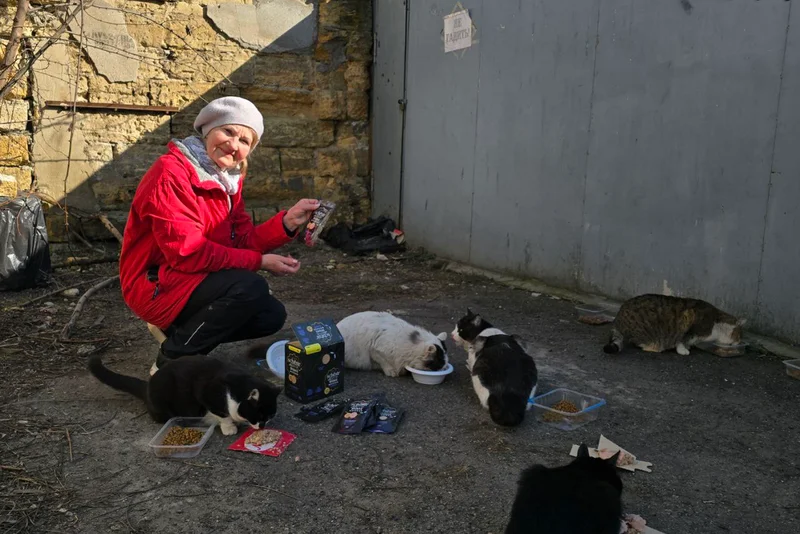
Even after a night of heavy bombardment, Olga wakes up at dawn and gets ready to feed Odesa’s cats.
“This city is my whole life,” the 74-year-old tells The Independent. Each day, she tends to the 50 cats that roam the debris and burnt out buildings in her neighbourhood, a consistent target of Vladimir Putin’s bombs.
Olga’s husband and son have both been dead for some time now, yet she doesn’t feel lonely - and she says she has long stopped panicking when air raid sirens go off.
“People are evacuating on their own, but I haven't looked into doing that.”
Olga is among a group of elderly people left to look after abandoned pets and community strays. Even before the war, Ukraine had a large stray animal population of up to an estimated 200,000 dogs and many more stray cats roaming the streets, according to the Naturewatch Foundation. Since the start of the war, thousands more pet dogs and cats have been lost or abandoned.
Experts have told The Independent that people who stay in their war-torn towns and cities often end up feeding dozens of animals despite having very limited resources of their own.
The work begins at 9am: “I go out to feed them. I start from the furthest points and end by the sea,” she says. Olga feeds the cats in her yard, neighbouring gardens, parking lots, and on the slopes along the way to the sea.
“Since childhood, I have loved cats very much,” she says.
Her favourite cat Lora, who she has nicknamed Chernushka, survived a tumour on the neck the size of a walnut. Since then, Olga has become very attached.
”She loves pâté and the tastiest food I can give her because she went through many surgeries. I had to nurse her back to health for a long time, so she became like a sick child - the most precious one.”
It is this love of animals that has stopped her from leaving Odesa despite the dangers; her biggest fear is not for her own safety - it’s leaving the animals defenceless.
“They simply won't survive without us humans,” she says.
While not on the frontline, Odesa has been targeted by Russia with intensified strikes in an attempt to strangle Ukraine’s commercial links with the outside world. Attacks have taken place along the coastline, targeting vessels and port infrastructure while Moscow tries to protect its own ships through the Azov-Black Sea basin.
On the other side of the city and totally unbeknownst to Olga, 73-year-old Nataliia remains a devoted carer to 13 pets and 27 strays.
“Living in a war zone is very difficult. The war has a very negative effect on my health and the state of my animals; they become nervous. I have to spend a lot of time monitoring their well-being and calming them,” she says.
“It's very hard to live without electricity and water, and sometimes even without heat during the cold season. Carrying water up to the eighth floor for the stray animals is tough- when the water in their bowls freezes, I have to thaw it and bring out hot water. All of this significantly complicates living conditions.”
Food for the animals comes out of her pension, with the United for Animals Foundation charity helping provide food for the strays.
“We are helping hundreds - dozens of hundreds - of stray animals survive. Animals that live in conditions of cold, hunger, constant explosions, and fear, when they are afraid to even come out of their shelters."
Getting pet food and supplies to these caregivers can be a challenge as many of the elderly recipients can’t carry the heavy bags from collection points, according to Martyna Maciejewska, the senior manager of field operations for Greater Good Charities.
“Reaching communities closer to the frontlines is even more difficult and dangerous,” she says. “Many elderly people have chosen to remain in their homes despite the conflict and continue caring for both their own pets and abandoned or community animals. Delivering supplies to these areas often requires navigating active security risks, making every delivery more complex and hazardous.
“The need has remained consistently high throughout the war. Many elderly caregivers survive on pensions of only 2,500–4,500 UAH (approximately £40-75) per month, making it extremely difficult to cover utilities, their own basic needs, and the cost of feeding animals. Without outside support, many would simply be unable to continue caring for the pets and strays that depend on them.”
Nataliia’s day starts at 6am and ends at 1am, as she cleans numerous litter boxes, feeds them and checks all the animals are healthy and uninjured after a night of air raids.
“During explosions, I worry deeply about the lives of both my pets and the street animals - especially the ones on the street, who could be hit by shrapnel or caught in a blast.”
“Since the war began, the animals' behaviour has changed significantly. First, they have become more demanding about food and require more of it. Second, they have become more fearful. If shelling starts, they scatter, and it is then very difficult to gather them all back to their feeding area. My animals are my life; we are one whole.”
Scientists have found that animals’ behaviour had significantly changed due to the war. Researchers in Ukraine compared the impact of conflict on wildlife by observing their behaviour after the Russian occupation with the same period in 2021. In a study published in June, they concluded that conflict significantly altered animals’ daily patterns. They became less active during the night or when active conflict was ongoing.
Olga has seen the animals change too, proposing that human nature has had just a significant impact on the animals’ behaviour as the shelling.
“What causes the most discomfort is that some people are against feeding animals... specifically near cars. A car is worth more than an animal to them. Of course, there are scandals and a lot of stress. My heart aches because of this, and my blood pressure rises, because not everyone treats animals with understanding.
“They suffer most from cruel people.”
Despite having seen the cruelty of conflict towards animals, both Nataliia and Olga have hope that the war will end soon.
“Hope is all that's left. Because there is no end or edge in sight, and the forecasts here are not very comforting,” Olga says.
Nataliia adds: “I truly hope it ends soon. I hope Ukrainian men return to their families soon, that children and women stop crying, and that mothers stop crying at their sons' funerals.”