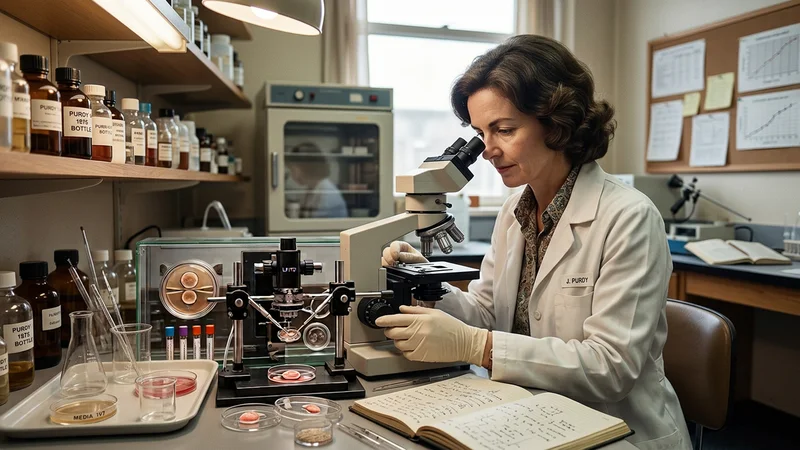
Taking a safe bet here that most of you who have heard of Louise Joy Brown have not heard at all of Jean Purdy, or her role in the birth of Baby Brown. Louise Brown was the first baby born of an IVF procedure on July 25, 1978. But this might not have been a joyful story, but for Jean Purdy.
Like all the heroines in this column, Jean Marian Purdy, a clinical embryologist and a critical part of the development of in vitro fertilisation, remained uncredited for a long while. Born in Cambridge, U.K., she went to work with physiologist Robert Edwards and gynaecologist Patrick Steptoe at the Physiological Laboratory in Cambridge. They were working on a high-risk experiment and taking medical science where it had never been before – who would have thought babies could be created in test tubes before the trio managed to show that it is possible.
Purdy trained as a nurse in Addenbrooke Hopsital in Cambridge, and joined Edwards in 1968 as a research nurse and quickly became indispensable to the team. Going back to study the records later, scientists established that it was Purdy who managed the laboratory, prepared and tested culture media, and recorded and organised the data of the early IVF work in the lab. Besides this, the records also put her at the centre of patient care, in this case, supporting women who volunteered their eggs and wombs at a time when public sentiment was entirely against it.
Purdy was the first to recognise and describe the formation of the early human blastocyst – the cluster of cells that forms five or six days after a sperm fertilises an egg, in the culture, a key milestone in pre-implantation development. It represents the early stage of embryonic development, where the embryo implants itself into the wall of the uterus to establish a pregnancy. Purdy was the first to see the embryonic cells successfully dividing in the lab, soon these cells would go on to become on 25 July 1978, she was the first to see the embryonic cells that would become Louise Brown. This moment is significant, because it was the first indication that their pioneering technique had worked.
That was not all; between 1970 and 1985, until her death, she co-authored 26 academic papers with Edwards and others in leading journals, including Nature, documenting methods, outcomes and sophistication that made IVF safe and more reliable.
After NHS funding for IVF was withdrawn following early successes, Purdy helped establish the world’s first dedicated IVF clinic, Bourn Hall Clinic near Cambridge in 1980, and served as its technical director. Again, she helped standardise medical protocols for IVF and scale up treatment, overseeing the birth of more than 500 IVF babies before her death from cancer at just 39 years, in 1985.
In their article The Oldham Notebooks: an analysis of the development of IVF 1969–1978. V. The role of Jean Purdy reassessed, archived in PubMed, Martin H. Johnson and Kay Elder, look at her body of work in early fertility care. The authors pored over the Oldham Notebooks - 21 handwritten laboratory notebooks and loose records kept primarily by Purdy between 1969 and 1978. They concluded that: “Purdy’s interests were clearly focused on the research and development aspects, especially those exploring viable embryo development and improved transfer procedures. For example, in a film made in 1980 (Williams, 1980), she talks about a modification to the transfer cannula that she was trying. Thus, whilst Edwards provided the ideas and the intellectual stimulation and Steptoe the authoritative clinical skills, it is arguable that without Purdy’s systematic approach and dedicated contributions, the project at Oldham may have faltered.”
Despite all this, centuries of sexism weighing in on the scientific community, a classic example of the Matilda Effect, her role was minimised in public memory for decades. Even though Edwards and other colleagues objected to it, Purdy’s name was omitted from a commemorative plaque installed at Oldham Hopsitals, associated with IVF’s breakthrough. Correspondence from Edwards archived at Cambridge later described Purdy as “crucial” to their work, underscoring how her erasure contradicted the team’s own view of her importance. In fact, Edwards’ own records state his growing confidence in her and her essentiality in the team: Purdy was “being ‘particularly good with the patients’, and her ‘cooperation had become crucial. It was no longer just Patrick and me. We had become a threesome’.
However, only Edwards was awarded the Nobel Prize in Physiology or Medicine for IVF. While recognition for the work that Purdy did, has grown only recently, thanks in good measure to the research of Johnson and Elder, some things cannot be corrected any more. Now, some museums and clinics cite Purdy as the first clinical embryologist, and other institutions have begun naming awards and exhibitions after her. Sidelined again, this time, though her collaborators acknowledged her work, Purdy’s contributions were callously and credit consistently denied.
Though belated, it’s now time to undo the wrongs. It is time to say her name! Say Jean Purdy, shout it out from the rooftops!
Published - August 16, 2026 05:16 pm IST