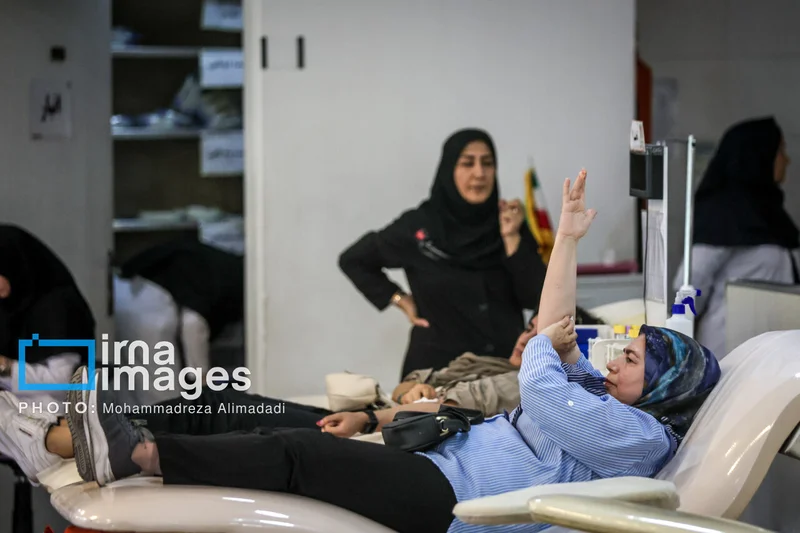
Women’s share of blood donation targeted to rise to 30%
TEHRAN — Women account for only around five percent of total blood donation in the country, a share that does not reflect their potential and level of social participation. The government has set a target of increasing women’s share of blood donation to at least 30 percent by identifying and addressing the barriers to their participation.
In this line, Zahra Behrouz-Azar, the vice president for women and family affairs, told IRNA that the roughly five-percent share of women in blood donation is not commensurate with their potential, stressing the need to identify and remove barriers to participation in order to raise the figure to at least 30 percent.
She described protecting people’s lives as one of the government’s top priorities, adding that initiatives such as the “No to Accidents” campaign, the “All Together Against Cancer” campaign, the expansion of clean energy, and support for blood donation are being pursued as part of this broader effort.
Referring to efforts to increase women’s participation in blood donation, Behrouz-Azar said Iranian women are active and influential participants in various areas of society. However, she noted that their share of blood donation remains at around five percent — a figure that does not correspond to their potential or level of social participation.
The vice president added that in the past Iranian year (March 2025-2026), following the signing of a memorandum of understanding and the issuance of guidelines to provincial authorities, increasing women’s participation in blood donation was placed on the agenda, and a number of measures were subsequently taken.
However, she emphasized that achieving lasting change requires practical measures to be accompanied by a thorough understanding of the barriers preventing women from participating in blood donation.
**Sole country able to meet need to blood **
Around 1.7 percent of the country’s population donates blood regularly, and the blood donation index is 27 per 1,000 population. According to the CEO of the Iran Blood Transfusion Organization,
Ahmad Qarah-Baghian, Iran is the first and sole country in the Eastern Mediterranean region that has been able to meet the country’s need for blood and blood products, relying entirely on voluntary and unpaid blood donations.
However, the need for blood is growing. The advances in medicine and the aging population are the two factors that increase the demand for blood and blood products, Babak Yektaparast, an official with the IBTO, has said.
According to Yektaparast, the amount of blood donation needs to be increased by 10 to 15 percent in the next five years. Currently, the majority of donors are aged 35-50 and it is essential to promote a culture of blood donation among the youth and women who comprise half of the country’s population.
The World Health Organization (WHO) representative in Iran, John Jabbour, has described the IBTO as a successful role model in the region.
“The Iran Blood Transfusion Organization is one of the most important and centralized blood transfusion centers in the region. The coherence and coordination of activities across the country have strengthened the organization, and this integrated structure plays a key role in ensuring the quality and safety of blood,” Jabbour said.
“The World Health Organization is ready to enhance cooperation with the Iran Blood Transfusion Organization and provide technical and specialized support to the organization to improve blood transfusion services,” he added.
Referring to blood safety indicators in the country, the official said the safety of donated blood in Iran is comparable to that of developed countries, which highlights the high quality of services and standards of the IBTO.