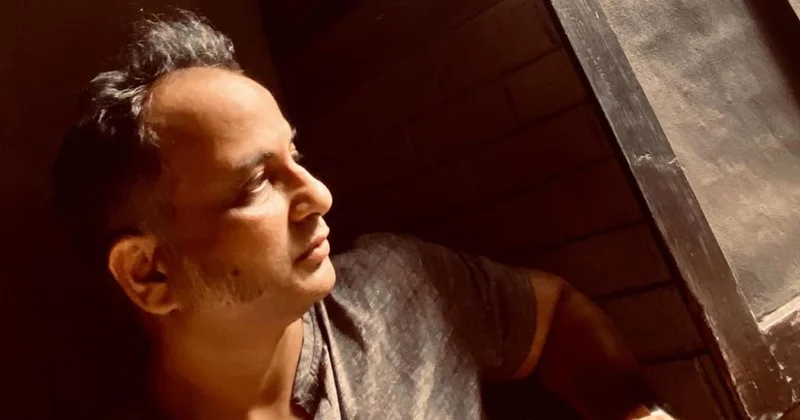
Prasanta Chakravarty’s Attention and Drift: Santayana and Cavell in the Present is an exuberant addition to what is already a versatile and impressive oeuvre. Chakravarty’s doctoral work was on the literature of the English Civil War of the 17th century. Since then, without losing his footing in the earlier centuries, he has engaged with themes unto the very present.
What unites his books is perhaps the ability to read literature and politics always simultaneously, each informing the other, each irreducible to the other. Thus, later works, including several edited ones, engage with figures like Machiavelli (in his historical period, as well as the shadow he casts today), as well as the complex thematics of what the media calls “populism”. Beyond this, he also edits a web journal, and is the author of four volumes of poetry.
Embracing risk and danger
The latest book on attention and drift is a study of two influential philosophers who are not generally paired together – George Santayana (1863-1952) and Stanley Cavell (1926-2018). These are American figures, and it is salutary that Indian literary scholars also engage with this Anglo-American tradition, instead of the French-German one which has dominated the curriculum over many decades.
Let us pay attention then to some of the chief arguments of these philosophers and cultural critics. Santayana, for example, insisted that life was encounter, a wrestling with power in its variety – human, animal and cosmic. This is the way one enlarges life, and avoids the fate of modest salary-making. He urges us to embrace risk and danger. One seeks less to explain oneself (even to oneself), but rather to be entranced, capricious, troubled, challenged by the world. As Chakravarty puts it, we must recognise that “existence is not courteous, for we are swimming in an opaque sea with amiable monsters.”
Santayana insists that we do not move in regular increments (education, marriage, job, parenthood, death), but in acceleration, clash, volatility, mutation. The chapter title, “Infant King”, captures some of this maximalist and fortuitous chaos – life is zigzag, and we often swing without respite from omnipotence to vulnerability and back again. Life itself is the reality of this tousled dream, and fiction is the make-believe that deciphers truth. Santayana writes: “Life is no illusion, and no source of illusion, so long as we simply take it for what it is, and express its visions and its passions as a pure poet might express them: all this experience is actual experience, all this dream is an actual dream…”
Stanley Cavell is equally a congenial thinker because he too wrote much on literature (as well as Hollywood melodrama, theatre, opera). As Chakravarty notes, Cavell too was interested in the “shimmering quality” of things, in guesswork and speculation, oddities, digressions, anticipations, veilings, inmixed guilt and secrets, slights, misdirections, dissociation, incantation, deception, reverie, and distortions – all these are to be preferred to the sanctioned authorities (religion, state, parents, partners, teachers, and so on). There can be no credible claim to epistemic salience. The pith of human life is intersubjective disarray: “we begin to express and respond to others in terms of guessing others’ motives and wishes”.
Cavell contrasts intimacy to vanity – in the former, one gratefully lets the world unfold immersively over us, and with gratitude. In contrast, vanity is a fixity of attention we demand from others, inhibiting both them and us. In an achieved intimacy, however risky, all partners are enlarged both, be it in joy or regret. Chakravarty notes that “Cavell inclines more toward the pole of attention; Santayana toward drift”. But what they share is the keynote of the required “mythmaking of life”, the belief that we can “defeat our self-defeats”, and live a supernal, technicolour life.
A gentler grasp of the fleeting
Chakravarty offers a refreshing vantage from which to look at the literary-political. Instead of the rather more familiar identities (class, caste, gender and so on), it is useful to also start from what seem more remote concepts today – such as attention, drift, myth. Chakravarty has usable definitions of these elusive terms. He sees them less as opposed, and more as (with critical labour) melting (conceptual and perceptive) rigidities, allowing a gentler grasp of the fleeting, of affording us a more authentic and spontaneous absorption of the wave and dream of life.
It is necessary for literary criticism in India to re-learn to see things freshly, else there is only the continuation of our stasis. New conceptual strategies need to be outfitted even to re-understand our own heritage. What may the usefulness of concepts such as attention and drift offer to traditional Indian literature and criticism? One may suggest that these ideas have some kinship with some of the strands of, say, the Kashmiri Sanskritic tradition – which too emphasised, as an initial move, the pulsing back and forth of dissolution/re-figurations of emotion (and selfhood) when one attended powerful theatre and ritual.
Whatever the path literary or cultural criticism takes in India, it is heartening to see strong new ideas being generated. This is necessary as English (and regional literature) departments are often accused of uninspiring syllabi, hagiographic orientations, overdetermined identity politics, exam/evaluation cultures purely oriented to government jobs and so on.
The interlinking of literature and philosophy may provide the necessary tension to revitalise both. As Cavell had provocatively asked: “Can philosophy become literature and still know itself?” Individual scholars can only bring these syntheses to the fore and shape a textual archive, and so one is thankful to Chakravarty for painstakingly building a body of operable work. One can only hope that he is joined by many more.
Nikhil Govind is the author, most recently, of Rama Rasa: Transcendence and Worldliness in the Ramayana Tradition.
Attention and Drift: Santayana and Cavell in the Present, Prasanta Chakravarty, Bloomsbury.
We welcome your comments at letters@scroll.in.