Gaza genocide: How Israel made horror a ritual of daily life
Life under genocide has its familiar daily rituals. A discerning eye detects latent horrors in the scenes that unfold in succession across screens.
Elsewhere, the scene itself disappears beneath rubble, entombing the bodies of thousands of Palestinians whose breath was cut off below, while their families remain unable to retrieve them.
In the Gaza Strip, modern brutality has made its terrible presence felt through atrocity after atrocity, in full view of the entire world.
These horrors were caused not by a natural disaster, but by the tsunami of modern genocide carried out by Israel using American and western weapons, munitions and technologies.
Genocide has taken possession of the defining features of everyday life in all their details, leaving its tragic imprint on the population in every sphere.
The fragments that follow are drawn from that reality.
The children of Gaza know no daily life without a menacing sound accompanying them day and night, without pause. This has been the case almost since the moment they first opened their eyes to the world.
Sonic terror
The sound that accompanies Gaza day and night is the buzzing of Israeli military drones, which circle overhead in swarms and tirelessly monitor every part of the Gaza Strip around the clock.
These drones acquired their local name from their disturbing acoustic effect: residents call them "zanana", an Arabic coinage derived from the buzzing sound they emit.
The world has come to know that there is no shelter in Gaza, and nowhere within it that is safe
Young children besieged in this narrow strip overlooking the flank of the Mediterranean Sea may find it difficult to imagine a world free of the noise, a noise that entrenches within them a constant sense of threat, of bombardment that may come at any moment.
In this way, the occupation seizes control of the soundscape and sends its inhabitants a message: they are being watched relentlessly and the next projectile may strike one of them here or there, killing or wounding that person together with everyone nearby.
This thunderous hovering is a mixture of auditory domination, sonic terror and psychological intimidation.
Every Palestinian in Gaza has personal experience of tragedies associated with these military drones in their various forms, through witnessing firsthand the bombardments that took the lives of relatives, neighbours and loved ones, whose bodies were torn apart while their memories remained.
Air strikes were unknown before the modern age. They began to develop during the First World War and gave rise to a preventive practice: warning sirens were sounded so people could take cover and seek refuge in shelters prepared for that purpose.
The genocidal campaign targeting the Palestinian people in Gaza since October 2023 has employed the most advanced instruments of warfare of its time, including squadrons of American-made warplanes and drones sharing the work of aerial bombardment.
Yet not a single warning siren has sounded in Gaza.
This is not the result of negligence or malfunction. The very idea of warning sirens has become absurd as bombardment has continued without interruption, making any warning a cruel joke.
More importantly, there is no shelter for residents to flee to, no possibility of protection from the exploding horrors falling from the sky.
The crowding of civilians into an underground shelter would itself pose a grave risk to their lives. Heavy munitions penetrate deep below the surface and leave vast craters, as has been seen in the heart of residential neighbourhoods, in refugee camps, around hospitals and near places of worship.
The primitive tools available cannot retrieve those trapped beneath the rubble.
The world has come to know that there is no shelter in Gaza, and nowhere within it that is safe.
Even United Nations schools in which displaced families sought refuge were turned into traps for repeated mass killings. The same was true of Muslim and Christian places of worship, which were crushed. Not even historic monasteries were spared.
Hospitals were reduced to ruins, ambulance crews were massacred, Red Cross facilities were not spared, and seven World Central Kitchen aid workers were killed when their convoy was struck in Deir al-Balah on 1 April 2024.
Art of survival
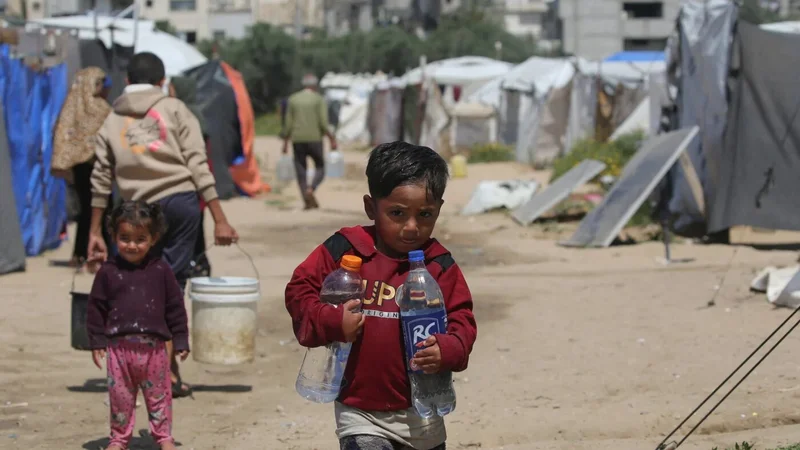
Daily life in Gaza means enduring without water taps and without any guaranteed, safe opportunity to quench one's thirst.
At the outset, the occupation army destroyed Gaza's water networks. On 9 October 2023, then Defence Minister Yoav Gallant announced a "complete siege" of the strip. Water supplies to its more than 2 million people were cut off.
With most homes destroyed and civilian infrastructure devastated, the ordinary household tap has almost disappeared. Only a few water points remain, where residents crowd to fill containers by rudimentary means. What once took seconds at a tap has become a prolonged daily journey, one with no guarantee of a safe return.
Israeli strikes have repeatedly targeted Palestinian men and women of every age, including children, during their march of torment in search of water.
Palestinian families have had to divide these daily tasks among their members: one person must fetch whatever water can be found; others carry empty vessels in the hope of filling them with scarce food that falls far short of the nutritional needs of children and adults alike; still others endure the hardship of searching for flour and other necessities of life.
They may find nothing. They may return wounded by Israeli bullets, or with bodies reduced to pieces by the projectiles of what calls itself "the most moral army in the world".
When obtaining water requires such threatening and arduous effort, attempting to meet ordinary human needs, such as relieving oneself or bathing, must take place under degrading conditions, particularly for women and girls.
Palestinian women in Gaza deserve recognition for their mastery of the art of survival under these crushing circumstances.
They have had to take the lead in moving their families from the ruins of destroyed homes to an open space by the roadside or on the sands of the beach. They help erect tents from whatever materials are available, in a form of forced recycling.
In this punishing mode of life, everything our age knows about perfumes, cosmetics and skincare products must be forgotten. Women and girls must adapt to a reality in which even basic necessities like feminine hygiene supplies and ordinary toilets are unavailable.
Moreover, women of all ages bear an immense burden in circumstances where privacy has been reduced to an absolute minimum.
The kitchen as ordinary families know it has vanished entirely. Whatever food is available must be cooked over a stove made of clay or stone, which mothers are forced to fuel by burning materials harmful to health and the environment.
This method may itself ignite fires that consume the crowded tents of displaced families.
When a person in Gaza speaks, we may notice things they would not ordinarily disclose. They may have permanently lost some of their teeth, like vast numbers of residents upon whom the genocide has left its mark in this respect as well.
This occurred after the occupation army crushed dental clinics throughout the strip and destroyed, burned or put out of service hospitals that had previously treated dental patients. It also inflicted heavy casualties among medical personnel.
For a prolonged period, residents suffered under a ban on the entry of medicines, therapeutic supplies and medical equipment.
Simply obtaining toothpaste and a toothbrush from the market became an unattainable luxury.
This wretched reality has caused a collective deterioration in dental health, affecting every generation. This society of crumbling teeth is an eloquent image of the enforced deprivation imposed upon a population in a territory where a suffocating siege strangles daily life, stripping teeth from the pale faces of its people and, at times, leaving them with no food worth chewing.
Barefoot witnesses
The Israeli occupation army has forced most of the Gaza Strip's population into repeated displacement from one area to another, through sudden expulsion orders or intensified attacks.
Time and time again, residents have had to surge along rough roads torn up by bulldozers, or move between heaps of rubble and refuse towards some destination within the strip, carrying their belongings and the materials needed for rudimentary camping.
No sooner do they settle there than the army may compel them to flee once again towards another destination, and so the cycle continues.
Palestinians, young and old, have experienced displacement in conflicting directions: on foot, aboard carts pulled by horses or donkeys, or in whatever vehicles remain.
Among the scenes witnessed by the world were displaced people walking in worn-out sandals, or even barefoot, after their shoes had disintegrated during the long journey and no suitable replacements could be found.
Residents are forced to patch their shoes and repair frayed sandals.
As the occupation authorities have prevented the entry of the population's many basic necessities, acquiring a new pair of shoes, or even a simple pair of sandals, has become an unattainable aspiration for many.
The cruelty of everyday life in Gaza is revealed in many such scenes: children and adults lacking usable shoes as they endure long marches along the routes of displacement. Yet in this merciless reality, this is far from their greatest concern.
One of the most horrifying truths is that there is scarcely a child in Gaza who has not repeatedly seen torn human remains.
Some of those remains may belong to people the child knew well: their family members, neighbours or friends. Some of these fragments remain lodged in children's minds. They may come to regard life stained with blood and human remains as something ordinary in this particular part of the world.
A child in this genocide is not merely a witness to what is taking place but a direct victim, as confirmed by the terrifying statistical indicators documented in specialised UN reports.
A child who spends a prolonged period beneath the rubble does not emerge unscathed.
Suspended between life and death, watching the breath of those around them extinguished in utter darkness, the child nearly loses all hope of emerging alive - until a hand finally reaches down and, with immense difficulty, pulls them back to the surface of life.
In this new life, the child will find no home in which to live. They may be almost the only member of their family left alive.
Yet their compounded tragedy will offer no opportunity to contemplate all that has happened, because the moving machinery of genocide may crush them at any moment.
What have the horrors of genocide left of the conventions intended to protect childhood, in a world that has allowed all this visible brutality against Palestinian children to continue year after year, its atrocities broadcast live, without the world restraining them?
The views expressed in this article belong to the author and do not necessarily reflect the editorial policy of Middle East Eye.